
Translated material
Ner: "A world belonging to everyone and everyone"
In Russia, the 2010s argue a lot about urbanism. In particular, they argue a lot about whether it is possible to be content with various projects of urban improvement in the context of an increasing restriction of political freedoms and the non -working system of political representation. According to Revzin and Baunov , this is a conflict between the Party of “European Citizens” against the Party of “European Citizens”, the choice between political freedom and the comfort of everyday life. At the same time, Europe, which both parties measure Russian political reality and the urban environment, are also the unique fiction of Russia in the 2010s. Sometimes this fiction manages to realize that in the park to them. Gorky in Moscow, then in New Holland in St. Petersburg. But from these individual successes, the dispute flares up only brighter. Moreover, for any progressive project for the arrangement of parks or streets, the city authorities have more than once tested method of “nights of long buckets”. Even the defender of Sobyaninsky urbanism Revzin is not to the liking of such a technique of urban improvement. “Sobyaninsky urbanism died. Infinitely sorry, ”Revzin stated in February 2016 after the first demolition of the kiosks in Moscow. And only Alexander Baunov continues to patiently explain that the philistine desire for comfort is the way to European present and it is time for us to part with our illusory ideas about the world and even more so to stop excluding Russia from it. According to Baunov, Russian urbanism of the 2010s is no worse and no better than urbanism in other “normal” countries .
Without eliminating systemic corruption, any city projects will continue to work for the benefit (that is, enrichment) exclusively class of officials.
This dispute, of course, is a lot of momentary Russian specifics. But it is based on the fundamental tension between the logic of the revolution and the logic of reforms, which in different ways postulate the role of urban transformations in the case of social and political progress. This contradiction was well designated by Frederick Engels in a series of notes, known under the general title “To the Housing issue”, written in 1872-1873. In these texts, he hatches the whole power of his criticism into two seemingly opposite trends - utopian socialism (and, in particular, pondin) and a conservative (bourgeois) philanthropy. In the context of rapid urbanization and exacerbation of the housing crisis in the industrialized Europe of the 19th century, both currents began to fight the same force for improving the living conditions of workers and clearing the slum. For Engels, these efforts seemed equally false and unsuccessful. He insisted: “In order to put an end to this housing need, there is only one tool: to eliminate the exploitation and oppression of the working classes in general with the dominant classes.” No reforms and temporary attempts to alleviate the position of workers, from the point of view of Engels, can change their life for the better, namely, to eradicate the fundamental class inequality built into the system of industrial capitalism. From this point of view, urban improvement and any attempts by social reformers (such as Baunov and Revzin) to insist on the need for urban transformations-only a way to disguise the social injustice of a capitalist society and distract the proletarian from its struggle for the radical reorganization of the world.
It seems that behind the modern discussion about bicycle paths, parks and kiosks, the Russian public, sometimes without realizing this itself, is trying to talk about how exactly the Russian society needs to be renewed, about whether, in principle, some changes without revolutionary upheavals are possible - and whether it is true that without eliminating systemic corruption, any city projects continue to work for the benefit (that is, enrichment) exclusively class of officials. But I would like this conversation about landscaping projects more frankly operated on the desired scenarios of the future and more honestly designated the unacceptable in the modern city and the state. Even if you suggest after Engels that urban transformations are secondary and are not capable of resolving social conflicts in themselves, the debate about the city is a very effective way to create and discuss projects of the future, and at the same time political demarcation according to more specific criteria than “for all the good” “against all the bad” Russian. Moreover, in Russia, such debates have a long and rich history. They argued a lot about the city both in pre -revolutionary Russia and in the Soviet Union. Moreover, if the disputes of the Urbanists and Desurbanists of the 1920s-1930s. They are more or less known to the enlightened public (I would like to believe in it), then the discussions about the city of the 1940s-1950s and even more so the search projects of the late Soviet period are for the most part forgotten.
The NER group project is an attempt to propose a system of resettlement on a planetary scale for a post-industrial company non-use.
In my opinion, one of the most curious and underestimated projects in this archive is the Ner group project, created at the turn of the 1960s. In the wake of the tennization and wide discussion of the principles of urban planning, a group of students of Markha in the second half of the 1950s took up the search for a scheme of the ideal city of the future. The first version of the project was presented as a collective thesis in 1960. A more detailed description of the “matrix” of the resettlement of the future Naerians issued a manifest book published by Stroyizdat in 1966 under the title “A new element of resettlement. On the way to the new city. " After that, the modified versions of the project were exhibited at the Milan Tiennale in 1968, together with the projects of such contemporaries as Arkimrams and Team 10, and at the World Exhibition in Osaka in1970, thanks to Dzhancarlo de Carlo, the book was first translated into Italian and followed into English. The projects of the NER group are an integral part of the European Neo-Avangard of the 1960s, which sought to humanize modernism. At the same time, the development of the NER group was meaningfully quite different from the projects of European contemporaries. In the wake of the revision of Stalinism, the Narovites tried to find architectural design to communism or at least designate the alternative to the microdistricts and Khrushchevs of the era "socialism with a human face." This is the desire to find the new forms of life of the society of the future and thus consolidate the results of the renewal of the Soviet project after the death of Stalin related to the NER group with artists and architects of the "Cultural Revolution" era of the 1920s-early 1930s.
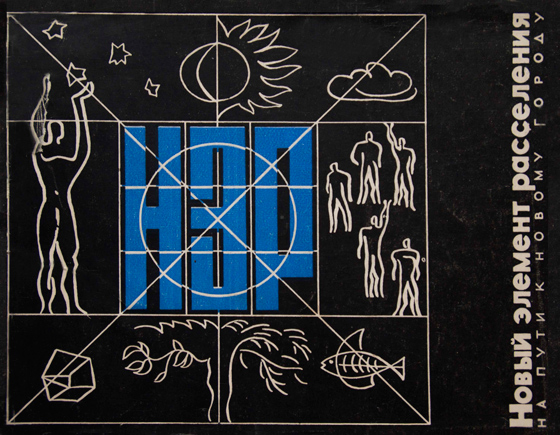 The cover of the book "New Elepe of Settlement". Authors: A. Baburov, A. Gutnov, G. Dumulton, I. Lyuba, S. Sadovsky and Z. Kharitonova
In fact, the Ner group project is an attempt to propose a system of resettlement in the All-Union and even wider, planetary scale for the post-industrial society of non-consumption. In this capacity, NER is a fairly radical alternative to both modern Russian urbanism and the global mainstream, which rarely questioned the basis of the culture of consumption and private property. The NER group set its task to find such a structure of resettlement, which will create a “world belonging to everyone and everyone, a world fulfilled by logic and respect for a person” (“New Element of Settlement”, p. 116). Not limited in their thinking realities of private land ownership, the Naerians proposed to create a uniform network of a limited settlement that does not exceed in the number of 100,000 people and ensure the maximum equality of opportunities. That is how they saw the main advantage of communism. In particular, they emphasized:
“Each person under communism will have a real and equal opportunity to freely and harmoniously develop their abilities and apply them in creative work. A person as a creative person is in the focus of the attention of a communist society. From the point of view of the problem of resettlement, this means that wherever a person lives under communism, he will have an equally favorable social and material environment for his development and creativity ”(“ New Element of Settlement ”, p. 22).
Narovites proposed creating a uniform network of limited settlements not exceeding the number of 100 thousand people.
In order to realize this ideal, the Narovites proposed to put an end to the uncontrolled growth of cities, reorient on the “systematic outdoor” growth of the industry and begin to think on the scale of the economy-geographical region (“New element of resettlement”, p. 33). Conditionally, in the model of the economy-geographical region, they distinguished three main functional zones: 1) the industrial and agricultural production zone; 2) scientific centers; 3) the residential zone (settleba). Industry zones, including zones of potential growth of industry, are fundamentally separated from the housing zone adjacent to the agricultural production zone and the free nature zone. Scientific centers, conceived as a union of research institutes, design bureaus, laboratories, higher educational institutions and libraries, are close to the housing zone. In the context of the transition to the post -industrial economy (or knowledge economy) and automation of material production, the role of mental labor in production will increase more and more, the members of the NER group considered, and the number of workers involved in the industry will be constantly declining. This Marxist representation is the basis of their ideas of the spatial organization of the economy-geographical region. It was scientific centers, and not factories and agricultural production, from the point of view of the NER group, who had to eventually become more significant centers of labor attraction. They are as close as possible to the settlement. The residential area was supposed to combine both housing itself and a number of children's institutions from nursery to secondary school, a free communication center, public leisure zones, parks and various public services, such as laundry, dining rooms and shops. In the development of design, the Narovites focused on the ideal of a compact city with multi -storey buildings, proportionate to a pedestrian.
 The scheme of the functional relations of the economy-geographical region from the English edition of the book (Gutnov, A., Baburov, A. et al. (1971). The ideal communist city. G. Braziller, New York, p. 46)
In the history of Soviet debates about the city of Ner, you can read as an attempt to reconcile the ideals of desurbanism and urbanism. Before us is a model of district resettlement with multiple centers of production and social reproduction, connected by a system of transport and various means of communication, which ensure the circulation of production, people and information within the region, which somewhat reminiscent of the projects of Mikhail Okhitovich, the main inspirer of the desurbanism. At the same time, the NER group proposed concentrating housing in compact settlements of a limited size. Scientific centers were also conceived as compact settlements, densely “populated” during the working day. In other words, striving, on the one hand, to the creation of uniform infrastructure within the framework of a region or country, which ensures the equality of opportunities for each individual individual, the NER group, on the other hand, also believed in the value of the collective and the need to equip space for communication and exchange. The emancipation of the individual and a happy versatile life, from the point of view of the NER group, are impossible outside the team, which means that the task of architects is to find such forms of resettlement that will meet not only the needs of an individual, but also the needs of different groups. Therefore, the Ner project can also be read as an attempt on a new round of Soviet history to find a balance between the needs of a person of the future in solitude and communication, a balance between collectivization and individualization in the resettlement system.
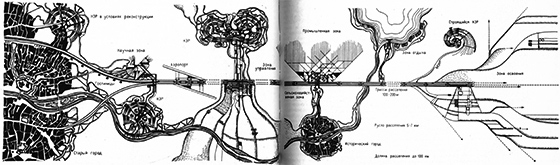 Search project of the NER group (1968). “The drawing is conditionally shown various situations of the formation and development of resettlement systems - the reconstruction of a large current city, the formation of an interconnected system of settlements, the development of new settlements in the context of pioneering development.” Illustration from the book: A.E. Gutnov, I.G. Lying. The future of the city. - M.: Stroyizdat, 1977, p. 44-45
At the same time, it is worth noting separately that it is not only about the need to socialize life, widely discussed in the 1920s. In production, especially in the rapidly growing field of research activity, the significance of the team will also grow. The post -industrial economy in the vision of the NER group is not a world of alienation as a result of automation, it is rather a world that is driven by the power of collective knowledge. The work alone, the Nerovtsy contrasted work in groups:
“Due to the mass production of information, the complex nature of the problems and the limited cognitive capabilities of people working alone, the nature of mental work changes. The receipt, exchange and processing of information at the decisive moment is not carried out individually, but collectively. Any complex problem affects several areas of activity at once. It requires its setting and solutions that the corresponding team of people is a problem team. <...> This, therefore, is not about the simple sum of narrow specialists who sometimes speak completely different languages, but about the collectives of completely multilaterally developed people with a vocation capable of full -fledged productive communication, to joint processing of information ”(“ New Element of Settlement ”, p. 31).
In the vision of Ner, cars, freeing people from dulling work, give people a unique chance to devote more time to self -development and self -education. In this sense, Ner's concept works to create adequate conditions of both life and work that contribute to the maximum “disclosure of individual inclinations and interests that complement and enrich professional training in the chosen field of knowledge” (“New Elepe of Settlement”, p. 31). The main spheres of life - labor and free pastime - are thought of complementary. It also means that a person in the urban planning concept of Ner does not come down to the figure of a worker or consumer.
 Illustration to the chapter “Production and Settlement” (Gutnov, A., Baburov, A. et al. (1971). The ideal communist city. G. Braziller, New York, p. 30-31)
Following the thoughts of Marx and Engels, the Naerians believed that working time would gradually contract, and free time would constantly grow:
“Given the limit of the rational reduction in working time to 4 hours a day and as a result of the rational organization of the household service system, free time in the next decade,” we read in the book, published in 1966, - can reach 8-9 hours a day, not counting the increase in the number of weekends and the duration of annual leave ”(“ New Elite of Settlement ”, p. 61).
These thoughts are prompted by Narovites on a fairly radical rethinking of a residential settlement. The life of a “new element of resettlement” is organized around the leisure center, which combines the functions of cultural production and consumption, communication and self -education. A sort of main city-forming enterprise in the concept of NER is a multifunctional club by the type of club of workers of the 1920s. And even the population of Ner is calculated by a group from the need to create such a “developed center for cultural amateur” (“New Elepe of Settlement”, p. 60). According to the group’s estimates, it is the 100,000-thousandth population, including 60 thousand adult population, is a “minimum social base for the club’s full-blooded life” (“new element of resettlement”, p. 65).
The balance between the needs of a person of the future in solitude and communication, the balance between collectivization and individualization.
In fact, this proposal is moved by the same idea of creating a more uniform infrastructure and a critical assessment of the concentration of cultural values and institutions in capitals and large cities. At the CPSU program of 1961, the Narovites advocate "an increase in the network of libraries, lecture and reading rooms, theaters, cultural houses, cinemas; the wide development of folk universities, theater groups and other amateur cultural organizations; The creation of a wide network of publicly accessible scientific and technical laboratories, art workshops and film studios for all those who have a desire and abilities work in them (“New Elepe of Settlement”, p. 63). In addition, the NER group insisted, “as free time and cultural needs increased”, such a universal interest club will become a place where people spend “the same amount of time, if not more, how much at home and in production (during the necessary working hours)” (“New Elite of Settlement”, p. 65). That is why the club is as close as possible to housing. Thus, the NER group sets a certain route “House-Club-Work” or “Work-Club-Dom”, which at the same time reflects the movement of the individual from the zone of solitude in the sphere of interest in interests and further into the sphere of professional communication.
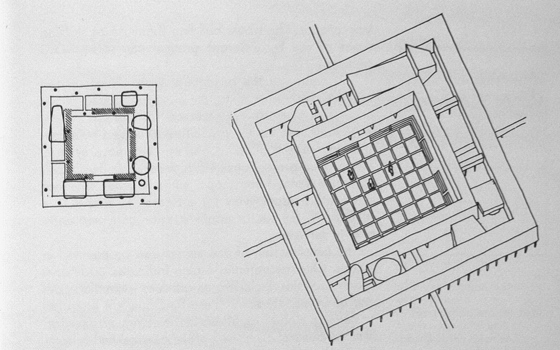 Public Center Ner. Illustration from: Gutnov, A., Baburov, A. et al. (1971). The Ideal Communist City. G. Braziller, New York, p. 125
Вовлеченность в жизнь клуба тоже мыслится как многоступенчатая система от более пассивного посещения лекций, выставок, обсуждений и представлений до участия в образовательных программах с целью повышения квалификации или смены сферы деятельности и до активного участия в деятельности секций и кружков в роли энтузиастов своего дела и учеников. Такой клуб — это площадка для обмена знаниями, место общения и развлечения. Культурное производство и потребление помещено в самый центр системы расселения. Материальное производство, быт, потребление — все это тоже неотъемлемые элементы системы расселения, но они организованы именно вокруг потребностей человека в общении и знании.
 Иллюстрация из книги: А.Э. Гутнов, И.Г. Лежава. Будущее города. — М.: Стройиздат, 1977, с. 108
Сегодня видение группы НЭР легко отвергнуть как утопию 1960-х, основанную на вере в эмансипацию через образование, культуру и человеческое общение, при этом сильно завязанную на систему централизованного администрирования и к тому же нечувствительную к вопросам экологии. Вместо критики этого проекта мне кажется важным задуматься о ценностях, которые легли в основу этого видения, и внимательнее взглянуть на ценности, лежащие в основе новых идеологий городского благоустройства. Мир пешеходных улиц с уличными кафе и магазинами — это «мир, принадлежащий всем и каждому»? Достаточно ли внимания мы уделяем в новых проектах благоустройства потребностям человека в производстве и потреблении культуры, в свободном общении с другими людьми вне контекста потребления? Доступны ли эти ценности кому-то помимо жителей столиц и крупных городов? Задавая эти вопросы, также стоит не забывать, что группа НЭР искала ответы, когда казалось, что страна движется к разрешению жилищного кризиса. Впрочем, решение жилищного вопроса, как указывал Энгельс, требует гораздо более радикальных мер и, возможно, действительно находится вне поля российского урбанизма 2010-х.
Скачать весь номер журнала «Разногласия» (№9) «Выйди на улицу. Верни себе город»: Pdf , Mobi , Epub