
Translated material
City on Lake Bodensky
The meeting of the Nobel Prize laureates in Lindau takes place annually, in late June - early July, and each meeting collects laureates of different years in one of the disciplines: physiology and medicine, physics, chemistry, economic sciences. This year the meeting is devoted to physics. Thanks to the organizers, the opportunity to listen to lectures and ask the laureates to be given a group of scientific journalists from different countries. Among the invited was the editor of the TRV-hunger Olga Blaztya . The main part of the meeting takes place on July 2-6, and in this issue we publish a short report from the day the conference is opened. (Photo of the author.)
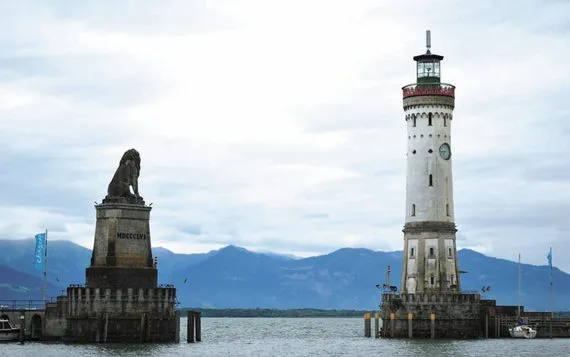
The town of Lindau is located on the shore of Lake Bodensky (Constantce is called English in English), and it is most convenient to get here from Munich. On the way by train from the windows, you see not only the usual windmills of power plants, but also small sites with installed solar panels. The roofs of some houses are also covered with solar panels. The day of July 1, however, is not very sunny, the sky is covered with a light haze, and in Lindau it was completely rain. The town is very small, and the island where the main conference events are held is even tiny: with paved with streets, narrow alleys, eater and other typically German details of the city landscape. It seems that in such a tiny place everyone should know about the so famous scientific event, but at some point in German they asked me what kind of gathering people were.
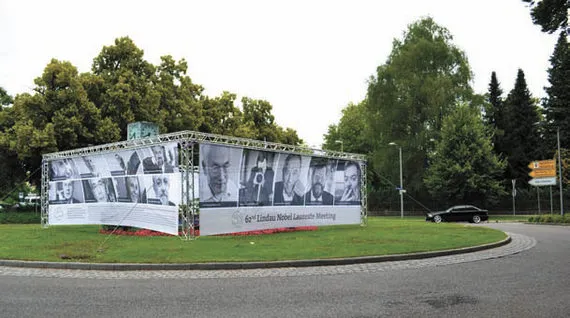
The 62nd meeting of the Nobel laureates in Lindau (the official name of the event, in English-62nd Lindau Nobel Laureate Meeting) began on July 1, but the discovery has so far solemn in nature: all lectures and discussions begin from July 2 and continue until the 6th day, when the participants are waiting for a public discussion on the future energy production. The program includes 26 lectures, 2 public discussions (the second is devoted to experiments on LHC) and 26 meetings with young scientists, 4 master classes and 4 “scientific breakfasts”. This year, 27 Nobel laureates from 12 countries and almost 600 young researchers from 69 countries visited Lindau. All topics that will be discussed at the meeting are related to physics, but participants are a prize winner in different fields: physics, chemistry, physiology and medicine.
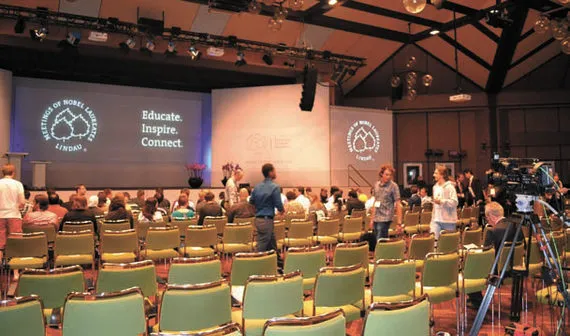
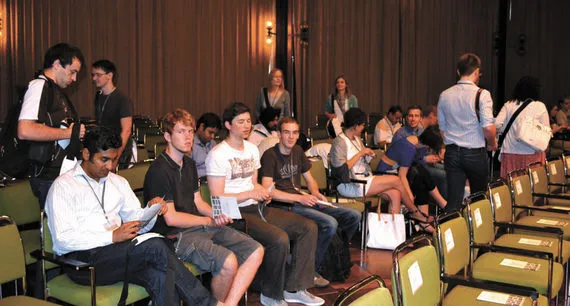
Although the scientific part of the meeting has not yet begun, events of this kind are very curious for observations even during official events. All participants are handed out by Badzhiks indicating the name, surname and organization. The color of the ribbon on which Badzhik hangs indicates the “species affiliation” of the participant: laureate, young researcher, organizer, guest, accompanying person, journalist. With Russian colleagues, we immediately begin to joke about color differentiation of pants. By the way, there are not very many Russian scientists: there are only eight people in the list of participants in the Russia section, of which only four are from Russian scientific institutions (most of all from Germany and the USA). Perhaps this is due to the invitation procedure for the meeting: a person who wants to visit Lindau must send an application to one of the scientific partners (Academic Partners), which includes research organizations, funds, private companies, as well as the Nobel laureates themselves (in total of about 300 organizations and people). Organization - a scientific partner has the right to nominate a young researcher to participate in the meeting. In the list of academic partners who supported the 62nd meeting, there is not a single Russian organization, but relatively recently, Moscow State University acquired this status. M.V. Lomonosov.
The 1st meeting of the Nobel laureates in Lindau took place in 1951. Its initiators were two doctors from this city: Dr. Franz Karl Hine and Professor Dr. Gustav Wilhelm Parade, as well as Count Lennart Bernadott Afa Borgorg, member of the royal family of Sweden. His descendant, Countess Bettina Bernadott Afa Bettina Bernadotte, President of the Council of Meetings of the Nobel Laureates in Lindau (The Council for the Lindau Nobel Laureate Meetings), opened this event in 2012 and invited all participants to be imbued "The spirit of Lindau"; “You ask - what is the spirit of Lindau? This can be discussed on Friday evening, when the last public lecture ends. " In her speech, Mrs. Bernadott mentioned a relatively recently created public archive of video and audio materials from meetings, starting from the first in the 1950s,- the Lindau media. This project was proposed by the Minister of Education and Research of Germany Annette Schavan. The media is already working, but the presentation of the materials is now changing: they are grouped by topics. In addition, German lectures and discussions of the first years of meetings are gradually translated into English.
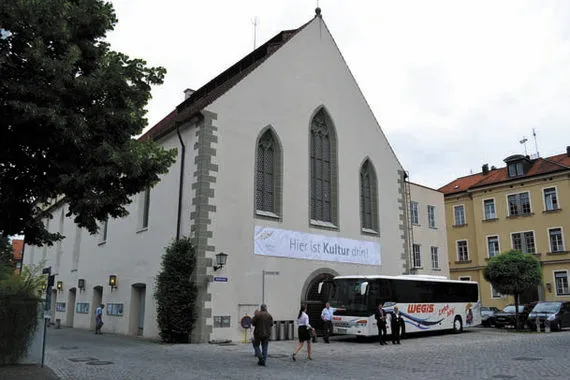
Philharmonic orchestra for participants. The inscription: "Here is a culture inside"
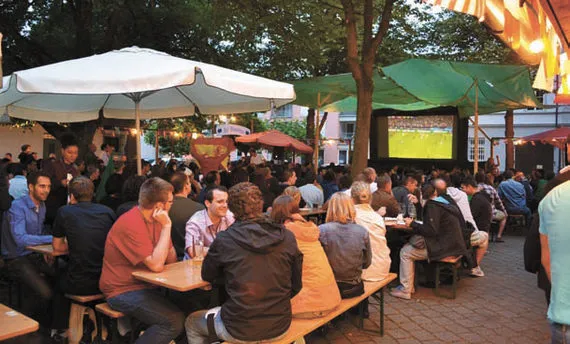
After the second ball scored by the Spaniards, in the local Biergarten
The key theme of the speakers at the opening was the sustainable development of mankind - or, as an option, survival in the face of various threats. Annette Shavan emphasized that this thought moved the initiators of the Nobel meetings as early as the 1950s, during the "economic miracle" of Germany, when the main goal of the country was economic growth. By the way, the Nobel meetings themselves were directly related to the consequences of World War II: according to Lars Heikenstein, executive director of the Nobel Foundation, they thought in order to again include Germany in world science after the war. Today, the scale of the event is such that you no longer remember these reasons: the meetings rather have become an event of world scientific and technical infrastructure. This can be judged at least by the list of Mediacers, patrons and donors of the Nobel Lauretes meeting fund in Lindau, which includes companies such as Volkswagen, Siemens, Microsoft Corporation, Robert Bosch GmbH, to be called the most famous.
Judging by the main topics of the meeting, the event can be called a scientific mainstream: it is planned to pay special attention to astrophysicist and cosmology, particle physics and energy problems. It can be assumed that the choice of these topics as key is responsible: in the first case, the “extreme” prize for opening the accelerated expansion of the universe, experiments on the tank and the general “global agenda” (Global Agenda).
So ahead is a week, and her lectures of astrophysicists, Nobel laureates Brian Schmidt, John Mazer and George Trouble, devoted to the study of the universe through observations, open her lectures.
The author thanks the Council of meetings of the Nobel laureates in Lindau for the opportunity to take part in the event.
Site www.lindau-nobel.org
Nobel community Lindau www.lindau.nature.com
MediaTheTE Mediatheque.Lindau-no-bel.org