
Translated material
How do they live in hell?
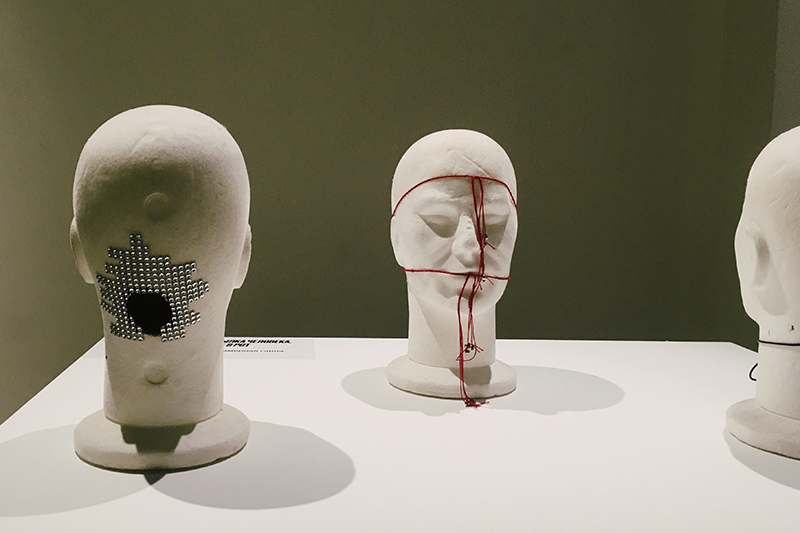
When you go past the ART 4 gallery, it seems that there is a store, something is sold, you can go in, buy and take something with you-a dress, tights on the legs-maneans. In fact, this is an exhibition of Linor Goralik “Dressing Demons” .
The exhibition is over, nothing can be carried away from it, but it seems necessary to understand what it was. This text is the result of conversations of three people in different conditions and contexts. Two of us were at the exhibition: Lenya and Polina. This text was originally a story for Ani Shchertina, and she helped to formulate some of the theses presented in it.
We offer already an executed story both to those who were at the exhibition and those who were not. Because the hell, which was at the Horalik exhibition, seems important and outside the ART 4 space.
The inhabitants of hell
Linor Goralik has a world - very described in detail, it is called the "Hell M1 sector." It gets there and there is Sergey Petrovsky - the father of Agatha, the constant heroine of the poems and the prose of Linor. Sergey collects the sector folklore, materials from it, and also reconstructs his own life.
In the book “Folklore of the inhabitants of the M1 sector” there is a definition of differences between paradise and hell: “Paradise and hell are how we feel (and how they are). Since they are in paradise, when they see us, they believe that we are also in paradise. We appear before them as we are in paradise <...>. Since we are in hell, when we see them, we know that they are in paradise. This is sophisticated and just <...>. Those who are in paradise are so happy for you that you are in paradise. Those who are in hell cannot say to those who are in paradise about themselves; It is impossible to say: “I am in hell,” because it would destroy paradise for those good. How this is “impossible” - there are many philosophical theories about it, I will not list. <...> Some, completely empty, tried to speak. This is terrible ( so it is hell ): you lit up, lit up, you seemed to say - but it, or something, did not affect - or they could not hear; Or how else. I am inclined to a simple version: you can’t - and you can’t, that’s it and hell , that's all. ”
The exhibition does not speak for the inhabitants of Hell, not on their behalf, it is a collection of objects, mostly wearable, since clothes and work with the body are one of the main occupations of the inhabitants of hell. The fact is that those who fall into hell are satane. Those who resist sedimentation are martyrs. Those who cease are demons. Sedimentation is a physical change: the demons are bent back in their knees, they stand on tiptoe (and they have noticeably blushing the tips of the ears). You have to overcome clothes. At the entrance, we are greeted by the pants of a satanic person - they are seized under the shape of a changing body. Clothing is what a person died in, or rather, what concerned his body at the time of death; It is very difficult to get any other, and the search for clothes and objects constitute a considerable part of life in hell.
The halls are devoted to various processes: here is preparation for the carnival, this hall indicates how they are trying to stop changes in hell. Here is about how they are boring themselves. Behind him - about how they find out what it is possible to do, and are engaged in their hellish creativity. All halls are next to the friend, there are seven of them.
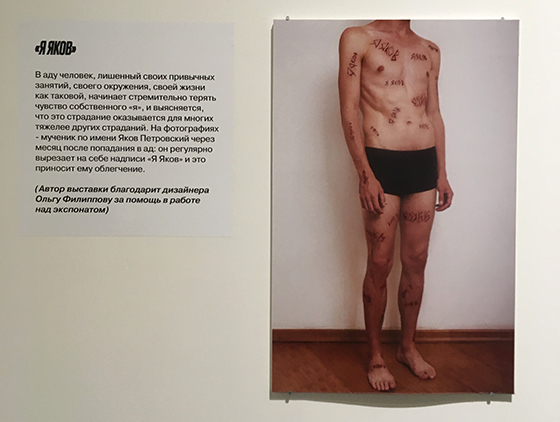
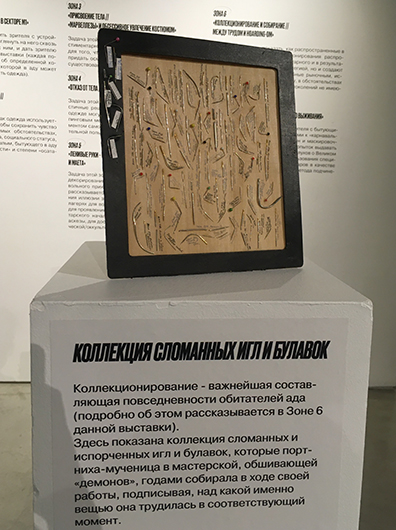
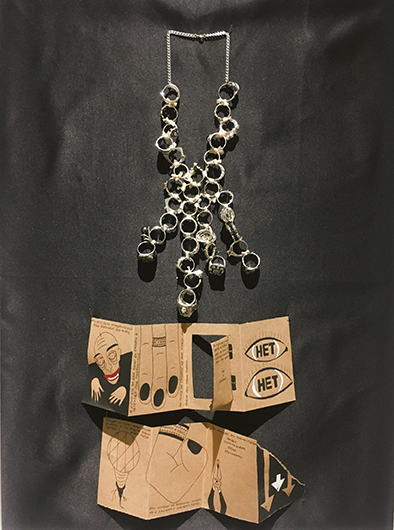
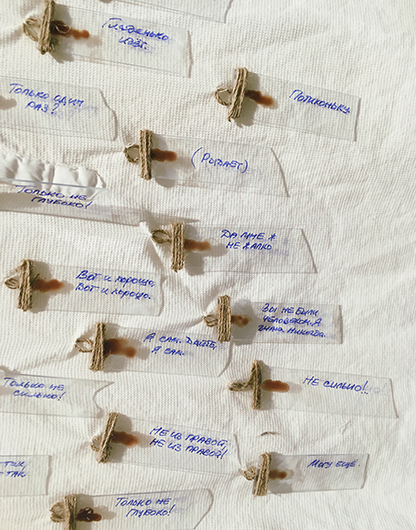
Objects are collected from different materials: there are clothes, and drawings, and dolls, and jewelry. There are ships with spikes inside (interfere with the satanum), there is a collection of exfoliated skin, there is a comic book about how the demon took the ring from the rings, there is an old tracksuit that was worn without removing, 26 years old, there are photographs of the “I am Jacob”, made in order to alleviate the suffering from the loss of their own “I”.
 © Polina Colosaridi
On explications in an even tone, with links to historical sources, objects are described and how they are produced. It is as if the materials of ethnographic research laid out in front of the audience. Sometimes artists and artists who helped in production or created something are mentioned there. But basically it was done by Linor Goralik, and Katya Stolz was the curator of the exhibition.
Totality of condition
Hell is total. Under the only small window in the museum - a stand with angels, inside of which chicken seeds are sewn. The inhabitants of hell do not like angels. But they are here - here in this form. Hell is obsessively described in detail. Hell is total, and everything that falls into it becomes part of the inner world.
This, as it seems, sets the first line of interpretation of the exhibition - psychological. At the exhibition is an internal state from which there is no way out. There is no other meaning, no other world, even if it is somewhere outside the window.
And this is turning the existentialist "Hell is different." Hell is me-sam/a. However, banal, but at their extreme poles, these seemingly opposite statements converge. Hell is me, becoming another. These are others who experience the same tension with themselves.
But from the point of view of the method, view, everything at the exhibition is existentialism that has survived or experienced postmodernism - and therefore there is an equally even tone for the description of everything.
Catalogization, collage, observing everyone, the author, absent subject, references to other exhibiting methods. All this is also at the exhibition, but it is not even. For example, the personal story of Yakov Petrovsky, brother of Sergei Petrovsky, an imaginary author of the book about the M1 sector: photos and stories from childhood are similar to how the stories of Jewish families in museums of memory are described. In general, blood pressure in many ways - and this is stated at the exhibition - looks like concentration camps. Here, the inhabitants are busy with meaningless work, it has no end, there is only the concentration of evil, scattered between martyrs and demons. The former, recall, turn in the second.
But the objects of the exhibition are arranged in such a way that they represent this reference to the terrible twentieth century - as already accomplished in history and existing in it. This is a story that we learn about from third -handed - as students from the textbook find out. This is a story, whose participants are mostly dead.
And in this sense, Linor works with a topic that is in its poems - about how poetry after the Holocaust is possible. It turns out that although the Holocaust happened, life continues. People (demons, martyrs, and in other works Goralik-animals and fairy-tale creatures) somehow live and try to feel new ways to speak, represent themselves to others, feel feelings.
A. Barash
How can you write poetry after January fourteenth, 1942?
After February 6, the 43rd? After March 11, 1952 ?
How can you write poetry after June 22, 1917 ?
After July 1917? After March 1984 ?
How can you write poetry after November 6, 1974,
September 11, 1965, August 1, 1902 ,
May 9, 1912?
How can you write poetry after the 26th day of the last month?
After June 10 last year? After June 12?
After December 14, 1922?
After that Thursday?
After what happened today at three?
It was probably wider only on November first of 1972.
Only on April 12th was the seventy-third, perhaps even worse.
Or the sixth of August 86th. September 4 , 1913 . Or, let's say,
The twenty -fifth of July 1933. Or twenty -sixth.
Someone probably fell from a mobile stairs in the library,
I broke the spine, I can never move.
Someone probably died
By mistake, blowing yourself together with the hostages.
Someone, most likely, the child ran for ice cream,
Literally in two quarters
And never returned.
No, literally around the corner. No, literally in a neighboring house.
No, he returned eighteen years later, on March 25.
Or twelve years ago, November 24, at 15:00 .
He died on the 26th day of the last month.
He wrote a single poem, very bad.
The exhibition is already addressing postmodernism not as the end point, but as one of the methods that allows us to say about life. So existentialism overcomes itself through postmodernism. Or, avoiding big heavy words, life continues, although blood pressure exists.
 © Polina Colosaridi
Minding realism
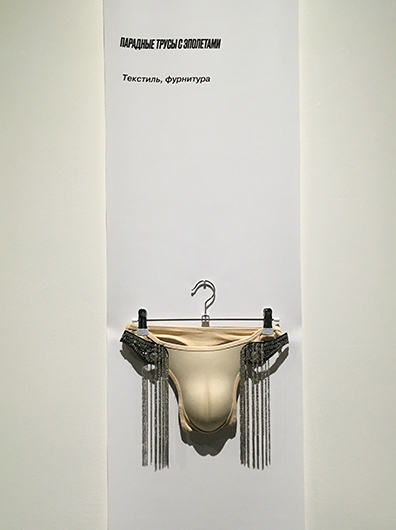
There are objects at the exhibition, frankly and immediately cruel - as, for example, "accessories for the back of the head of a person who shot himself in his mouth." There are rather incomprehensible - like "panties with epaulettes." It is still not clear which is worse. Perhaps the first - as offering strong experience of bodily experience. At the exhibition, people rush, laugh and freeze, sometimes at the same time. Perhaps the more terrible second - cowards with epaulettes are not explained in this world in any way. They can be found with us - well, theoretically speaking. Seeing them on someone or in the window of the store, we will feel Hell for them. So the exhibition, in general, seems to be closed on itself, opens outside.
This is surprisingly without metaphors. And this is an impressive work of the artistic method Goralik - after all, the very idea of the exhibition seems to be built on metaphors of changes in the body and soul, clothing and making with itself. But the world of the exhibition is so dense that objects themselves are not metaphorical, they do not embody, do not represent, but represent the reality of hell. The realism of this reality is achieved in many ways how objects are collected and how the texts are made to them. This reality is as undeniable as the embodiment of fantasies in the children's game. That is, she not only copies the world of “adults” or fairy tales, but makes it real for teaching and playing. Here the same thing happens with hell.
Realism is also supported by the objective and at the same time inventive language of the exhibition: it is adjacent to the “Maya” as a description of the suffering of the inhabitants of hell and coping strategy for working with it. This is a language and always existing, both historical, and modern. Between these modes of the language, Goralik does not distinguish, turning them into one, capable of describing the reality of the inhabitants of Hell so that it is clear to those who came to look at it.
The viewer is at the exhibition in a strange role. All of it is for him. The subject, the storyteller, is completely incomprehensible, is eliminated that we are left alone with objects. At the same time, we are informed of the history of the extraction of objects, sometimes monstrous.
 © Polina Colosaridi
At the exhibition with Polina was her son eight years old, who became interested in the object from the bracelet and collar connected by a thin chain. The object connects two people. Anyone who goes in the collar can cut the chain at any moment, but does not do it. Polina did not succeed in explaining why the inhabitants of Hell did not break the chain. Perhaps the fact is that it was the only metaphorical object at the exhibition. Perhaps he united in himself those weaknesses and Maytu, who seemed to have an external explanation - there are things, they are created in an attempt to live. Then they arrange life, we follow their material instructions. This does not stop.
And, although hell is total, the variety exists in it is deafening. Others are always different in it, with different clothes in which they died, with different words spoken when taking blood from a finger, with different copying strategies and a collection of needles broken when lifting clothes. This variety is so deafening that we cannot cope with it, in general, without uniting into a total. In this sense, the exhibition is also about the cruelty of attempts to appropriate and present the history of hell, about cruelty to be an artist and interact with art. The fact that art with this cruelty is constantly trying to glorify, heses, applies coping strategies. Like all of us.