
Translated material
The planets are there, the planets are here ...
In early March 2011, a large, 400-page report [1] with the presentation of NASA plans for research on the solar system in 2013-2022 was published. This document can be obtained on the Internet [2]. It not only posts a list of missions under discussion and recommends on their priority, but also a detailed analysis of the current state of affairs in this area is given.
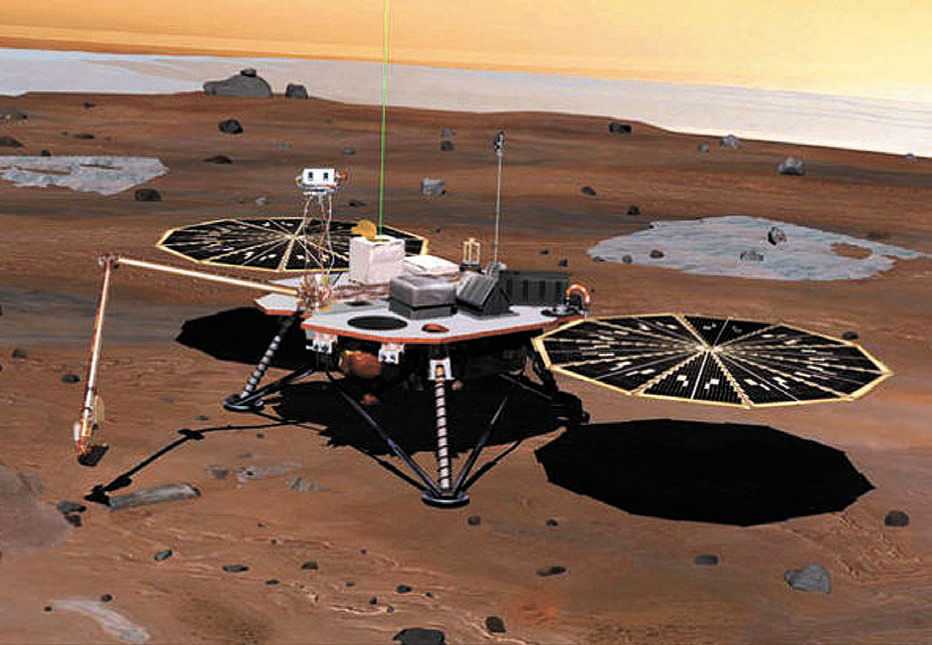
The report discusses only those space projects that are sufficiently worked out to include in a priority list. As a result of a detailed discussion, the commission, which created the report, determined which of them give a “maximum scientific output in the calculation of the invested dollar”, while the balance was observed between large, average and small missions and between studies of different objects of the solar system. Of course, purely technical aspects were also taken into account (for example, risks associated with the fact that some technologies are still “not brought to mind”). The result was lists that are still a recommendatory nature.
Among the scientific tasks, the commission considers the delivery of Martian soil to the Earth. In second place (with the understanding that this is a very expensive mission) is the study of the satellite of Jupiter - Europe. The authors of the report also offer to think about a more detailed study of uranium and Neptune. Therefore, the development of a project of special missions for Uranus also fell into the list of priority tasks.
Inexpensive missions were attributed to the Discovery program, and their discussion went beyond the competence of the commission. Therefore, only one recommendation is given for small companions. Attention is drawn to a promising mission (planned together with the European Space Agency - ESA) Mars Trace Gas Orbiter. This project was not included in the Discovery program, so the report contains support for this mission.
Middle class projects belong to the New Frontiers program. In the near future, two missions will be selected for research "the most mysterious and unknown areas of the solar system." The commission recommends slightly increasing financing of this program.
Much attention in the report is paid to large, flagship projects. Mars Astrobiology Explorer-Cacher (Max-C) was put in first place. This is the first of three launches as part of the Martian soil return program. It is recommended, however, to reconsider its financing towards reducing costs (by a billion), since, according to the commission, the project deals with unreasonably large funds, inhibiting other planetary research. Europeans, together with whom this project will be carried out, have already been concerned about the possible reduction in financing by the United States.
The second place among the flagships is the Jupiter Europa Orbiter. Here again, the commission draws attention to the excessively high cost, and therefore calls for narrowing the circle of tasks so as not to select funds from other studies.
The third place was given to the satellites - Uranus Orbiter and Probe Mission. The commission believes that the project must be implemented until 2022, but again we must think about a decrease in value.
In case of budget reduction, the authors of the report offer to abandon Jupiter Europa Orbiter (this is the most expensive project - almost $ 5 billion). In the case of an increase in the budget, it is planned, firstly, to increase financing of small missions (Discovery program), secondly, to make another mission within the framework of New Frontiers, well, thirdly (if things go very well), to implement another of the flagship projects: either ENCELADUS Orbiter Mission, or Venus Climate Mission. If things go very badly, it is proposed to cut large projects, but in no case do not touch Discovery and New Frontiers, as well as technological development and research work.
Meanwhile, Joseph Catanzarite and Michael Shao (Michael Shao) received assessments of the frequency of planets of the Earth type in “inhabited zones” in stars of the Sun type [3]. To do this, they used the results from the Cupler satellite [4]. Having studied the data on more than 150 thousand stars for four months, the project team announced the discovery of more than 1,200 candidates in the planets for about a thousand stars. So far, data posted by this project is not enough to direct the number of earth -like planets in the right range of large pennies of the orbits, but we can carry out reasonable extrapolations based on the established correlations of the parameters. The authors were interested in planets with radii from 0.8 to 2 earthly. This corresponds to the masses sufficient to hold the oxygen atmosphere, but not too big for the planet to move into the status of Neptunish -like. For the “inhabited zone”, a rather strict condition was chosen, which in the case of the solar system would give a range of orbits from 0.95 to 1.37 of astronomical units. The stars of the spectral classes F, G, K (recall that the sun belongs to the class G). In the galaxy, these stars make up about 7% of the entire population.
Assessments of the authors indicate that 1-3% of stars of the Sun type have planets of the Earth type in “inhabited zones”. This is a lot, as it means that in the entire galaxy - about a hundred million. The results will be specified as new data arrives from the Kepler satellite. Actually, one of the main tasks of this project is precisely the determination of the number of such planets.
Sergey Popov
1. Vision and Voyages for Planetary Science in the Decade 2013-2022, National Academy of Science (2011).
2. Www.nap.edu/catalog/13117.html
3. Arxiv: 1103.1443 ( http://arxiv.org/abs/1103.1443 )
4. Arxiv: 1102.0541 ( http://arxiv.org/abs/1102.0541 )