
Translated material
To the death of the hero
The last few years, and possibly decades we have heard the same sentence: "Photo journalism has died." From this phrase every year, Jean-Franesu Leroy begins its famous festival in Perpignan , dedicated to nothing to another, like photojournalism in its purest form. The verdict sounds the more pathos, the more absurd, especially in the light of the event itself, collecting more and large crowds from year to year, which no longer fit in the local amphitheater, but also spread to the main square of the city, where the waiters with the dishes of the pasta and the bottles of first -class burgundy scrape out between the tables of the yuro, and the blood flows on large screens and the blood is possible - it is possible, as if obstructive seasoning. Tasty, but long -bored dishes.
Photo journalism did not die, but gained new features. Especially those who are most engaged by her are like to talk about her death. Not a hairdresser, not a dentist, but exclusively photojournalists themselves. Perhaps this is a coquetry or a substitution of concepts.
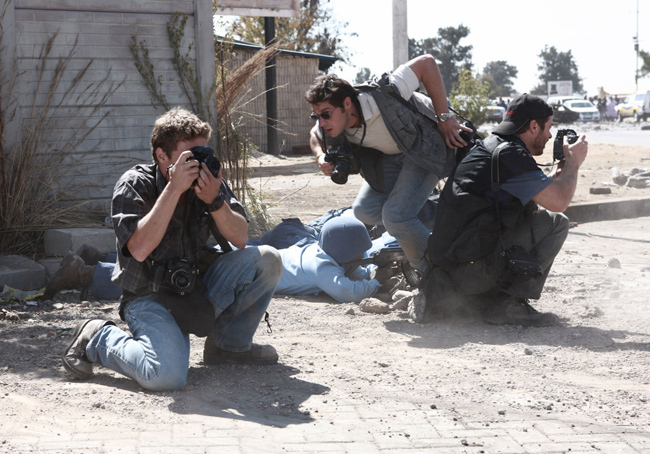
The hero-photographer has died to us. A kind of macho in fashionable pants with pockets, such a glazed cheese with a tumor bundle flying from Paris to New York, from New York to Zimbabwe, who manages to close a couple of children somewhere on a transplant in Paraguay and then telling us in such an ordinary voice: “And then we were abducted, they were taken to the jungle and already announced us a mortal The verdict, how is it ... "
Hero-lover, hero-amen, hero-plut, who saves the world along the way. The cult since the exploits of Hercules has always remained the sweetest theme of mass culture. In the XVII century, Spanish Plutov’s novels about the extraordinary adventures of a cunning germ without a family, the title and education excited the minds of people. He always has a couple of thousand stories in the reserve of how he got out of difficult situations. The hero should always save someone, expose and neutralize someone, with a deft and fraudulent way to get somewhere, but this is not important: our sympathy for the hero remains unchanged. So folk love did not allow in Soviet times to ban novels about Ostap Bender, the standard of a merry-pendant-adventurer.
A photographer for such a macho-blut story is the most suitable hero. The photographer manages to penetrate everywhere, use all channels and loopholes, bypass bureaucratic quirks and prohibitions on shooting, always remaining an unlawful standard of honor, as a kind of Robin Hood.
His goal is not wealth, not glory (all this comes by itself), but the photo images of the world. Photo images that can change something. His life can grow stories about incredible adventures, the proof of which will be his pictures. Moreover, the story of the adventures, the legend around the photograph, the complexity of its extraction and the uniqueness of the moment is sometimes more important than the picture itself, as it was with the heroic shooting of a drop of landing in Normandy, which, according to legend, threw an excited laboratory assistant, although in fact, the photographs were removed in complete darkness and therefore simply under -executed (my timid assumption).
The photographer manages to penetrate everywhere, use all channels and loopholes, bypass bureaucratic quirks and prohibitions on shooting, always remaining an unlawful standard of honor, as a kind of Robin Hood.
Despite the jambs, behind the back of the legendary photographer-hero is always the most caring editorial office in the world, capable of ordering a plane to send films, and laid out on a magically luminous table of index prints.
The first photographer to attempt to heroize his personality, and thereby lifting his work in the price and status, was Robert Kapa, a well-known rogue (Cartier-Bresson was too intelligent and thin). Legends go, like a shot of cap was able to inflate his adventures ten times. Even his name is a product of such an absurd deception, an attempt to sell the cards of a certain “famous photographer of a cap” is many times more expensive than they would cost from an unknown Hungarian Jewish Jew of an exiled camera.
His famous image of the “death of a soldier” is not a forgery, but just an innocent distortion of Capshen for the sake of a red word. No one dies there, but only - depicts death, falls, plays in front of the camera. However, this does not detract from either the symbolic meaning of the photograph, nor the heroism of the cap, who went to the war in Spain and paid the life of his beloved Gerda Tarot. But even he later turned her death at the heroic moment of his own biography, showing her shabby photograph to each meeting and saying how he suffers.
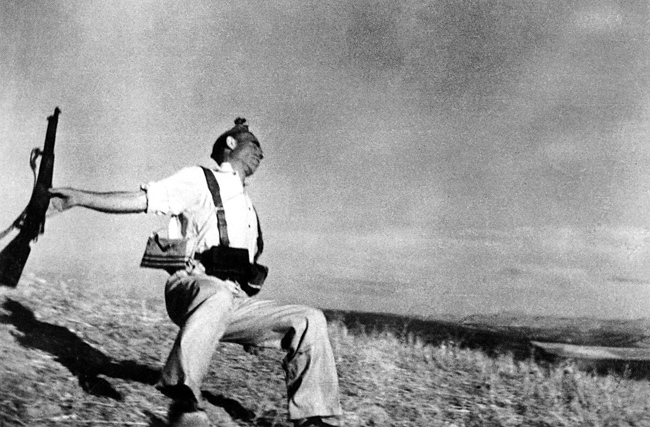 © Robert Capa / International Center of Photography "Death of the Republican"
The merit of the caps is that he was not too lazy to write books about his adventures (the most famous of them is “slightly not in focus”, for some reason translated into Russian as a “hidden prospect”). It is written in a simple, accessible language and tells about the adventures in the manner similar to heroic and rogue novels. The charm of the cap is in Self -irony, which sometimes resembles Don Quixote. But it was precisely the documentation of these databases, their unification in the book, the creation of a kind of finished product available to the masses, who became a milestone on the way of heroizing the collective image of the photographer.
It was enough to “soak the score”, to draw attention to the person standing behind the image, as the photojournalist as a whole ceased to be an nameless and unknown supplier of pictures, and in itself turned into a hero and a media staff. There were many other heroes after him: the stunningly relaxed autobiography of Shutterbabe Deborah Kogan as a female version of such a hero, a film about an incredibly honest scum, a monk from a photojournalism, and an autobiographical “black passport” of Stanley Green, along with his “steep” and a slightly careless interview with Chechnya (“my wife abandoned me, and instead of becoming to become to become An alcohol, I went to the war!
The photojournalist, since he became a character-hero, is no longer a quiet sheep, peacefully grazing in the meadow of significant events and then carrying wool-photos on the pages of newspapers and magazines. Together with the pathos of Machism and all the accompanying privileges (money, glory, women, expensive hotels in the capitals of the warring states, the rivers of wine, sometimes too similar in color to rivers of blood, etc.) a load of moral responsibility for what you do.
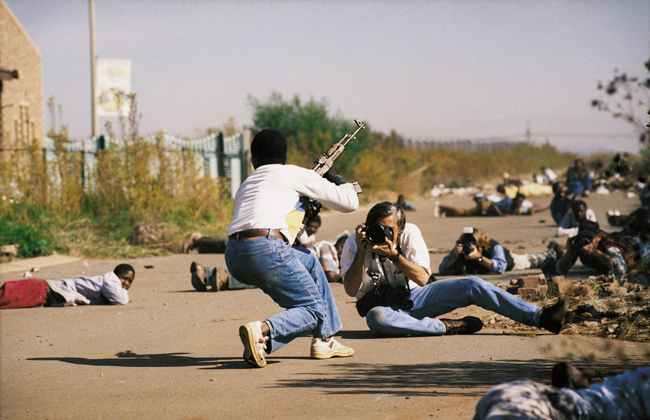 © Christian Frei Filmproductions James Nakhtva at War PhotoGrapher
The photojournalist fell victim to an insoluble conflict of his profession - or, if you want, the struggle of ethics and aesthetics. A photojournalist is not just an advanced extreme tourist who also produces a certain product along the way. The inevitable cynicism of the profession is only akin to the cynicism of the surgeon. He grows over the years as a shell, only, unlike a surgeon, you do not save anyone. No one should save anyone. And then, when you bring the cards, it turns out that you also had to save someone.
It is not yet a symbol of the death of a photojournalist-hero, but already its omen has become the suicide of Kevin Carter and his posthumous stigma. Kevin Carter just belonged to that gang of heroes, clicking on the camera, although, if not for the invention of the photograph, perhaps in their hands could only be an automatic-but what else to be in a difficult time, in a dangerous place, with a seething young soul, eager for adventure and lifetime glory?
However, the collapse was widespread-not so much because of a starving girl and a symbolic vulture. More precisely, not at all because of her. She was completely hanged on Carter after death, tied too simple the reason to the tragic investigation. But the stone that the hero stumbled was more likely to be banal lack of money, discords in the family due to long business trips, the death of friends-gatherings in the war, lost films, drugs. Kevin Carter was not the first, not the last, but - a sign.
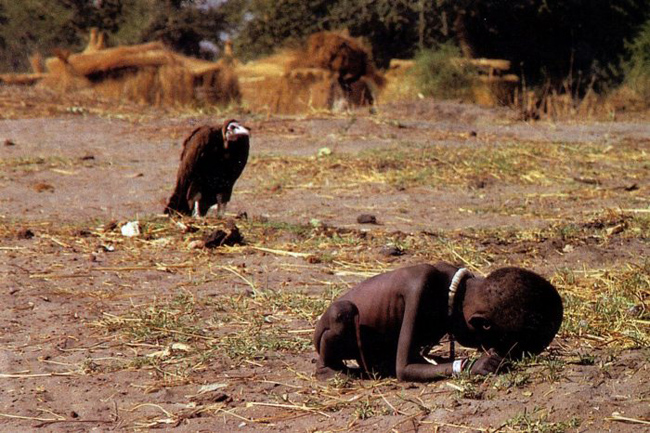 © Kevin Carter / The New York Times
Sadly, but the collapse of the image of a hero-journalist is the collapse primarily financial. Technical progress came to our camp, and we prematurely rejoiced. This progress destroyed the elitism of the photojournalism, which we were so proud of. They say that planes and the Internet made our world small, but also digital cameras have done their job. Thanks to these three factors, advanced photographic and sometimes extreme tourism became possible. The ability to create images has become massive. Not only to be photographed against the background of monuments, but also to take torture on mobile phones. Bloggers, Utuyubs and free photo banks have become a real competitor to professional publications. The first significant precedent was the fall of the twin towers and the subsequent photo exhibition, which equalized professionals and lovers. Suzen Umbrelor managed to write about this shortly before her death. It turns out that in this eternal struggle, the form and content in photojournalism won a hundred percent victory. When we chase the event, the one who has a faster legs, and not the one who has a sharper eye and a poetic look, blurred by a haze of a monocle, wins.
The reflex to respond to significant events by the descent of the shutter is a conditional reflex, but it is very easy to educate. And photojournalists by heroizing their, sometimes excessive, the ego brought up the army not fans, but imitators. And since then, the technique responded to mass demand by the simplicity of automatic settings: humanity no longer thinks about endurance and diaphragm. It is useful for the user to know about this only within the framework of general development, as Kant's knowledge is useful in the practice of boiling.
It turns out that in this eternal struggle, the form and content in photojournalism won a hundred percent victory.
And the Bresson theory of the decisive moment eventually turned out to be not so true and universal. Looking at the fireworks in the sky or at a screaming person in the crowd, we want to photograph it, “catch the moment”, especially when he is not a familiar, normal state of things. And even that is why. “Catching the moment” has become the same general, reflex place as to clap himself in the ear if it seems that the mosquito bursts in it. Absolutely everyone can do it.
You can even teach a monkey to click with a camera (and possibly some of its pictures will also be masterpieces). Yes, there are several more points - the ability to navigate the terrain, find the right people, to separate the main thing from the secondary. But this, too, learned to own advanced tourists with photos. This is sometimes called civilian photojournalism, and some domestic researchers for some reason compare this with the movement of rabcores and rurals in the 1920-1930s ).
In the packaging of the New Age, we got not only new rabcores, but also the crazy variety of platforms and almost non -destructive streams of information called the Internet. Magazines that provide quality information under their authoritative brand have lost influence. Life left, selling his Google archives, which became a sign of a new era, replacing the meaningful and beautifully presented stories of the past with finely chopped olivier from unverified components in the present. We will never determine the author of what pops up in front of us in Google Images . The author ceased to be a landmark, significant - a guarantor of honesty and veracity of images.
At the same time, the illusion has gone that photography and a photo station can be an independent author's genre. Olivier of flat illustrations defeated, where everything is in the forehead, where the card tells about the event clearly and briefly, even if smoke over the bombed city is ten -shocked ten times.
All the photographs created at the moment, even if they are printed with a pea, you can fix the globe several times. At any conference, dozens of photojournalists try to capture the minister simultaneously against the background of the logo and on the one hand, so as not to fit each other in the frame - this is the last stronghold of journalism. The photographers that I meet at the events now look almost as dull as television operators. And they almost always whine: "Well, why nothing happens?" - Or: “Well, when will all this end? I want to eat, sleep, I want to go home to the children. ” I almost do not see the heroes. Yes, and there are almost no them. With the exception of people of old hardening like Yuri Kozyrev. But they sing an old song that this is "their choice is to be where events take place."
The author ceased to be a landmark, significant - a guarantor of honesty and veracity of images.
And many, like Maximish, could not stand Beslan and abandoned extreme photojournalism. And they are partly right: not only photojournalists exist for the war, but the war is often arranged for photojournalists (about this not so long ago, Alexander Gronsky wrote on Colta.ru - ed .). There is no time for the idealistic Vietnam, when it was possible to stop the war. Everything that was after, can be considered relatively unsuccessful attempts to save the world or change at least something for the best forces of photojournalism. And the inevitable arrival of cynicism, if not lies.
Somewhere there should be an end to all this, and it has come. Returning to Perpignan: I recalled how crowds of novice photographers with badges hunted photo editors, just to show them their clear portfolio, and those hid from them on VIP lunch. The era of the heroes ended, but someone, in the old traces, still dreams of becoming one of them.
Publications can no longer afford to send a photographer to war, an earthquake or even to the resort village: the photo editor ceased to be the best friend of the photographer and became a piece, which had long been flattened between the hammer and the anvil - between his love for photographic skill and hard editorial policy, when the writing correspondent can take a photograph between it. In the best case, they say: "Well, you go, bring, and there we will see."
Nobody except Fricice-photographs and worried, sort of photographs, by and large, does not matter whether it will be a super-pepotography for a reversal or just a cheap illustration. Professionals have not believed in the objectivity of the photo frame for a long time, no matter how true it may be. And give the layman to give the prepared information, where the quality is at least in centimeter pixels, like a log in the eye. All the same, the most important thing is the signature.
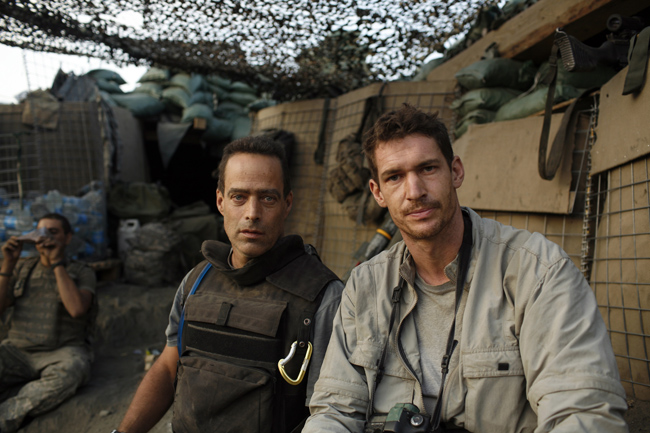 © Outpost Films Tim Heterington (right) on the set
Arab revolutions showed the whole caricature of the profession. When enraged crowds raped journalists in Egyptian squares and the army killed journalists on the approaches to Tripoli, this ceased to be ridiculous. The death of the brilliant Tim Heterington was a point of no return for me. It came to an end, but for smart people any end is only the beginning. Like in the game “Mario”: you just jump from one platform to another, and if you stand for a long time, it falls under you into the abyss.
Long live the new media technologies, no matter what the hell was understood by them. Precisely because no one knows what kind of beast this is, everyone is very interesting. Anyone who first steps into this unknown, and will be a new hero. The functions of the video in all new cameras are an undoubted sign on this path, the development of a new market segment, although I am terribly do not like these economic terms. And even if the new hero will not have to jump in the war in bulletproof vehicles on the off -road jungle, and instead sitting in a stuffy installation, taking video, sound, photo and text, and even begging the money almost in crowdfunding, I like this new hero even a bit more, as if, in fact, there are now five professions instead of one pressing. button. Long live multifunctional geniuses!