
Translated material
Immortality Tarelkin
The Death of Talerykin, a play about the ruling community of crooks and thieves that create an unimaginable police arbitrariness, clearly alive with us, and it is strange that it was prohibited by censorship only for the first 30 years after the creation. Both direct meanings and forms of Sukhovo-Kobylinsky trilogy predict subsequent anti-utopias-Zamyatin, Kafka, Orwell. Plus, there are still “relatives to pain” details of reality and characters. Sukhovo-Kobylin was the only author to whom Meyerhold was returned four times in his phantasmagoric productions. It was this play that he released in the spirit of the Himeric terrible two days before the October Revolution in Petrograd, and then during the celebration of its fifth anniversary in Moscow - a tragedy, booth, circused version, in which the regime was mocked over a citizen, passing it directly visually through the meat grinder of the “organs”. “The public is covered by fear. She is not up to the tricks. She feels the most important thing: the mockery of death over a person, ”the reviewer admitted. All this should not be mentioned for the “historical context” on duty: this is an inseparable semantic field from the text of the play, which is directly reflected in today's performances. For example, in the two latest: Hugo Erickssen and Oscaras Korshunovas (one is a student of Rimas Tuminas, the other is Jonas Waitkus, and now the leader of the Lithuanian directing himself now; maybe this matters ...). It became a regularity: the current political text (written in 1869, you can’t do anything with it, you won’t throw the word: classic) is interpreted at once at several levels, including superreal.
The story of Tarelkin and the phenomenon of his “death” in a century and a half turned into a national myth.
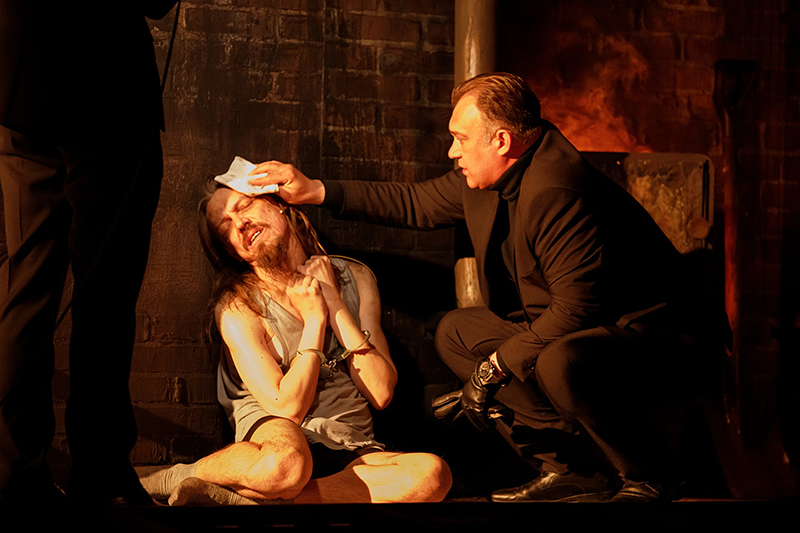
In the production of Erickssen at the Pushkin Pskov Theater (now associated with the St. Petersburg Alexandrinsky, the National Drama Theater of Russia), the figure of Tarelkin was immediately set a little over reality, slightly away from reality. The subject of the intrigue is very strange, twisting, biliary, intellectual, evil. It is really dual - and you do not need to pretend. The performer of the role is a rock musician and artist Denis Kugai is not straightforward, but clearly makes it possible to feel the presence of an unusual power in this phenomenon. He is closely video, at the same time, he is physically present on the stage, his recorded speech is somehow failing, he changes his clothes, a wig, an inserted jaw ( some kind of vampire jaw-and in the plot, law enforcement officers in it are afraid of a ghoul), and where the present is impossible to examine. At first, it seems to be led by Mephistophelian nature from the inside, but by the end of the platform is broken, it is grinded by the state machine and comes in the last interrogation in the cell - with a exhausted face and tangled hair to the shoulders - in a state as before crucifixion. Erickssen's finale is tougher than in the play. Tarelkin’s attempt to oppose himself to the “system” 150 years ago, as Sukhovo-Kobylin showed, was not fatal. There, the defeated Tarelkin, who again took a foreign appearance, was released into the wild, and here under a terrible animal howl they put him in the coffin that he prepared for his own pretense, and the winner Burravin sits on it in a friendly manner until the moans cease to be heard.
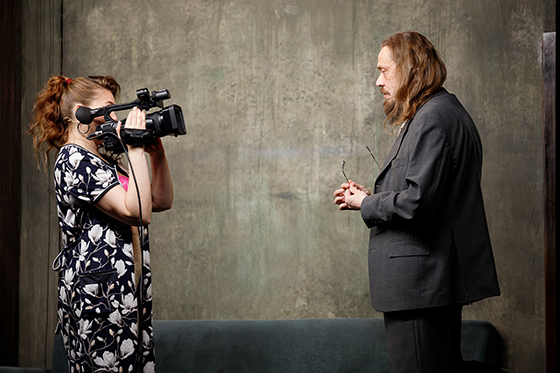 © Vadim Bochenkov Scene from the play “Death of Talerykin” by the Pskov Academic Drama Theater named after A.S. Pushkin, dir. Hugo Erickssen
The time of action in the play is also flickering. A technical mark on a direct ( live !) Video shooting belongs to what is happening by 1998. We see a video camera on the stage, one of the characters captures what is happening-it looks real, but in some strange way on the screen resembles a home video, which was part of a household (and police) life in the 1990s . The scenographer Yutta Rotte built a living plan of action and the screen above it of the same size, so that two films are obtained as if. The wall of the police station, a semblance of a corrugated chronic metallic container painted in a red-brown bloody color, is peculiarly resembles in shape and size a “meat grinder” of the Meyerchold performance. Visual details (an audio center, a bottle of “Soviet champagne”), the costumes of the characters seem to attribute action to the first post -Soviet years, a portrait of Yeltsin can be seen in the police room, scraps of music of those years are heard. We see a stylization for the “paintings of the past” (Sukhovo-Kobylin invented such a mask in the genre designation of the trilogy, although it is quite obvious that he did not only write about real modernity, but used his own experience with the law enforcement system-however, there, on the cover, it looks defiantly absurd: “I wrote the paintings of the past from nature”).
Erickssen revealed the first political play about the modern state machine in Russian classic in Russian classics.
Stylization allows the authors of the performance to extremely strengthen the drama of social mechanisms that have not remained in the past. The words of the quarterly overseer Razplyuev “All our! I can take and plant everyone ”and the Okha bailiff“ our time has not yet passed ”directly into the hall, and a panorama of rows with today's spectators appears on the screen. The text is updated - for example, the size of bribes is calculated by thousands of bucks, Barravin is called “Comrade General”, “electorate”, “deputy inviolability”, “publication of parrots” are mentioned, and the speech style is completely modern and typical for “our” places of action. Tarelkin is trying at all costs to preserve the documents exposing Barravin, and for the sake of destroying this anti -corruption investigation, a complete police cleansing of the territory is carried out. We see torture on interrogations with the help of a bottle of champagne, poisoning by the doctor of the opposition, who does not want to immediately obey the young and proud person. Perhaps, over time, the details of the “witnesses” interrogation are specified (in the video of the premiere, it seems, there were differences from a living performance that I saw later-if so, then this is an interesting impact of the documentary theater on the interpretation of the classics, in this case the reasonable for the essence of the play and the similar, for example, to change the circumstances of “Mysteria-Buff” at each new staging). Artists play extremely realistic, with accurate character and details of behavior - play modern people. There is a hierarchy between the security forces and a complete mutual understanding of completely different characters: naive and in their own way sincerely fascinated by serving the cause, the struggle with those who were declared “evil spirits”, dreaming of recognizing the selfless work of Rasplyuev (Maxim Plekhanov), the contemptuous and insensitive intelligent appearance of Oh (Viktor Yakovlev), the wounding of Barravin (Andrei) Kuzin). And the spectrum of subordinates autocracy-adapting to its most disgusting manifestations (Chevkin-Alexander Ovcharenko), indifferent executive (doctor-Kamil Hardin) or trying to the last extracted limit is also realistically represented (Pakhomov is also Kamil Hardin). Hugo Erickssen revealed the first political play about the modern state machine in Russian classic in Russian classics. Political - in terms of the meaning of the conflict and the course of action, in the content of characters, in style and dramatic accents.
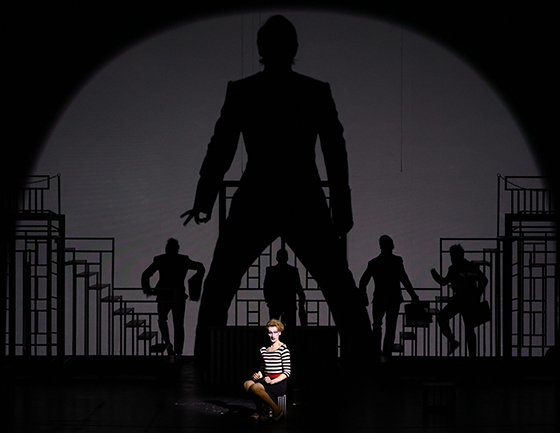 © Stas Levshin Scene from the play “Death of Tarelkin” Theater-festival “Baltic House”, dir. Oscaras Korshunovas
The postmodern consciousness, even being tuned in tragedy, does not obey the norms of the "artistic integrity of the performance." The semantic center is subjected to metamorphoses, artistic optics may change several times. Korshunovas begins the performance in the St. Petersburg “Baltic House” in a tongue mixing cold surrealism, horror, dark-emphy. A colorless environment outside of time and specific space, the movements of the characters are puppet. They themselves are almost virtual. The actress-Anna Shchetinina plays in the cross-casting of Tarelkin-and plays it, and plays, very tough, expressively, and the Mavrush’s cook, the old woman, appears in the guise of the young artist Stanislav Shapkin, the next to the aggressive style of the club, where there are many shades of gray. This is the space of total evil, there is duality, there is shadows and strange mechanism. The action of visible figures on a huge screen is duplicated by black silhouettes that do not repeat the first plan, doubles in the theater of shadows live their life, and the text acquires ambiguous meanings. Physically, real figures communicate with imaginary, existing only in video projections.
Korshunovas turns the constructivist style in cyber-ha-tech.
The scenographer Gintaras Makaryavichyus distributes things to the contours. In frontal scenes, actors use poses of poses as expressive accents. The new performance clearly plays with the motives of the constructivist production of Meyerhold 99 years ago (it would be pointless to directly continue that aesthetics)-from there, and the biomechanical method of the game, clowning, and visual motifs reflecting the geometric forms of costumes and a cage-ruler through which the detainees are passed. There is another genetics of these scenes: from the productions of Korshunovas himself on the texts of the Russian Oerius (“Old Woman”, “To be here”), “ PS Case OK ”, “Master and Margarita” - the director at different angles plunged into the space of non -being, to where the laws of the universal mind have lost strength, and an eccentric image is required to express it.
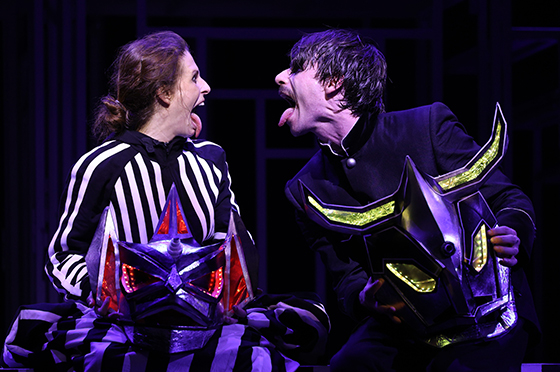 © Stas Levshin Scene from the play “Death of Tarelkin” Theater-festival “Baltic House”, dir. Oscaras Korshunovas
Moving on the plot further, the director turns the constructivist style in cyber-ha-tech (their direct connection, by the way, is convincing). The society of living people degenerates into a soulless aggressive game of virtual objects with appropriate movements and sound effects. Several scenes are in the receptions of rap opera . On the characters, the helmets of cyborgs, and the impersonal Tarelkin, he is also the Kopylov, in essence, is identical to Barravin, and the children of Brandylystova (five pieces) generally turned into walking emoticons. The police rocked and shattered - with hockey helmets on their heads, also from a computer game, also clones, also not marked with any properties of living people. From this reality, “Large plans” of Tarelkin and Barravin (Yegor Lesnikov) are distinguished, who at some point growl at each other, as if animals clinging in the wild, and the cracked Brandylystov, played by Maria Lysyuk in the brightest eccentric manner.
Another projection of Talerykin’s history, which is built by the director, is a political satire. Idiotic and ruthless interrogations in the police station look very similar to those that were in the Korshunovas play “Man from Podolsk”, paradoxically depicting a modern law enforcement situation-up to the intonations and costume of the investigator (here is the private bailiff in Cross-casting-actress Elena Karpova). The collage of action is overloaded with gags of different qualities, terrible meanings disappear, almost forgotten. Funny numbers sometimes look flat, not transformed (as probably conceived) by absurd aesthetics. In this line of the performance, there is a lot of cartoons and playing out funny details of the text, it seems too long, not too original, almost pop, amusement until the moment when the light and the quarterly overseer of Rasplyuev (in the realistic, completely believable, in the school of the Filstinsky, the performance of Alexander Perekov) is self -propelled between the rows and, triumphantly, muffledly, muffledly, muffledly Looking right at us, announces: “All our Fatherland is a whole flock of wolves, snakes and hares who suddenly turned into people, and I suspect everyone; Therefore, it should be decided by the rule - everyone should be arrested. The government is to roll up the proposal: so, they say, and so, to teach in our Fatherland the verification of all persons: who are they? Where? Didn't they turn around? Is there a pity or poisons with them? " According to the general meaning of the performance, the reality is dual, in violence and in the game we all related to dark forces. The phenomenon of the total “werewolf” tells the theatrical aesthetics.
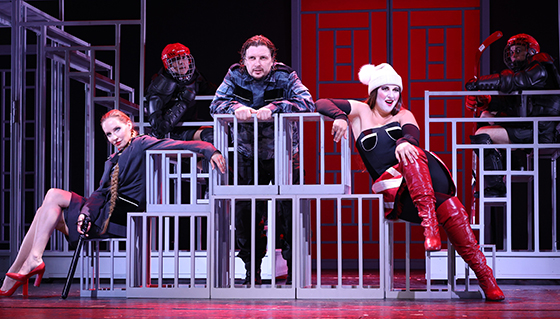 © Stas Levshin Scene from the play “Death of Tarelkin” Theater-festival “Baltic House”, dir. Oscaras Korshunovas
A series of eccentric numbers is interrupted by reading to the church organ music of the retelling of apocalyptic dreams (from the “sleep of a funny person” and from the “crime and punishment” of Dostoevsky) - about humanity in his insignificance. The director wants to force us to sympathize with the suffering of Tarelkin, who is experiencing physical torture during interrogations, fulfilling all the requirements of the security forces, obeying universal widespread lies. The final visual and plastic image of the “baking” (where, according to the text of the play, the varravin who defeated him sends Tarelkin, and judging by the convulsive dance, he himself sets off) should be understood as a general inevitable prospect.
The story of Tarelkin and the phenomenon of his “death” in a century and a half turned into a national myth. The theater reads it so.