
Translated material
Crusade
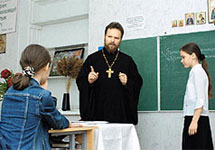
The Ministry of Education and Science approved the concept of the creation of the curriculum "Spiritual and moral culture" developed by the Russian Orthodox Church and recommended that the Russian Academy of Education take into account the proposals of the Church in the development of a new state standard of education. According to Kommersant on Tuesday, this problem was discussed on the eve of Christmas readings by the head of the Ministry of Education and Science Andrei Fursenko and Metropolitan Kaluga and Borovsky Clement.
“We repeat the request of millions of people to include a new educational area in the new standard, in which children from Orthodox families could study the Orthodox spiritual and moral culture so that this subject is included in the main program and covers the entire period of schooling from 1 to 11th grade,” Metropolitan appealed to the public.
The Ministry of Education and Science agreed with the proposal of the Russian Orthodox Church. "The concept is sent to the Russian Academy of Education for use in the development of new standards," Fursenko said.
Unlike the previous religious and educational initiatives of the Russian Orthodox Church, it is now proposed that not only Orthodox, but also Muslims, Jews and Buddhists engage in moral education. The interests of atheists are also taken into account: if parents do not want the foundations of morality to their children to be taught on a religious and cultural basis, an object of non-religious, philosophical and cultural nature will be introduced.
However, representatives of other religious organizations still do not agree with the initiative of the Russian Orthodox Church: despite the declared pluralism, they are afraid of the dominance of Orthodoxy in schools.
At the end of 2007, the Patriarch of Moscow and All Rus' Alexy II said that since 2009, the “Fundamentals of Orthodox Culture” will be taught in Russian schools as part of the compulsory subject of “spiritual and moral culture”. Earlier, the defense industry was introduced into school programs as part of the regional component. This subject was taught in the Smolensk, Kaluga, Bryansk and Belgorod regions as mandatory, and in 11 regions - as an optional one. In early December, the president signed a law canceling regional and school components in secondary education.
Dossier: science and religion. Polemic around the letter of academicians