
Translated material
Gone at a loss
Almost ten -year large -scale cooperation with the state oil company Venezuela PDVSA brought Rosneft only losses. This was reported by Reuters with reference to the internal documents "Rosneft" at the end of 2015 inclusive and to data from open sources, including a later time.
Since 2010, Rosneft has invested about $ 9 billion in Venezuelan projects, but these expenses have not yet been covered.
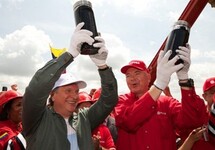
The largest project of the Russian state-owned company in Venezuela was the development of the Khunin-6 field in the Orinoko River basin. Production began in September 2012; The chief executive director of Rosneft Igor Sechin personally attended the ceremony on the occasion of the start of work. The 60 percent share in the field belonged to PDVSA, the remaining 40 percent-the Russian consortium, which, in addition to Rosneft, included TNK-BP, Gazpromneft, Surgutneftegaz and Lukoil.
However, the project did not bring the expected profit. Already in November 2012, PDVSA, without coordination with Russian partners, took one of four drilling rigs from the field. In addition, the work was inhibited by protests carried out by local residents. As a result, by the end of the same year, only 6 wells were drilled at the field instead of the planned 47.
Spare parts for drilling rigs were purchased from Bariven - PDVSA units - however, it took 10 months to a year and a half. The installations were idle 37 percent of the time. The drilling of one well took an average of 49 days with the expected project 22.
Predictions of production were reduced. If in September 2012 Rosneft stated that by the end of the year the daily volume of production at the field will be 20 thousand barrels per day, then in fact, only 21.4 thousand barrels were obtained over the past four months of the year.
The situation did not improve even after 3 years. The Rosneft report for the I-III quarters of 2015 announced the “unsatisfactory quality” of construction and “non-optimal trajectories” of wells. By the end of the same year, the forecast of the daily peak of production on Khunin-6 was reduced from 450 thousand barrels per day to 250 thousand. Meanwhile, the consulting company Wood Mackenzie in April 2018 appreciated the value of this indicator even lower - at 120 thousand barrels.
The trade union leaders in conversations with Reuters noted that the problems in the Orinoko basin are preserved to this day. Of the dozens of drilling plants in deposits east of the city of Khunin, only a few act. The workers do not even have a basic equipment - boots, gloves and helmets.
PDVSA offices are no better, the publication says. There is not even enough paper. Employees are massively quit. Some personnel departments, unsuccessfully trying to prevent frames leakage, hang out the plates with the text "dismissal are not accepted."
Already in November 2012, Surgutneftegaz left the consortium engaged in the development of Khunin-6. In December 2014, Lukoil also announced the same decision. The shares of these companies were redeemed by Rosneft; The total amount of transactions exceeded 300 million dollars. In addition, in 2013, Rosneft acquired TNK-BP, and, accordingly, its share in Khunin-6. Thus, Gazpromneft remained the only Russian partner of Rosneft in the project.
In addition to Khunin -6, Rosneft, together with PDVSA, took up the development of four smaller deposits - these are Carabobo and Petromonagas in the Orinoko basin, Petroperich on the coast of the Caribbean and Bokeron in the east of the country near the coast of the Atlantic Ocean. These four projects also brought losses to the Russian state -owned company.
The profit of profit was no less problematic for Rosneft than prey. So, in 2012, PDVSA without the consent of Rosneft seized $ 12 million from the Khunin-6 budget, citing the need to satisfy the needs of local residents. Meanwhile, only 350 people lived on a area of about 447 square kilometers provided by the consortium under the concession agreement.
In addition, having investigated the wiring between the PDVSA and the joint venture "Petromonagas", Rosneft's auditors concluded that the Venezuelan state -owned company has underestimated the volume of revenues from the sale of oil "Petromonagas". PDVSA challenged this value, and in the future the amount of underestimated revenues was reduced to 500 million.
Only for the IV quarter of 2015, the amount of dividends from three joint ventures that were not received by Rosneft amounted to 337 million dollars.
In April 2015, Sechin approved the plan for the protection of investments of the Russian state-owned company. However, six months later, in October, the first Vice President of Rosneft Eric Leron notified Sechin that since August 15, PDVSA has been in a technical default.
Over the next years, the Russian state -owned company managed to obtain more control of investments, in particular, by attracting its own contractors. According to the financial report of Rosneft dated February 5 of this year, the advances provided by PDVSA decreased from $ 6.5 billion to 2.3 billion.
However, Reuters notes, problems are persisted. Oil production is still lower than expected, and the terms of field development are either broken or transferred. Khunin-6, as of 2017, was still at the stage of intelligence and experimental development. Moreover, one of the members of the Gazpromneft board already in a recent conversation with the agency described the project as "commercially meaningless."
By the end of last year, Rosneft, according to Reuters, spent about 1.5 billion dollars more in Venezuela than she received in the form of dividends. At the same time, the agency notes, this assessment may even be somewhat underestimated, since some factors were not taken into account when calculating, in particular, the tax that the Russian state -owned company pays in Venezuela.
The deposits of Petroperich and Bokeron in the financial report "Rosneft" for 2018 were called unprofitable. Petromonagas also did not live up to expectations - as of July last year, even less oil was produced there a day than in 2015.
Meanwhile, in 2017, Rosneft received from the regime of the then President of Venezuela Nicolas Maduro license to develop shelf gas deposits of Patao, Mehilloes and Rio Caribbean at the Venezuela shelf. However, as of the last year, neither a plan for the development of these deposits, nor a plan for the development of infrastructure were prepared.
Reuters sources - both close to Rosneft and related to Venezuelan projects - explained the investments of the Russian state -owned company in the Latin American country with political reasons. They explained that the task of Rosneft is to help restrain the regimes of President Hugo Chavez, and then his successor Maduro.
“From the very beginning, this was a purely political project. We all had to introduce our share,” Gazpromneft member of the board noted the agency.
It is no coincidence that the publication is noted, Rosneft, led by Sechin, is played by the main role in Venezuelan projects - one of the most entrusted by Vladimir Putin.
The expert of the Moscow Center of Carnegie Alexander Gabuev noted that, increasing the presence in Venezuela, Russia is approved in the territory close to the United States. He also noted that the Latin American country is a major buyer of Russian weapons.
Meanwhile, Putin’s spokesman Dmitry Peskov assured the agency that the Kremlin does not force Rosneft to invest in Venezuela. Rosneft works as a commercial company, ”he said. - In all corners of the world, she works benefit. "Regarding the loss -making of Venezuelan projects of the state -owned company, the official noted:" Naturally, such large projects are designed for a long perspective. "Immediately after that he added:" As for the estimates of the benefits of these projects, this should be given by the company itself, this is not our business. "