
Translated material
Hood Bai, Lenin
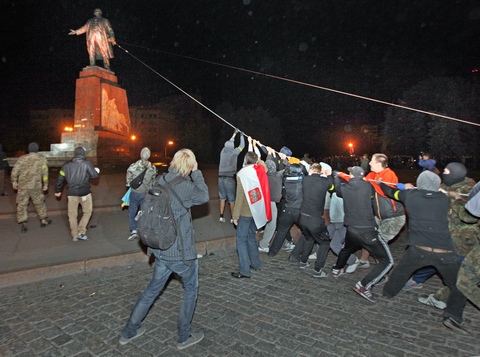
What happened last weekend in Kharkov was the last spectacular chord of the epic Ukrainian Leninopad. It began with the “demolition” of the Mercury monument in Kyiv, and this was in December 2013, in the first weeks of the Maidan, and ended with the “liberation” of Kharkov Square of Freedom. Between these two “demolitions”, Ukraine survived the revolution, occupation and war, said goodbye to its “heavenly hundred”, lost Crimea, loses Donbass and loses people in the Donbass - a soldier and civilians. It would be strange to seriously “worry” about the fall of a stone idol, one of many, in fact. Although, it seems, this one has become the last - at least that is how it is perceived.
For those months that have passed since the overthrow of the Kyiv monument, Leninopad has become massive throughout Ukraine: Dnepropetrovsk and Odessa, Poltava and Chernihiv, Zaporozhye, Khmelnitsky and Krivoy Rog, dozens of district centers and small cities throughout Ukraine were consistently. On the eve of the epic “liberation of the Square of Freedom”, monuments in Mariupol and Pavlograd were demolished. Yes, and the monument itself in the Square of Freedom was either the third or the fourth of those demolished in Kharkov alone. But it was in this - in the Central Square - there was a kind of symbolic meaning: they said that this was the largest monument to Lenin of all existing ones. In fact, it is only reliable that he was the largest in Ukraine (20.2 m), and that he was in one of the largest areas in Europe. In a certain sense, he corresponded to her, and let the rumors about his artistic value (as in due time to talk about the “beautifulness and uniqueness” repeatedly repeated Merkurovsky Ilyich) are greatly exaggerated, but the ensemble of freedom with the magnificent “Gosprom” building is a monument of constructivism and a monument of Soviet history, in fact, glorious Kharkov history of the 1920s. It was the left avant -garde Ukrainian Kharkov, the city of Skripnik and Khville. Lenin was appropriate there, how appropriate he was generally appropriate in this Soviet history.
The experience of the “symbolic” often turns out to be stronger than the experiences of the real (mimic), and, which is obvious, the actions performed in this symbolic field inevitably multiply all kinds of symbolic reflection. The parting with this - the most spectacular of the Soviet monuments - became a sign of the final liberation of Ukraine from the USSR, its final departure from the Soviet Empire. Perhaps that is why Kharkov events became the “theme of the day” in Russian -speaking blogs: moreover, Russian historians regretted the Kharkov monument most of all. Against this background, a stingy reaction of the Ukrainian media is characteristic: the demolition of the monument is just news, nothing more. Moreover, Ukrainian media, unlike Russian bloggers, monitor the “law enforcement plot”, or rather, the incident: on the fact of demolition, on September 28, a criminal case was opened, and a few hours later, when the monument was demolished, the case was closed. The governor of the Kharkov region Igor Baluta retroactively signed an order on the official dismantling of the monument. Advisor to the head of the Ukrainian Ministry of Internal Affairs Anton Gerashchenko “illuminated” the events on his Facebook: “Lenin just fell. When dismantling the monument, no one was injured, ”he reported in fact, and then posted photos of the defeated“ Idol ”with a comment:“ The idol's head split. Selfies are made inside the head, highlighting with phones. ” The head of the Ukrainian Ministry of Internal Affairs Arsen Avakov himself “shared the status”: “Lenin? Let him fall ... If only people would not suffer. If only this bloody communist idol, leaving, did not add victims to himself. If only the villains and scoundrels did not use the storms of the Kharkiv’s emotions, did not use this for the next clashes ... He gave the police command to ensure exclusively the safety of people, and not an idol ... After the governor of Baluta about the demolition, the Ministry of Internal Affairs is not interested ... It is important that the process would pass without additional excesses. ”
In Kharkov, they are now really afraid of provocations, the so -called. “Geping”: Kharkov mayor Gennady Kernes (in the colloquial - hepa) is known for the addiction to the “double game” and often provokes instability itself. In the morning, a clash of “mummers” nationalists with “mummers” communists (under the television) occurred in the square. From Monday, Kharkov Street has been patroling the National Guard, and on the recommendation of the Ministry of Internal Affairs, the University and Gosprom metro station were closed.
Ukraine. Kharkov. September 29th. Participants in the rally "Kharkov is Ukraine" demolish the monument to V.I. Lenin on the Constitution Square.
Photo Sergey Kozlov /TASS