
Translated material
Three comrades

In the regions
 Three comrades
March 1, 2007 Alexander Cherkasov
Of course, this is an accident - the Tver Interdistrict Prosecutor's Office began to "check" our book "appeal to the European Court of Human Rights" on the eve of February 23. Papers from the Prosecutor General could go down the instances a little faster or slightly slower. But the date itself - the “Defender of the Fatherland” - helps to highlight some possible aspects of prosecutorial interest."Day ..." This is celebrated not only by "defenders", but also by other departments. Internal troops, for example, or the Federal Security Service - are unlikely to refrain from "noting". Although everyone seems to have their own special date.
But there are others who, if this day celebrates, is only as a day of memory and sorrow. On February 23, 1944, the eviction from the Caucasus of the Chechens and the Ingush began.
However, then not everyone was evicted.

Many - too many in order to call the deportation successful - managed to hide, go to the mountains. The rebel movement lasted many years, was no less fierce than in Lithuania or Western Ukraine. The last Abrek, the 76-year-old Khasouhu Magomadov, was killed only in the mid-seventies.
And someone simply could not deliver to the collection points. During the operation "Mountain", a sudden snowfall flooded mountain trails. Old people, women, children could not go down to the plain. In the village of Haibakh, several hundred of such non -transportables were locked in the stable of the Beria state farm and burned. Nothing personal - service ...
When the Nazis and their accomplices in the occupied Soviet territories did this - this was called a war crime. For many more years, the Chekists caught policemen and punishers and made them sentences without taking into account self -justification such as "I carried out an order."
Those who deported the Chechens, on the contrary, were presented to awards and to increase the titles.
But since then many years have passed. The world was horrified by the abyss of crimes committed by the Nazis. The system of international law has changed, there is a universal declaration of human rights of 1948, the Geneva Conventions of 1949 and additional protocols for them, already from 1977. Everything so that the past does not happen again ... For the same, there are the European Convention on the Protection of Human Rights and Fundamental Freedoms, and the European Court of Human Rights. After all, before a certain country becomes a threat to the international world and security, internal symptoms appear. This proved the experience of German Nazism, and not only ...
But in January 2002, a group of special forces Eduard Ulman fired at the UAZ, kills one and captures five passengers. They caught like Hattaba, but already in the process convinced that he was not there. And there are peaceful people, a woman ... They bandaged the wounded ... Then they talked with the authorities for a long time. According to Ulman, the authorities “hinted” that “all the“ two hundredths are hinted ”. That is, the killed. And not to fulfill the order. It’s impossible to fulfill the order. So, at least, especially capable journalists write. And if someone is to blame, then this is the authorities who gave the order. So Ulman himself, in the third court, said the task of destroying the enemy. I considered these people not detained, but opponents. I was sure that this order was justified, since there were no cases when there were crimes with the hands of the reconnaissance groups in my memory. " So nothing personal. As in 1944 in Haibakh. The Ulman captured by the Ulman group were killed. And the special forces managed to justify the jury.
But so far the case of Ulman is listening to Russian courts. And it did not reach Strasbourg.
But there were considered several cases in which the "bosses" just appear.
The case of the attack from the air on the refugee column near the village of Shaami Yurt on October 29, 1999. On October 23, the exit from Chechnya to Ingushetia along the Caucasus highway was blocked-the military, under the leadership of Colonel-Dankist Anatoly Khrulev, began to equip a large, echeloned checkpoint. The official media reported that they would open it on October 29. That morning, a multi -kilometer column of refugees accumulated on the highway. "Corridor" was not given to them. They began to turn back. And at the heights of the Sunzhensky ridge there was another regiment, hence the movement on the plain. The called attack aircraft "worked" on the column. Dozens of dead ... Then the pilots wrote that they were all the time aiming at a truck with militants, but for some reason, refugee cars turned out to be on the path of missiles. And he commanded all the military groups “West” - that at the post, that at the heights are army general Vladimir Shamanov.
Another thing is about the bombing of the village of Katyr-Yurt on February 4, 2000. As numerous generals have repeatedly stated, during the brilliant operation “Hunting for wolves” they managed to lure Chechen detachments from the formidable in order to destroy them on the plain. They destroyed this way: they made “traps” in the villages for them, launched there, blocked, and then “all available means” ... Whether this brilliant operation was planned or everything turned out by itself, I will not say. But here are the militants in the villages, from which they did not let the residents leave were blocked. In the village of Katyr-Yurt, which was a few weeks earlier declared a “security zone”, also numerous refugees were also declared. The “vacuum” ammunition of the Pinocchio installations could not distinguish civilians from non -peaceful residents. As well as the “sausages” of plastic tons of weight-the elongated charges of cleansing the UR-77 system ... The militants for the most part left, and a person’s one and a half people died from not militants.
I am not saying that everyone was killed intentionally and consciously - "nothing personal."
The generals - mentioned by Vladimir Shamanov and Yakov Nedobitko from the internal troops commanded the operation.
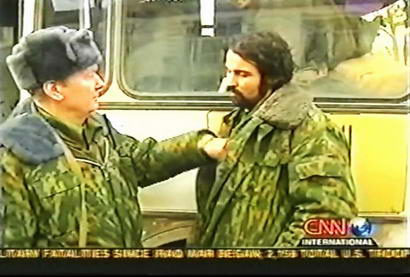
The largest success of that “hunting” was to capture sixty militants ... that is, not militants, but the wounded, whom the militants left in the hospital in Alkhan-Kale. There, the military arrived in time two days after the start of the departure of Chechen detachments from Grozny. And General Alexander Baranov, who commanded this group, spoke in front of the television camera with one of the militants, Hadzhimurad Yandiev , said the following: “Take it off, to hell, kill him, shit, here, take him away, damn it. Come on, come on, take it away, get fired, fired at the same day ...” The audience of NTV and CNN television channels could see how two soldiers led the detainee. The operator was still called to the cemetery - to shoot shooting - but he did not go ...
However, as it is there: "I considered these people not detained, but opponents ..."
The Strasbourg court in its decisions emphasized that Russia has the right to fight terrorists, with "illegal armed formations." But - not "all available means." And in these three cases there was a crime. And that criminal cases, "closed" by the Russian military prosecutor’s office, must be investigated, and guilty - to punish.
Where do you think the listed generals are now? Where Shamanov is known: he went into politics, he returned, now - the chairman of the interagency commission on prisoners of war, interned and missing.
And where are the rest?
Anatoly Nikolaevich Khrulev in April of last 2006 was appointed commander of the 58th Army-the main association of the Armed Forces in the North Caucasus, Lieutenant General.
Yakov Viktorovich Nedobitko in December of the same 2006 became commander of the OGV (C)-a united group of troops (forces) on the counter-terrorist operation in the North Caucasus region, Lieutenant General.
Alexander Ivanovich Baranov since July 2004 has been in the position of commander of the SKVO (North Caucasus Military District), Army General.
Three main team positions in the hottest region. Three generals. Like three precious stone in a sovereign crown ...
It was unlikely to be done on purpose. But now the current arrangement of military chiefs in the Caucasus, probably, still in a certain way reflects the attitude of Russia's leadership to the European court, humanitarian law and much, much more.
Nothing is heard about the resumption of the prosecutor's office of the investigation of criminal cases against these generals. And high officials in this regard add: "We will not give our generals."
But our book about the European Court is “checked” just on February 23. Coincidence, of course. But this coincidence only highlights the ambiguous meaning of our history and its tight inner interconnection.
Author - Member of the Board of the Society "Memorial"
Alexander Cherkasov
All rights to materials located on the EJ.ru website are protected in accordance with the legislation of the Russian Federation, including copyright and related rights. With any use of the site and satellite projects, hyperlink (Hyperlink) on EJ.ru is required.