
Translated material
"Anti -utopia has grown up"
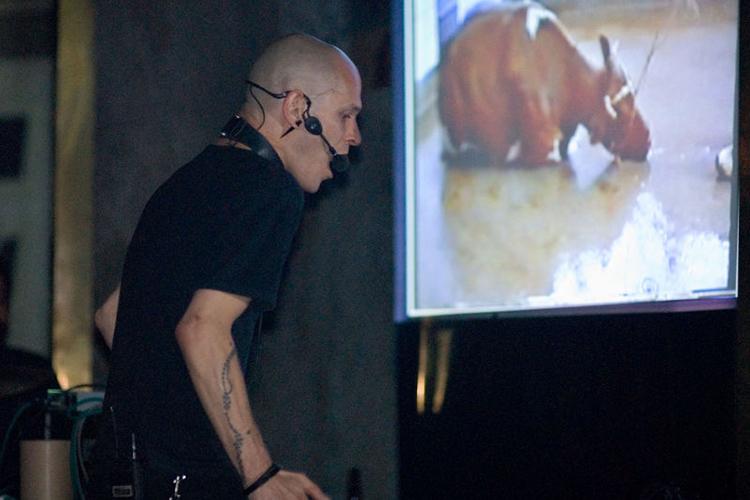
Dave Phillips is a famous Noise-musician and Sound Artist with a huge discography (on it has more than 150 releases-solo and collective), a participant in the art unit Schimpfluch and one of the founders of the Swiss grand corn Fear of God . Last year, his new album “ Homo Animalis ” - a kaleidoscope of styles that the musician addressed throughout his career: from Musique Concr è TE to a hard noise. The other day, Phillips played in Kaliningrad at the Sound Experimental Music Festival Around Kaliningrad . Boris Shibanov talked with the musician and theoretician about his ideas and a positive program.
- Theoretical constructions are often behind your music. For example, your new album " Homo Animalis ” is built around the concept of“ Humanimalism ”you created ( Humanimalism ) . Tell us what is it?
- This is a rather extensive concept, but if briefly - it describes the developed existence of a person who accepts the false, in fact, phases of religion, materialism and Supreshism only as part of the evolutionary process, but was already able to overcome them. He realizes himself as part of the whole, he no longer dominates. He becomes a conscious creature capable of empathy, he is preoccupied with social and environmental problems. And this allows him to move away from one -sided and severe, rational, logical, male, anthropocentric view of the world.
- Yes, it is known that the ecology for you is an important topic and you are taking a clear position regarding the protection of animal rights.
- Beast rights for me are directly related to human rights, women's rights, minority rights. Animal rights were just the first step.
- At the same time, in your texts you often talk about religion as a “main enemy”. In Russia, the overgrown power of the Church takes more and more frightening forms, but from here it may seem that in the West religion no longer plays an important role.
-I would not talk about the “main enemy”, in my opinion, religion-rather, one of the biggest mistakes of mankind-but this is a mistake that may also be necessary. It’s just time for religion to become an attribute of the past. Although I want to emphasize: religion is a private business and personal choice of everyone. I am critical only in relation to the “organized” religion, which will always give rise to enemies and conflicts. In the end, the “chosen people” can be only one ... Religion shares. Therefore, all organized religions carry a danger to life, for evolution.
- In your theory and in your music, instead of religion, you offer rituals. What are you putting into this concept?
- In fact, I do not offer any "instead". I understand the value of rituals in a person’s life and value the energy that they can contain. But, as in the case of religion, the ritual becomes meaningful only when it becomes personal.
The human appearance seems to me a young animal who has yet to find out what it means to be a child.
- It seems that your music should translate “ancient images” into the minds of your listeners. How do you get to this antiquity?
- Here we touch the area of the subconscious, treasure of all kinds of knowledge. Therefore, it is very difficult to choose the right words to describe these processes. The interpretations of my work can be monstrously different from each other. But I am not surprised that my music-my intentions-conveys something "ancient". In general, human life is extremely limited today, and limitations are my main “antagonist”.
- Your track " Rape Culture ” recalls the works of Krzysztof Penderetsky. Is it accidental?
- Of course, no, Penderetsky - this, one might say, is an “old friend”, given my listener attachments. I listen to everything that can inspire, a lot of diverse music (including modern academic). Although even newspapers can inspire me.
- You are the organizer of the ATONAL concert series . What do these concerts give you personally? What can be said, judging by these works, about the state of atonal music today?
- Atonal has become a platform for me, where I can imagine interesting sound arts. At the same time, the “evolution” of musical thought is the least important (albeit interesting) aspect. It is much more important to me an honest approach from the artists whom I represent, and in general, people who attach great importance to “unconventional music in a non -profit context”, existing outside the consumerist, capitalist, passive world. When I see how people are freed from this, I feel that lightness and mobility that are associated with the very essence of life for me.
-Recently, Peter Brewsman , a well-known free jazz musician, came to Russia; The book of conversations with him bears the pessimistic name "We thought that we can change the world." Obviously, this faith in the generation of Brezman has disappeared. What do you think about what is happening today?
-I think humanity has to learn that religion and materialism are only a couple of steps on the path to something great, creating a balance in the general state of affairs. As soon as we take these couple of steps (if we make them), we are likely to find our place in nature - we can be part of it, not striving for dominance. The human appearance seems to me to a young animal who has yet to find out what it means to be a child, not to mention what they mean not to be. I want to achieve changes, offer something constructive. I would like to believe that there is hope, but I myself often encounter suffering, operation and destruction.
I think despair is born due to the slowness of changes. I know that when I feel “thin -skinned”, the world seems severe, cold and insensitive. When I follow the news, I have the feeling that the anti -utopia in which I found myself has grown to unbearable size, that I have no chance. On the other hand, I meet people with whom I have the opportunity to exchange important knowledge. A lot of inspiring and loving people, which gives me hope.
The question is - what to give preference? One -sided, often depressive perception that the media offers us? Or the impressions in which you see glimpses of progress, changes, hopes? Maybe I'm a romantic, but ... I survived the phase of extreme depression several years ago ... But I decided that the struggle would continue, and in it I want to show myself from the best side.