
Translated material
Economic Union with a political background
In the economy
 Economic Union with a political background
May 29, 2014. Maxim Blan
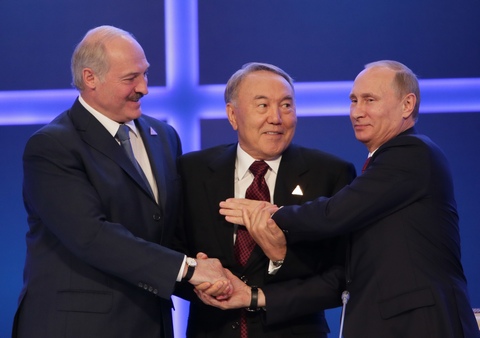
Putin flew to Astana that together with colleagues from Belarus and Kazakhstan - Alexander Lukashenko and Nursultan Nazarbayev - to sign an agreement on the creation of the Eurasian Economic Union (EAEU), which will replace the Customs Union and a single economic space. The contract is signed in a cut -out form: the participants did not agree on the creation of a single currency. However, even in a cut -out form, the EAEU creation agreement is a very impressive volume. Putin’s assistant Yuri Ushakov told reporters that he contains 28 sections, 118 articles, 32 applications, occupies a total of about 700 pages and consists of two parts. The first, institutional part, describes the goals and objectives of the organization and enshrines its status as a full -fledged international organization. The second part, functional, regulates the mechanisms of economic interaction, and also records specific obligations in the industry areas of integration. The headquarters of the Eurasian Economic Commission (the main executive body of the EAEU) will be in Moscow, the court in Minsk, the financial regulator in Alma-Ata.
In addition to Belarus, Kazakhstan and Russia, Armenia and Kyrgyzstan can join the EAEU. Among other states that declared intention in one form or another to join the Union, Abkhazia, Transnistria, Tajikistan, Syria and South Ossetia. Negotiations are underway on the creation of a free trade zone with Vietnam.
If we distract from high -profile statements and the amount of paper that has gone to the printout of the document, it can be stated that fundamentally new provisions, compared with those that were fixed in the Regulation on the Unified Economic Space, will not enter into force in the near future. Only the name and status of the association is changing. And although the EAEU will begin to function on January 1, 2015, all agreements will come into force only from 2025. By that time, in Russia, Kazakhstan and Belarus, the free movement of capital, labor, goods and services between all participants should be legally enshrined. In addition, a single oil and gas market should be created, and participating countries should carry out a single macroeconomic, tariff and monetary policy. In the countries of the Union, it is planned to unify the investment regime. Investors will receive the right to reimburse the state by damage to their investments as a result of unrest, wars and revolutions. Each country will have the right to pursue its own industrial policy, including subsidizing enterprises. But they will be able to challenge in court the EEAS measures to support industry used in another country.
The main issue of which three countries failed to agree is the creation of a single currency and a common emission center, similar to a European Central Bank. Talks about a single currency have been ongoing since 2012, when Putin publicly supported the initiative of the President of Kazakhstan to switch to Altyn over time - a kind of analogue of the Euro for Belarus, Kazakhstan and Russia. Instead, by 2025, a single mega -regulator should begin to operate, which will be engaged in supervision and regulation of banking activities in the territory of the Union.
If we take into account the lack of fundamentally new integration initiatives and the extremely distant terms of implementation of existing ones, we can state that the creation of the EAEU is a much more political step than economic. It is fundamentally important to demonstrate to Putin that the Ukrainian crisis did not affect relations with the nearest partners and did not interfere with the creation of the economic union. EAE, of course, has a certain potential, but everything will depend on Moscow’s attempts to solve its political problems with its help. If Moscow will be on to accept Transnistria, Abkhazia and South Ossetia, Kazakhstan and Belarus in the EAEU, most likely will reduce their participation in the union to formal membership, and the EAEU will turn into another stillborn child, like the CIS.
In the photo: Kazakhstan. Astana. May 29. President of Belarus, Alexander Lukashenko, President of Kazakhstan Nursultan Nazarbayev and Russian President Vladimir Putin (from left to right) after signing an agreement on the creation of the EurAsEC, at the Independence Palace.
Photo by ITAR-TASS/ Mikhail Metzel