
Translated material
Jew as Russian
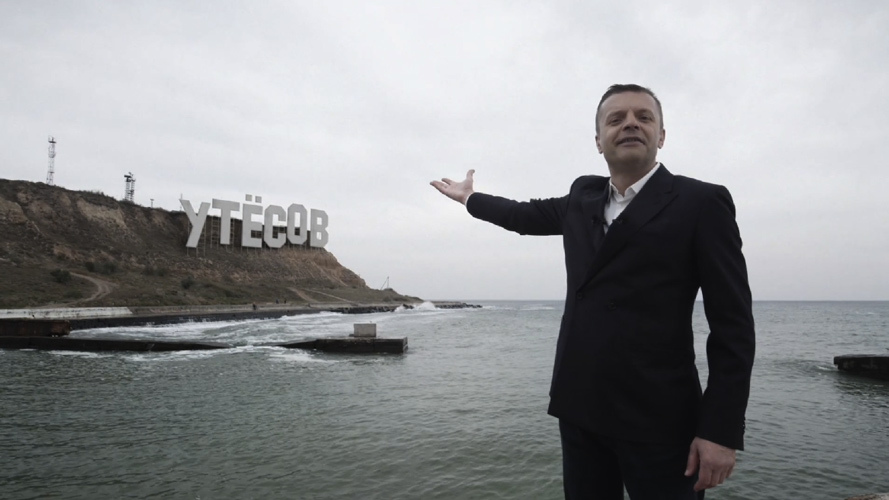
Leonid Parfenov presented the public the first part of the Russian Jews documentary trilogy. When all three parts are ready (and this will happen by the end of the year), a discussion of television broadcast on Channel One will become possible. But so far, from April 14, the film will be shown on the screens of Russian cinemas, and this is the first project of Parfenov, which will begin with the film distribution.
The Moscow Documentary Cinema Center in the calculation of interest in both the topic and the personality of the presenter took up the distribution of the film.
You do not expect new ideas or new information from Leonid Parfyonov - usually in his films (and this is no exception) there is nothing that would not be known to those interested in the topic. All his films are an appeal to a wide profane audience; In this sense, of course, they are television, that is, they are designed to attract the scattered attention of the viewer, stop him on the way to the bathroom or in the kitchen, to captivate, hit, and focus.
“Russian Jews”-of course, another step forward in the development of Russian popular science cinema. The director of the film Sergey Nurmamed (Parfyonov has been working with him for many years, he made the films “Bird Gogol”, “Zvorykin-Muromets”, “Color of the Nation”) uses the latest technological techniques to make dull archival documents-all these static engravings, portraits, fading photos, fragments of newsreel-turned into a visually rich, beautiful, diverse diverse And, most importantly, a very dynamic film. You can’t show a motionless image for more than 7 seconds on the screen, Nurmamed is convinced. Actually, it is his directorial decision that becomes decisive when the question arises about choosing an object for shooting. The main principle of Parfenov - everything that can be shown should be presented clearly - is realized by any means, from documentation to animation. In the film “Russian Jews” they say portraits of emperors, the accused of ritual murder Menacham Mendel Bailis comes to life, and there is even a short stand -up of the writer Maxim Gorky. So the visual attraction was certainly a success.
All his films are an appeal to a wide profane audience; In this sense, they, of course, are television.
As for the content, the Parthenov remains faithful to his author’s style: the leader’s speech is densely beaten with cloves of aphorisms, well -remembered and brightly formulating the essence of the matter. So, talking about the three sections of Poland of the 18th century, as a result of which Russia joined the lands with a dense Jewish population, Partenov effectively concludes: "Not Jews came to Russia, but Russia came to Jews."
The first film covers the gigantic part of history, from the time of Kievan Rus to the 1917 revolution, and, of course, many key and important milestones have not been included in it. But Parfyonov explains that he was not interested in the “Jewish question”, that is, not the relationship of the state and Jews, and not even the life of Jews in Russia, but exclusively their movement towards Russian culture, assimilation, the transformation into Russian artists, poets, musicians and revolutionaries. Naturally, most of the time the film devotes the end of the XIX and the beginning of the twentieth century, when there was an active breakdown of traditional ways. As is customary in such a television format, the historical process is shown through private fates: the heroes of the film are Levitan, Utes and Ostrakh, their teacher Stoyla, Chukovsky and Zabotinsky, three Rubinstein, Trotsky ...
To illustrate the famous Chisinau pogrom specifically, in the spirit of silent cinema, whole scenes have been shot. Bailis's case is considered in great detail as a mini-series. Another potentially serial plot is the murder of Stolypin Dmitry (Mordko) Bogrov, nicknamed Mitka-Bourgeois, the grandson of the Jew, the son of a rich homeowner, a supporter of assimilation. All these complex and multi -component events in the film are inevitably compressed and simplified, however, Partenov manages to find a bright and compressed form for them.
For example, in the story of the childhood of the future idol of the Soviet people Leonid Utesov, it is shown how his father, Osip Weisbein, comes to a neighbor, butcher Kondrat, ask permission to pay for the training of his son Nikita. The fact is that the presenter explains that in the only Jews of Odessa, the Russian commercial school Faygi was a 50 percent norm for the Jews, and since the training was very expensive, and the Russians were where to study without it, each Jewish student voluntarily took for maintenance and paid for “his Russian”. This scene is also resolved in the film in the spirit of the great dumb, with exaggerated gestures and accented details: in the role of Kondrat - a huge height, a man who is busy with his own business - he cuts the carcass of pigs, and the petitioner is half as much, he presses to the door and cautiously looks at his bared pork head. The situation is played as comic.
Such stereotypes always turn out to be either Zionist or anti -Semitic.
Of course, the prepared viewer cannot but have a need for a deeper understanding of events. The problem, however, is that, being a product of mass culture, such a film can operate only with common ideas typical of the collective conscious, and regarding the Jewish theme, still surrounded by many myths and defaults, such stereotypes are always either Zionist or anti -Semitic. There is still no generally accepted, understandable, and at the same time imperfect, unbiased position. It is not only in relation to Jews, it has not been developed on many issues, which, incidentally, makes it very difficult to create works of mass culture.
Leonid Parfyonov tries not to reproduce the old stamps, but there is no other canonical norm, so the film remains a retelling of interesting details, charming details and exciting stories do not develop into the overall picture.
It must be remembered that this film is only the first part of the project. The other two should cover the periods, as the Parthenians mean, official sodophilism (from the 17th to the mid-40s) and the official surge-from 1948, the year of the murder of Mikhoels, until the end of the 90s. With the disappearance of the Soviet state, Partenov believes, the topic left, dissolved, was removed. Today there is no state anti -Semitism, and the public is almost invisible, conflicts and nervousness have gone the past along with interest standards, prohibitions on profession and suspicion.
Since the films about the Soviet era have not yet been shot, in the discussion about them, I inevitably forced to make assumptions. At the discussion after the screening of the first film, the Partenov quoted Solzhenitsyn’s words about Jews as a support of the Soviet regime, which turned away from him in the fifties: “Without them, even Steni-the Bolshevik fanaticism not only lost in ardor, but even ceased to be fanaticism, he was reassured in Russian.” Actually, Parfyonov, in these words, is not interesting to the Solzhenitsyn concept about the “fusion of Soviet Jewry with Bolshevism”, but rather a curious contrast between Jewish activity and Russian passivity. Domestic and stylistic details are generally good for the visual series and are saving for a neutral position. I doubt that Parfyonov in the following films will delve into the details of how in the thirties the finally “Russified” Jews and their Soviet comrades are pursuing unassimited Judaism, scrape the traditional Jewish way, destroy the synagogues. And about how the new Soviet Jews supplant Jewry from their consciousness, he is unlikely to tell how he did not talk about the crisis of national identity in pre -revolutionary Jewry.
It is unlikely that the film will also look after the veil of secrets over the mystical attitude towards the Jews of Russian Orthodoxy in its simple-income-in-law anti-Semitism, so clearly expressed by Empress Elizaveta Petrovna in the famous resolution imposed on the resolution of the temporary entry to the Jewish merchants, which indicated a tremendous benefit for the state building from the development Trade: "From the enemies of Christ I do not want an interesting profit." By the way, in the film Parfenova, Elizabeth herself pronounces this phrase, and the revitalization of the portrait seems more important than the meaning of its archaic verbal structure.
It is incorrect, however, to make claims to the film, the genre of which does not imply the presentation of what there is no public agreement. The film shot in the Must Have genre will not replace public discussions, mass culture stagnates in an atmosphere of impashing. But it seems to me that the beginning of special institutions, which was not closed inside, and, I have no doubt, a very relevant discussion, the film by Leonid Parfyonov can serve as a very relevant discussion. With the readiness of society to rationalize the dark spots of its subconscious, of course.