
Translated material
A human rights conference
On December third, a number of human rights organizations organized a joint press conference dedicated to the package of laws in question, which are seriously advancing to the rights and freedoms of Russians. The event was supported by the Sakharov Center, the International Memorial, the Human Rights Assembly of Memorial, the Moscow Helsinki Group, the Public Verdict Foundation, the SOVA information and analytical center, the Human Rights Council of St. Petersburg, the ROO "Man and the Law" (the Republic of Mari El), St. Petersburg OO "Civil Control"). Due to the ongoing quarantine, the press conference took place at Zoom.
This is how the human rights activists themselves describe the situation in the accompanying letter: “In November 2020, several bills were submitted to the State Duma of the Russian Federation ( https://sozd.duma.gov.ru/bill/1052523-7 ; https://sozd.duma.gov.ru/1057914-7 ; https://sozd.duma.gov.ru/bill/1057230-7 ; https://sozd.duma.gov.ru/bill/1057895-7 ), the first was introduced by the Government of the Russian Federation, the rest were deputies of the State Duma and members of the Federation Council. At first glance, it is obvious: these documents are aimed not only at the suppression of the activities of Russian non -profit organizations (NPOs), public associations, branches of international non -governmental non -profit organizations and human rights activists, and to further restrict the rights of Russian citizens to freedom of associations. They also infringe on the right to free expression of opinions, to the freedom of distribution and obtaining information. In addition, they limit the freedom of assembly, not only rallies, but also of any public events. Finally, legislators intend to strengthen control and regulation in the field of education and education in the broadest sense. ”
Natalia Taubina opened the event ("Public Verdict"). She recalled that legislative initiatives are far from the only form of attack on civil society. Right now, the authorities are trying to send from Russia the chairman of the Netherlands NPO “Legal Initiative” Vanessa Kogan, although she lived in the country for 11 years and in September submitted documents for citizenship. Dozens of human rights organizations signed a letter demanding to extend Kogan residence permit and provide citizenship according to an accelerated scheme. Otherwise, she will be forced to leave the country for two weeks.
After that, the word was given to Natalia Evdokimova from the human rights center of St. Petersburg, who told about the problems that were already available to the NPO. Natalya Leonidovna began the performance by the fact that all measures directed against NGOs are anti -constitutional. In the 14th year, after the adoption of the law on NKO-foreign agents, the Russian Constitutional Court stated that this law itself did not violate the constitution, but in an explanatory letter clarified that the organization who fell under its action should not be subject to any discrimination, but only inform about their status.
But in fact, such NPOs and their members do not have the right to participate in the elections, support political parties, communicate with foreign intelligence and FSB officers, conduct simplified methods of accounting, perform socially useful services, delegate representatives to the PMC, engage in anti-corruption examination-and this is not a complete list of prohibitions. Evdokimova was the first to raise the problem, which was then mentioned by all the speakers: an extensively understanding of “political activity” in the framework of law enforcement and arbitrariness in assessments.
So, while Levada-Center’s sociological service was recognized as a foreign agent engaged in the same VTsIOM, who also receives money from abroad, does not have this status. And the most frequent foreign agents in Russia generally remain environmental associations and groups of activists fighting the HIV epidemic. But all Evdokimova’s attempts to indicate these problems during the meeting of the Human Rights Council under the President of the Russian Federation did not lead to any consequences.
Then Maria Agaltsova, the head of the legal department of the international memorial. She compared the Russian law on foreign agents with international experience, in particular with the American law Fara, which pro -government speakers like to refer to. According to her, our law is similar to American, like a cartoon to the original. Firstly, only organizations engaged in direct lobbying for specific political initiatives should be recorded as foreign agents in the United States. Actually, any lobbyists are registered in the United States, and Fara only clarifies a special procedure for registering those who lobby for the interests of another country.
In addition, in order to obtain the status of a foreign agent, it is necessary to receive a significant part of the funds from the government, and not just from abroad. A characteristic example is the fate of the Jewish Agency-Merican Section, promoting the idea of preserving Jewish culture. This group was not included in the register of foreign agents and received such a status only after law enforcement officers discovered a document indicating an agreement between the JA-AS and the Israeli government, according to which NPOs obliged to promote, among other things, the idea of Aliyah-the repatriation of Jews.
The performance of Tatyana Glushkova, a member of the Memorial Council, according to her, “from a burning tank”: a couple of hours before the press conference began to “Memorial”, a prosecutor’s check came, which demanded to provide a detailed reporting, up to the papers of individual requests for experts for comments. Against this background, the story of new restrictions awaiting NGOs sounded especially expressively.
Deputies want to oblige organizations recognized by foreign agents, to coordinate their programs with the authorities for a year to advance. At the same time, the executive authorities may require any program without indicating the reason, and in case of refusal, NGO can be eliminated through the court. This gives huge opportunities. For example, since there are no official political prisoners in Russia, what prevents the Ministry of Justice from demanding to cancel the support program? In fact, we are talking about an attempt to establish complete control over the activities of any NKO-foreign agent: he either plays according to the rules of the authorities or is liquidated.
Also, the obligations of NPO members will also expand to inform the public about the status of their organization - as a foreign agent. Persons involved in the work of NPOs must, in the implementation of political activities, accompany all their materials with instructions for cooperation with the foreign agent. As Glushkova said, taking into account the expansion interpretation of “political activity” involved in NGOs, up to the cleaning lady, will be forced to supplement any statement on social networks, more substantial than the cat’s photograph, to indicate where they work.
Finally, the authorities receive such an instrument as the opportunity to introduce an “unregistered foreign organization” to the register of foreign agents. In fact, they recognize any group of people gathered for the sake of some purpose related to (again, very expandably interpreted) politics and received at least 10 rubles from abroad. After entering the register, the group is taxed by all the duties of the foreign agent in terms of reporting. Violations will be punishable by fines.
Alexander Verkhovsky from the Center "Owl" spoke about the prospect of the appearance of individuals - foreign agents. He recalled that the legislators have already approached the opportunity to give such a status to citizens a year ago, when they offered to recognize individuals for the media and give the status of a foreign agent when foreign financing is detected. The corresponding law was adopted, but its application turned out to be so confusing that the authorities needed a simpler mechanism. In accordance with their proposals, to obtain the status of the in agent, an individual is enough to meet two criteria. Firstly, receiving any material support from abroad is not only money, but also “methodological instructions”. And secondly, to collect military-technical information or engage in political activities in favor of a foreign state, organization or even an individual.
The Russian who has received the status of a foreign agent cannot have access to GOSTIN, to occupy non -intake government posts, and when trying to run even to the municipality, he is obliged to indicate his status everywhere. Any person who received money from him for political activities within two years before receiving status is considered "affiliated with an individual-foreign agent."
In addition, the mention in the political context of the NPO or individual in the media or the Internet, which was recognized by the foreign agent of NPOs or the Internet, according to the new laws, must also be supplemented by indicating its status. Moreover, the bill is formulated in such a way that the clarification will have to be included even in private correspondence, although this is more likely to reflect the unwillingness and inability of legislators to work with clumsy formulations and clear criteria.
Sergei Davidis, head of the Political Purchase Support program, member of the Council of PC Memorial, spoke about the changes that will affect rallies and other public events. According to him, the offensive of legislators for freedom of Russians would not be complete without restricting freedom of assembly, and the deputies did not hit the mud in the face. If the proposed bills are accepted, then for any public event you will have to start a special billing account, where all donations will come and from which all financial transactions will have to be carried out. After the action, the organizers will be obliged to submit a detailed report about all expenses and return extra money.
And the donors will have to indicate all their personal data, while a whole group of persons and organizations is prohibited from making money for such accounts: citizens under 16 years of age, foreigners, as well as foreign agents - both people and NPOs. NPOs will still be able to organize events, but it is not clear whether they will preserve the opportunity to finance their own shares, which jeopardizes, for example, the action “Return of names” held by the “Memorial”.
In addition, legislators propose to be punished with fines for agitation in favor of ideas that differ from the stated goal of the action, as well as for changing the stated organization’s goal after its registration. They also receive the right to transfer the place, time and date of any event on the basis of the threat of a terrorist act or in a state of emergency. With all the ensuing consequences, they equate consistent single pickets with all the ensuing events. According to Davidis, we are talking about the full capture of any legal street activity.
The director of the Sakharov Center, Sergei Lukashevsky, spoke about a bill designed to tighten regulation in the field of education, calling it in a bad sense "revolutionary". After its adoption, any people engaged in enlightenment will be carried out by the executive branch that regulates their work. The breadth of formulations characteristic of deputies is noteworthy: enlightenment is any distribution of knowledge, skills and experience outside of educational institutions. A post with a culinary recipe, a story on how to achieve the return of goods in an online store, a public seminar - everything falls under the bill.
Separately stipulates the ban on the distribution of “inaccurate” historical information, as well as information defaming the culture and traditions of the peoples of Russia. Neither one nor the other concept is explained in any way, which will turn the state into the supreme arbitrator of any historical disputes in general. It is enough to find at least one person who doubts a particular historical fact, for example, in who carried out executions in Sandarmokh, and the state already has every right to intervene, evaluate and punish.
There was a place for the fight against foreign intervention in the field of education. Now an educational institution planning to organize an extra -curricular event involving foreigners requires a visa from the federal authorities. The very need to rise to such a level can create serious problems for regional schools and universities.
The regions were completely dedicated to the last performance-the report of Irina Protasova, co-chair of the ROO "Man and the Law" from Mari El. She told how the legislation on foreign agents hit the work of NPOs in the province. According to Protasova, one of the main problems is the desire of local authorities to “work ahead of course”. So, in Mari-El civil servants and without any laws, they actually banned to cooperate with NPOs recognized by foreign agents, having once torn regular educational programs on human rights that the “man and law” organized for employees of the Ministry of Justice. The state also ceased to provide NGOs and, according to Protasova, pushes a private business. And now, even before the adoption of the laws, many inspections have hit them.
This creates a nervous atmosphere, due to which more and more people are scared to cooperate with the organization, and the laws discussed will undoubtedly strengthen this fear. He is also facilitated by the fact that the fines provided, unpleasant, but still lifting for Moscow, St. Petersburg and other large cities, are ruined in the province. According to Protasova, if civil society does not stop the authorities, the human rights organizations will soon remain only in the capitals and several rich regions.
However, human rights activists do not intend to give up. In her final word, Natalya TraUBINA said that they are actively preparing and sending the Ministry of Justice and the Ministry of Justice of the conclusion on the proposed bills, and also write appeals to the office of the UN Commissioner for Human Rights and the Head of the Commission of Human Rights under the Council of Europe with a request to pay attention to the current situation. In addition, the speakers called on ordinary citizens not to despair and write letters and appeals “their” deputies call to vote “against” the draft laws under discussion.
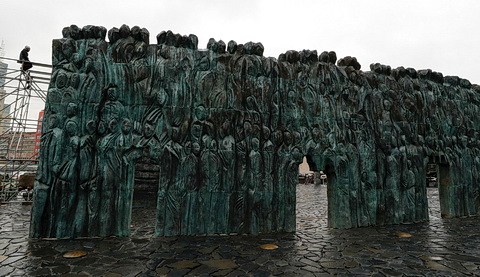
Photo: Russia. Moscow. The memorial to the memory of the victims of political repression "Wall of sorrow" of the sculptor Georgy Frankulyan at the intersection of Academician Sakharov Avenue and the Garden Ring. Mikhail Japaridze/TASS