
Translated material
Vlasovites: tragedy and wine
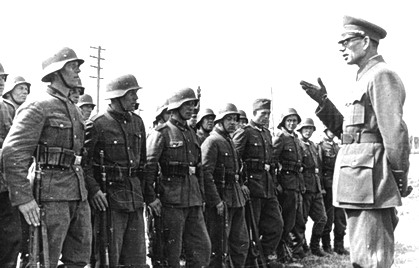
Disputes around Vlasov and the Russian Liberation Army (ROA) will be carried out for a long time. For most Russians, the Vlasovites as they were and remain traitors without any “but”. The minority is not so one. Some (very few of them) consider Vlasov and his associates heroes, others see the tragic figures of Soviet history in them.
To begin with, any attempts to shut up uncomfortable topics, including the “Vlasov”, are unacceptable, no matter what they are explained. Only an honest discussion with the participation of various points of view can dispel historical myths. In the same way, the use of double standards is unacceptable in historical discussions. An example is the “chewing” of the circumstances of the personal life of General Vlasov under the chaste silence of no less stormy circumstances of the biography of Marshal Zhukov. As well as completely unacceptable personal insults to ideological opponents and, even more so, their persecution, as is the case in the “Podrabinka case”.
The appeal to emotions, albeit the most righteous, does not contribute to approaching the truth - to evaluate historical events, not emotions, but facts are needed. And they are the following.
During their stay in power, the Bolsheviks unleashed terror against representatives of various social groups - from the "bourgeoisie" and the clergy to the wealthy peasantry. The Gulag system was unprecedented for the history of Russia, as well as the expulsion of a huge number of Russians of the so -called first wave of emigration. Therefore, a significant part of the population remaining in Russia did not consider the Bolshevik state to be its own. This is what pushed many into the ranks of the Vlasovites who hoped for the Germans as liberators. Talking about Nazism as an absolute evil was perceived by opponents of Soviet power as another propaganda, such as “social fascism”, in which quite respectable social democrats were accused of the Soviet Union.
The uprising against the repressive state can be recognized as fair, however, when assessing the specific situation of 1941-1942, many complex issues arise. To begin with, the people who opposed the Bolsheviks in alliance with the Germans were in the role of accomplices of the aggressor, whose intentions did not include the reconstruction of the Russian state on a democratic basis - it was about the destruction of Russia. Therefore, many anti -Stalinist Russians - both in exile and in the USSR - refrained from all cooperation with the Germans. The example of General Anton Denikin, who retained the strict rejection of Bolshevism (after the war, protested against the issuance of Vlasovites in the USSR, where they were waiting for death or camp), but remained a Russian patriot. Pavel Milyukov, shortly before his death, managed to rejoice at the defeat of the Paulus army near Stalingrad.
The position of General Mikhail Lukin, captured in October 1941, is also indicative - he commanded the troops detaining the German army near Vyazma (this delay played a large role in the next defeat of the Germans in the battle of Moscow). In captivity, the seriously wounded Lukin was amputated by the leg. Having recovered a little from the wound, he dramatically critically responded about the Stalinist government during the interrogation in December of the 41st, but then added: “You are talking about the liberation of the peoples. But we did not hear anything about the liberation of Ukraine or Belarus, captured by you, and we say that there will be no freedom for Russia either. This gives rise to resistance to the aggressor. Of course, the party apparatus and the Chekists are not friends, but the invading enemy is an aggressor, and it is necessary to fight with him. ” Despite this, Lukin raised the question of the possibility of creating an alternative Russian government, which "can become a new hope for the people." It was not about ambitious plans (it is ridiculous to assume them with a military leader chained to the hospital bed) - the fact of creating a government would become a signal that the Nazis did not want to destroy Russia as a state. However, such actions were not included in the plans of the Nazis who feared any forms of independence of Russian people. It is not surprising that later Lukin refused any cooperation with the Germans, despite numerous persuasion, including from General Vlasov.
As for Vlasov himself, he agreed to German conditions - participation in propaganda that decomposed Soviet troops - without any obligations from the Nazis. He signed leaflets on behalf of the “Russian Committee”, knowing very well that this body does not exist in reality. He urged a soldier to cross the front line and move under the beginning of this committee, although he himself did not have any power. Regardless of their intentions, Vlasov and Vlasovites were an instrument in the hands of the Nazis, who sought to weaken the enemy as much as possible and used any means for this.
Vlasov continued cooperation with the Nazis and after his propaganda tour of the occupied territories when he faced a ban on further performances. For the Nazis, an appeal to Russian patriotism was unacceptable, even emanating from a person who was in their service, and Vlasov tried to position himself as an equal partner of the Germans.
Is an analogy in this case with General Zeidlitz, who was engaged in anti -Nazi propaganda on the Soviet side? Especially if we take into account that the German authorities canceled the death sentence of the Nazis to this general, who, however, refused to become an agent of the NKVD and, after the end of the war, was sentenced to 25 years in prison (he returned only to Khrushchev times). Let us leave aside the question that Nazism was an absolute evil, and it was the recognition of this fact that caused the justification of the Zeidlitz. Let us pay attention to the key detail - the USSR did not even theoretically consider the issue of destroying Germany. Already in 1943, the National Committee “Free Germany” (NKSG) was created, which was supposed to become the prototype of the new German government, unlike the virtual “Russian Committee”. Zeidlitz became part of this organ - he had reason to see in his actions something more than only propaganda. NKSG figures actively used the factor of German patriotism - without any obstacles. Another thing is that after the war the committee was unnecessary for the unnecessary and only part of its members, or belonging to the Communist Party, or the most accommodating, were admitted to the authorities of the GDR. However, it was not easy to foresee such a development of events in the 43rd year.
Despite all this, having returned to Germany, Zeidlitz lived in moral isolation for recent decades - the colleagues have not forgiven him of the treason, and no court decisions could force them to reconsider this point of view. The heroes of anti -Nazi resistance enjoy great respect in modern Germany, but it never occurred to them to cooperate with foreign special services. This applies to the organization "White Rose" and to Stauffenberg.
Let's get back to the "Vlasov" topic. Only in the fall of 1944, when the Soviet troops were already fought in Poland and the Balkans, and the Anglo-American allies in France, the Nazis agreed to create the Committee for the Liberation of the Peoples of Russia (Conr), led by Vlasov and the formation of the Armed Forces of the Conr. Then they were ready to bet on anyone and give any promises - it was not about conquests, but about survival. In turn, Vlasov and their associates fought for life, understanding perfectly (there were many good military specialists among them) that Hitler’s game was lost, and after the war there will be a sad fate. The Vlasov "Prague Manifesto", filled with many words about freedom and democracy, was written by antitotalitarian intellectuals, but in practice it was primarily addressed to the United States and England, which the Vlasovites expected to be useful - especially having in their hands weapons issued by the Germans. The calculation was made in the conflict between the totalitarian USSR and Western democracies, during which the Vlasovites could be useful to the latter. They did not take into account one thing-the “Cold War” began not in May of the 45th, but a little later. And for most Americans and British, the Russians, who had a German uniform, were traitors who deserved contempt - hence the masses of not only the Vlasovites, but also part of the emigrants of the “first wave” immediately after the end of the war.
Cooperation with the Nazis often involved people in aiding their crimes. At the same time, one cannot deny the good intentions of many collaborators - however, as you know, it is they who are paved to hell. A journalist who got the opportunity to tell the truth about the Stalinist regime at the same time published articles about the “victorious German army”, “Great Fuhrer” and “World Jewry”. Sooner or later, the policeman was involved in participating in mass executions (even if he stood in a cordon and made sure that the victims would not run away). The intellectual, appointed by the Germans, the burgomaster of his city was supposed to engage in many useful things-from supplying the population with food (the Soviet authorities did not care how their citizens survived “under the German” in the winter of 1941-1942) before the opening of the temples. But at the same time, to do something else - for example, to participate in the creation of the ghetto, where the Jews were driven, and then to be able to eliminate this ghetto in the framework of the “final solution to the Jewish issue”. It was also necessary to inform the German authorities about all, suspected in relations with partisans, or about members of the partisans. The former burgomaster of Smolensk Boris Menshagin, a person internally strong, admitted in his declining years that 10 years out of 25 years in prison after the end of the war, he served for business. And this despite the fact that he himself did not directly participate in war crimes (if he had participated, he would have received the “highest measure” if not immediately after the war, then later, according to “newly discovered circumstances” - such cases) and tried to help fellow countrymen as far as possible.
Another thing is that it is necessary to clarify the definition of Russian collaboration. In the West, the collaborators include those who actively cooperate with the enemy, extracting from this, or acting from ideological reasons. It is ridiculous to attribute to this category of a teacher who simply performed his work and did not engage in ideological issues, or a priest who communed, professed and buried his parishioners, as well as engaged in missionary activities (for example, within the framework of the Pskov mission). The expansion understanding of collaborationism was characteristic of the Stalin regime, and its successors who retained the question of the occupied territory in the profiles. In modern Russia, it looks ridiculous.
As well as it is ridiculous not to pay attention to the heterogeneous nature of the Vlasov movement, some of which really was ideological in nature - it was far from limited to banal policemen, then enrolled in the “sharp -battalions”, and from there transferred to the first division of the ROA. Even in the trial over Vlasov and other figures of this movement, this topic “erupted”, despite the obvious reluctance of the court to affect it. General Malyshkin said that he conducted anti -Soviet activities by conviction, and the colonel (in the ROA - General) Myandrov spoke of his ideology, which caused a clear irritation of judges. General Trukhin mentioned his membership in the NTS, about his following the program when he was a participant in the Vlasov movement and that the Germans were not favored by this organization and it was in a semi -legal position. However, ideology does not exclude collaboration - the Second World War gave this mass of examples. The difference from Western Europe is that there, on the side of the Nazis, the ideological right -wing, hated liberal democracy appeared on the side of the Nazis. In the Totalitarian Soviet Union, on the contrary, the Vlasovites made a left -breeding position, and not only in the Prague Manifesto (which was mentioned above), but also in Malyshkin’s speech before emigrants in Paris in the summer of 1943, when the outcome of the war did not seem solved yet. However, in the conditions of the Third Reich, such an alternative was ephemeral. By the way, the performance of Malyshkin was perceived by the Germans very negatively-before the fall of the 44th they did not want to hear not only about Russian patriotism, but also about democracy.
How to relate to the modern justification of the Vlasovites in Russia, including in the texts of Fr. George Mitrofanov? Apparently, partly as a reaction to the spreading “non -stop”, the desire to return the former idols, to cynical discussions about the rationality of the Stalinist violence, to attempts to at least partially justify the crimes of the “leader of the peoples” and his minions. If Beria turns into an effective manager (and his crimes are “smeared”), and Molotov in a great diplomat, then why not become a true patriot, not understood by contemporaries? In part, the acquittal of pathos can be considered as an attempt to see in the Vlasov movement the continuation of the movement of white, also directed against Bolshevism. Although the whites in the fight against evil did not go to moral compromises - on the contrary, they were so realized that they did not even dare to recognize the independence of Finland, not to mention the possibility of joint actions with Petlyura. The cooperation of the whites with representatives of foreign states was based on the system of allied agreements concluded by the royal and temporary governments. As we see, this is very far from the political practice of the Vlasovites.
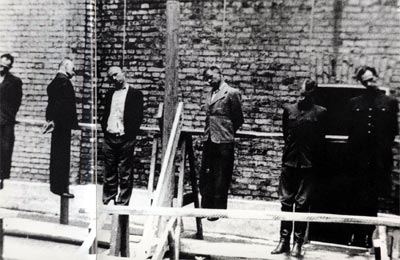
The defenders of the Vlasovites rightly pay attention to the tragedy of Russian people who are on the side of the Nazis. O. George is right when he says that “they went to fight against Stalin with those who were not very different from him both in their ideology and in their practice. It was a step of despair. " But I must say something else: the tragedy does not mean innocence, and despair in the Orthodox tradition is a sin. The gross violations of the principles of legal proceedings during the trial of Vlasov and his associates (the closed nature of the court, the deprivation of the defendants of the right to defense, etc.) do not cancel the fact that at least part of the charges against them were fair. Otherwise, on this basis, one can justify the same Beria in respect of which the same unfair practice was applied. The personal attractive qualities of individual collaborators (Menshagina or General Trukhin, about whom O. George was so respectfully spoke of) cannot be an excuse for the mistakes committed by them, or crimes in which they were directly or indirectly involved. Without understanding this, an attempt to an objective approach to the dramatic pages of Russian history is impossible.
Author-First Vice President of the Center for Political Technology