
Translated material
The departure of the super -minister
In the Kremlin
 The departure of the super -minister
September 27, 2011 Alexey Makarkin
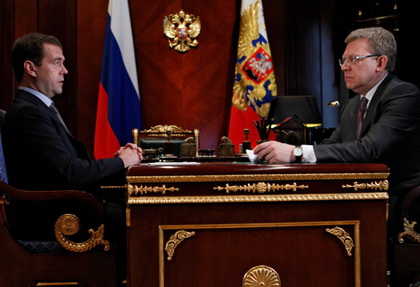
Alexey Kudrin resigned. One of the veterans of the Russian Cabinet of Ministers, Deputy Prime Minister and Minister of Finance said he did not intend to work in the future government of Dmitry Medvedev because of disagreements on economic issues. In response, Medvedev demanded that he either renounce his words, or resign until the evening. Kudrin appealed to his chief Vladimir Putin (according to the constitution to dismiss the minister, the prime minister is necessary), but he went to meet the president. The resignation took place; Whether Medvedev won is a big question.
Let's start with the circumstances of the already well -known statement of Kudrin made in Washington. The Minister recalled that decisions on defense order for the army, monetary allowance, pensions for military personnel and equipment of the defense complex of industry with new technologies in 2012 increase budget expenditures by about 1.3% of GDP. And taking into account the growth of these expenses in the coming years, in 2014, in comparison with the current, such an increase will be in the amount of 3% of GDP or 2.1 trillion rubles. In these conditions, not only the minister, but many experts are alarming. Given the expectation of the “second wave” of the crisis and the sad forecasts of the price situation for energy carriers, such generosity seems very risky.
The announcement of Kudrin on the resignation (as well as the circumstances of his express amendment to Medvedev) is unprecedented for Putin's Russia, where “sovereign people” (after the resignation of Alexander Voloshin in 2003) do not leave their posts voluntarily, but wait for the decision of the highest power. The minister’s statement is more consistent with the practice of the 1990s, when demonstrative departures in the Russian government were not a sensation. But then the officials went into politics - from Yavlinsky to the border General Nikolaev. The situation with Kudrin is somewhat different. He never claimed an electoral role, his economic views are divided by many experts, but unpopular in society. True, this spring he was seen for the role of the leader of the “right -handed” (along with Igor Shuvalov and Arkady Dvorkovich), but Kudrin, like other liberal officials, reasonably refused, realizing that the party’s prospects are extremely foggy. The experience of Mikhail Prokhorov showed the correctness of this decision.
What is the resignation of Kudrin? Immediately appeared the version that he was dissatisfied with the unsecured premiere. However, it does not look convincing enough. Kudrin really claimed the post of chairman of the government in 2004, when it became clear that Mikhail Kasyanov has been in this position of recent weeks. However, Putin preferred the little -known Mikhail Fradkov, whose candidacy was promoted by the “security forces” - and Kudrin was disciplined in the Cabinet of Ministers. Now, Kudrin’s claims were written in the media, but the contradictions of the Minister of Finance with influential elite groups (which in 2004 had not yet been) reduced the likelihood of such a choice. Putin Kudrin was needed in the government not as a “first person”, but as a strong minister, opposing supporters of increasing expenses, among whom there are both industry and corporate lobbyists and adherents of the speedy modernization of the economy.
It seems that a more serious argument explaining to Kudrin’s decision is a difficult relationship between the current president and Minister of Finance, which clearly manifested yesterday - but not only. Even on May 2009, at a meeting with businessmen in Barvikh, Medvedev unexpectedly invited Kudrin to change his work if the official continues to make frightening forecasts about the Russian economy. In December of the same year, Medvedev subjected the Minister of Finance personal criticism, considering that Kudrin at a meeting of the State Council offended the head of Vnesheconombank Vladimir Dmitriev.
After these stories, the president did not directly criticize the minister. However, Medvedev’s statement made in an interview with The Financial Times is noteworthy on June 20 of this year. Then the president said that “the beautiful leader of the“ right ”party would come out of Alexei Kudrin, and in vain he refuses. I believe that it would be good for the country. ” Outwardly, such a review looked complimentary, but not everything is so simple. The transition to the post of leader of the party with obscure prospects threatened Kudrin with great problems in the government if the “right” did not go to parliament - this would be a strong reputation blow to the positions of the minister. In fact, according to the results of the elections, he could be supplanted from the Cabinet of Ministers. By the way, the refusal to lead the right Medvedev reproached Kudrin yesterday.
However, apparently, the main reason for Kudrin’s departure is the essential problems, which he stated in his interview. Previously, he also made quite sharp statements. So on September 13 of this year, he said that after the election of the president of the country, the updated government will return to economic reforms and will be forced to increase taxes if he does not abandon part of the pre -election obligations. Thus, the minister formulated a clear alternative facing Russia - either tax increased, or reduction of expenses. This is a politically extremely unpleasant choice, but not as dramatic as that of Greece or Portugal, which, in the context of a debt crisis, have to simultaneously increase taxes and reduce expenses. Kudrin also admitted that he personally would not be bored with transformations in any position - which was regarded as claims for premierness (although the desire to remain a minister could mean, retaining his political influence), at the same time he noted that “if there are no active transformations, then yes, it will be less interesting.”
At the plenary session of the State Duma on September 21, Kudrin again stated that the authorities would have to choose from two evils in the near future - either to increase the age bar for the retirement of Russians or compensate for the missing funds by raising taxes. The head of the Ministry of Finance said that over the past couple of years, the retirement age has been increased in a dozen countries, including neighboring Ukraine. This is fair, but the decision on the retirement age - coupled with a number of other unpopular actions - led to a sharp fall in the rating of Viktor Yanukovych. Therefore, the reduction in socially significant expenses and radical pension reform are associated with significant political risks for the Russian government - it is not surprising that she would like to avoid such a scenario in every way. But the increase in taxes is not considered as an optimal measure - Putin skeptically responded about such an opportunity, responding to Kudrin's statement made on September 13.
The announcement that Medvedev will lead the government could be regarded by Kudrin as a negative reaction to his proposals, an attempt to “bypass” the dilemma put forward by him. Kudrin has long been disagreements with the assistant to the President Arkady Dvorkovich, who is an ideologist of the economic policy aimed at creating more favorable business conditions - and, therefore, leading to the emergence of new falling revenues in the budget. At the same time, with the premiere of Medvedev, Kudrin would be more difficult to appeal to the president than with the “family” Kasyanov or the politically weak Fradkov. In addition, Putin is currently supported by Putin (in particular, the prime minister in public space actively promotes the idea of re -equipment of the army). The Congress of United Russia and the prime minister and the president accepted on it as a pre -election program only exacerbate the problem of the growth of government departments, which could not arrange Kudrin and, apparently (along with Medvedev’s candidate), stimulated his demarche.
In turn, Medvedev was faced with a choice - either silent or counterattack. In the first case, he could bear reputation damage. In the second-to encounter Putin, who did not see anything ineffective in the Kudrinsky statement, as evidenced by the Sunday statement of the Putin spokesman Dmitry Peskov, which was very favorable in his regard. Medvedev decided on a counterattack, forcing Kudrin to immediate resignation. Why didn't Putin stand up for him? Firstly, it was already about several months of Kudrin’s stay at a ministerial post. Secondly-and this is the main thing-Putin’s persistence could lead to a political crisis, unambiguously unprofitable “United Russia”, at the head of the election list of which Medvedev is located. Presidential discrediting would damage the party’s rating, in the success of which not only Medvedev, but also Putin is interested in the election.
However, the decision to resign Kudrin can create serious problems for the president - not now, but somewhat later, in May next year, when he himself will have to form the cabinet under the command of Putin, who returned to the Kremlin. Then Medvedev may already face the problem of coordination with the president of his candidates for ministerial posts. It is clear that, going to the government, the current president believes to receive, if not card blanche, then at least significant opportunities in the formation of the office, which he is now deprived (Kudrin is the first minister, dismissed at his request). Now such opportunities may decrease.
Kudrin can now continue his career in various fields - from business to teaching (he came from the scientific environment for the civil service in 1990). In any case, he will remain in the Russian establishment (after all, he was not quarreling with Putin, which is fraught with much more negative consequences than ordinary resignation). In the future, it is possible to return to the ranks of “sovereign people” - for example, to the post of head of the Central Bank, which belongs to the presidential nomenclature. However, in the coming months, Kudrin can become the object of election criticism from United Russia, especially since the party has a long -term relationship with him. However, he is not used to it - it is more important that government failures will now not write off on him.
And after the presidential election, the Medvedev government - immediately or with some temporary lag - will have to be allowed to resolve the dilemma proposed by Kudrin. If with delay, then in a different, even more difficult situation than now.
Author - First Vice President of the Center for Political Technology
Photo by RIA Novosti