
Translated material
The face is like a manifesto
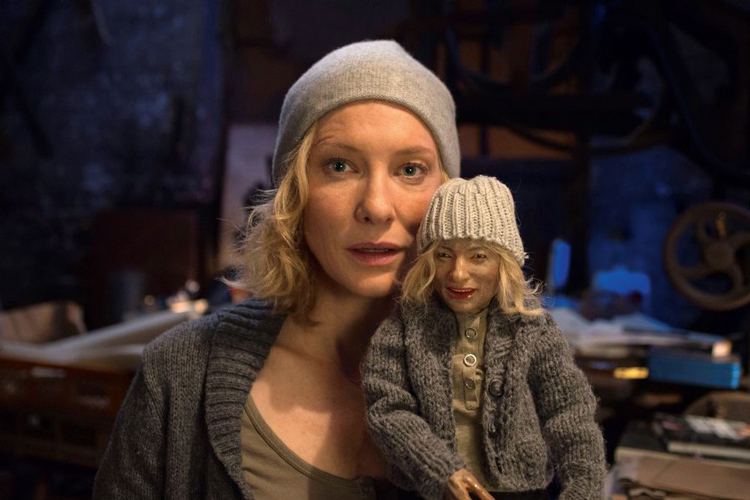
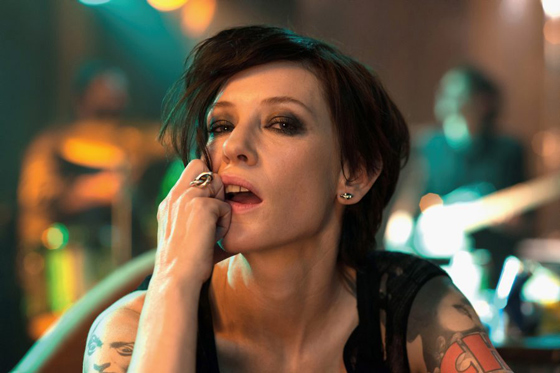
The film version of Juliana Rosephald Manifest is released in the rental, in which Kate Blanchett reads the programmatic manifestos of revolutionaries of all varieties, from Marx and Marinette to Trier with Winterberg. However, the main attraction of the picture is not a kaleidoscope of concepts and statements, but the face of the Australian actress, the only performer of all roles.
Recently, a column on the new cinematographic cult appeared on the Wared website, capable of standing on a par with the “horror of the horror of Rocky Horror” - a parody musical that has been going on for forty years and has an indestructible army of fans. We are talking about Carol, Todd Hinse, staged according to the early story of Patricia Haysmit “The price of salt”.
In his column, the Wired journalist reports that for Carol a much longer fan art loop stretches on the Internet than any other picture of the same caliber. In New York, the Metograph Cinema has been spinning a film on endless repeat with unchanged Angollays for many months, fans celebrate on April 17-the day of the final reunification of heroines-and gather in the clubs of the obsessed ones, about one of which was recently shot “Carol Support Group” .
It's nice to know from the international press that you are not alone in your illness. It is also interesting to observe how in the situation of total cultural gusts, scattered brigbling pictures and phenomena, a Wow effect with immediate oblivion, phenomena and phenomena that confront the course that are tightly consolidated in a variety of media, from Tumblr to logos on T -shirts like Flung Out of Space (phrase from the film, speech fragment Carol in love addressed to the heroine of Runi Mary.
 © Australian Center for the Moving Image
At one time, the book Haysmit became a revelation, parted with a million circulation and caused a flurry of grateful letters to the publisher. This was the first work of American literature in which homosexual characters were not punished by the author, but gained a semblance of happiness. And in the film, Hinse is amazing at the first approximation, dumbfounds a happy ending that is not foreshadowed by anything: despite the age difference and position, Teresa and Carol decide to try again. But among the fans of the film are people of different sexes and gender, and not every of the good paintings of interested audience revise hundreds of times, as in the case of Carol.
Haines's film is a utopia overturned in the plush the day before yesterday, and despite the difficult circumstances of the heroines, it has a unique sedative effect. One nostalgia, however, is not enough for the emergence of a cult - otherwise from where so much dead retro would get? The point is not only in the reconstruction of the analogue world by means of the analogue world (the film was shot on a film in the Super -16 format in order to closely close the image to the contrasting fine -grained EKTachRome slides, which were often used by photorepectors in the 1950s). The point is in music and in the temporite, the director’s ability to create an external space outside the physical world that you want to return to. This film is a sealed glass ball with falling snowflakes (the name of the title heroine refers to the Christmas anthem, the acquaintance of the two women occurs on the eve of the New Year). The embodied New Year's wishes, which is never embodied in reality: "Everything will always happen, everything always comes true."
 © Australian Center for the Moving Image
Once, filming the “talented Mr. Ripley” by the same Haismit, Anthony Mingella turned her heroes, American golden youth from the Amalfitan coast, from artists to musicians. This made it possible to get rid of non -engineering paintings in the frame and build a movie according to the laws of jazz improvisation: Tom Ripley loves measured classics, but he acts as situational and jerking. Hines does a similar operation: in the book, Teresa dreams of becoming a theater artist, she takes pictures in the film. Peeping through the camera behind a new object becomes a form of initiation for the girl’s timid, a way to see and see the world - first through the mediation of optics, and then with the naked eye. “Carol” is a film about how a vision turns into a look, the reception is into penetration. Can the director make a greater compliment to his audience, consisting of the Sinefilians-Woeiereists?
But there is another reason for the infinite attractiveness of this picture - the face of Kate Blanchett; The column in Wired begins with the journalist’s story about how she looked at the cheekbones of the actress for two hours and was unable to resist hypnosis.
Fifteen years ago, there were speculations in fashion about the capture of the industry with virtual stars that do not roll up a tantrum and did not require an increase in the fee. The capture did not happen that it serves some comforting argument in severe thoughts about the role of a person in a robotic world. It turned out that people still love to look at people, and this would not be possible to cancel. It can be assumed that the public is interesting when scandals and novels are attached to celebrities: after all, nothing similar happens to digital clots. But Blanchett has never even divorced, from morning till night she plays in her husband’s performances and is not involved in literally anything except that she named one of the three sons born in a legal marriage in honor of Dazhyl Hammet.
 © Australian Center for the Moving Image
However, in the anecdotic “you just go, go,” much more sense than it might seem. Blanchett is an example of how significant the presence in the world of an individual person, whose appearance and manner of behavior (and not at all roles and deeds) can hypnotize millions of observers. With age, the relief of her face was only more complicated, and she began to resemble an Egyptian statue - an image accompanying us from birth, that is, present in culture as if always. Last year, Terrence Malik voiced Blanchett's Travel Blanchett - no less than a biography of planet Earth. Blanchett’s stay like time brackets, outside the momentary - one of the reasons for the attractiveness of the film "Carol".
One of the first large films of the actress, Elizabeth, Shekhara Kapoor, ends with a demonstrative transformation of the naive red-haired princess into a famous whitened mask, a queen-girl. The directors, having got Blanchett, experience an indefatigable need to do something with her face. Beliles, turn into male (as in a strange baiopic of Bob Dylan of the same Heinns), change a wig, disfigure tears, transform into something else.
The most radical deconstruction, the face of Blanchett is subjected to Massive Attack “The Spoils” in last year's video. Within six minutes, it is adjusted by computer surgery, loses its eyes, skin, exposes the facial muscles, bones of the skull, turns into a mask, into a visual obstacle, into a hollow object, into a doll, into a paleolithic venuver.
 © Australian Center for the Moving Image
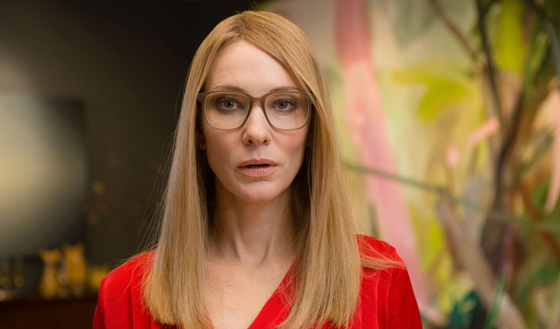
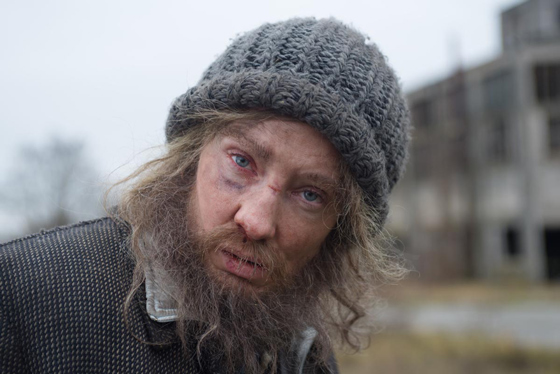
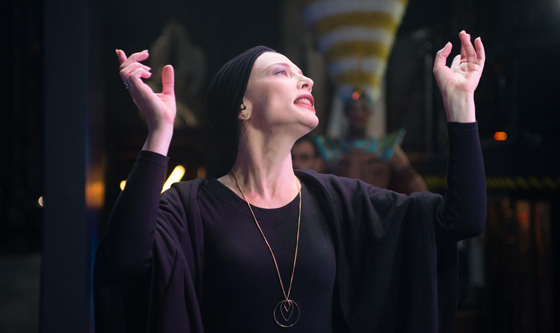
The same need for the study of this person pushed the German artist Julian Rosefeld to create an art project “Manifesto”-installation, which was exhibited and continues to exhibit in different cities of the world. 13 large screens, 13 mini-films, in which he hanging over the viewer, differently, but unchanged Kate Blanchett (homeless, caricature on Pina Bausch, widow at the funeral, the hostess of the family, the TV star , the factory worker ETC. ) Reads the whole or fragments of well-known manifestos.
The screen version that goes into our rental seems to be a thorough, but flat synopsis of the exhibition, and it is not easy to withstand it - if only because the text comes out of the museum space in the first place, and the manifestos are usually written “for” as “contrary” and most of the words pronounced loses the pathos outside the historical context and the spaces of struggle, turning into a comedy (manifesto (manifesto The Communist Party Blanchett, for example, reads the lonely baboin on the ruins of a factory). It is important, however, another: it is obvious that not only the directors, but also Blanchett herself is in the need for the deconstruction of her own cult and her own person. In each of the episodes (not only where she is a bearded tramp) the actress is emphasized by ugly, and sometimes really creepy. Her own real family - the husband of Andrew Apton and three sons - we see in an atmosphere of the Puritan house, decorated with scarecrow of animals. All five are sitting to pray before dinner. A prayer becomes pronounced with the outer religiosity of “I am for an art” by the sculptor of the class of Oldenburg - a work that the author himself ironically called the “literary attempt”. Despite the restrained humor of the situation, the personal silent manifesto of Blanchett, whose appearance belongs to the whole world, breaks through the dead letters: “Look! There is nothing more boring than my life, there is nothing worse than my face. ”