
Translated material
Facebook to the poor
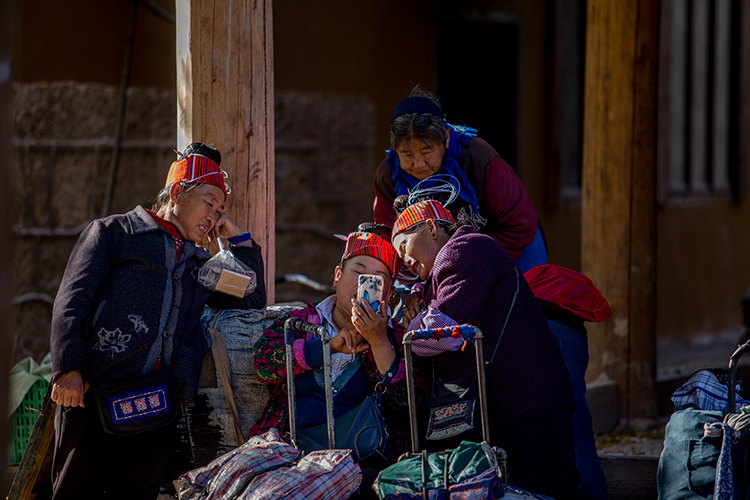
How many people know the password from your account on the social network? In Chinese villages, 83 percent of users inform him to loved ones. The password is not customary to keep secret from his wife or husband, brother and even friends. In the Indian rural areas (in the state of Tamil-Nadu, not far from Chennai), the numbers are close-73 percent. It is seductive to think that this is such a distinctive feature of Asian collectivist thinking that does not recognize any priest, but also 28 percent of people who are not inclined to secretly find out of London. True, in the English village, unlike Chinese or Indian, almost exclusive (in three cases out of four) the right to know your password remains with the partner-so that he has the opportunity to trace if you are flirting with someone in personal messages.
Who We Post is a project of anthropologists from the University College of London ( UCL ) about the behavior of people of different cultures in social networks designed for five years. At the end of February, they launched a site with gigabytes of tables and videos and even a mass online course -five weeks of lectures and homework, anyone can sign up-dedicated to the entire results of the project. Nine groups have been engaged in field research at nine points of the planet for the past year and a half: small cities and villages in southern Italy and south of India, near London and Chile, in Brazil, on the Caribbean island of Trinidad and the Syrian-Turkish border were included in the list. China is represented by whole two points: a village in the north of the country and an industrial city in the south, as it turned out, live in social networks of a completely unlike life.
In the English village, the right to know your password in three cases out of four remains with a partner-so that he has the opportunity to trace whether you are flirting with someone in personal messages.
The word “ we ” (“we”) in the name of the project is used not without crawling: the audience of anthropologists and those who are being examined are still very, very different people. But even if you read on Facebook some of Mikhail Yampolsky with the glory of Zizhek and your Fredena has nothing to do with the Frendalend of the miners in the south of Chile - this study will at least help to understand who six new buttons with faces instead of one classic husky have been invented.
It can easily turn out that for commenting on Yampolsky with a slurry from new likes is a good thing. Anthropologists know well: if some practice is perceived as a stranger, and its creators did not mean you at all-not the fact that in your culture there is no new rethought function for it. Selfies invented for teenagers? Most likely, it is. But for Burmese monks, this is an obligatory element of pilgrimage to the next statue of the Buddha. And online stores with delivery are popular with the poor in the Indian state of Tamil-NADA, not because they can save time, but because making purchases in a real store for an Indian from a lower caste is a chance to encounter rudeness from sellers and other buyers.
A caste system where buyers of online stores organically fit in is not the only example of how the Internet strengthens the archaic, which it seems to be loosened. Is the social networks not the space of open communication, the way to overcome the boundaries and the means of spreading non -certificate information? First of all, anthropologists prove, they help maintain the status quo and smooth out sharp corners. Therefore, one of the 11 books that are going to print according to the results of the project (three are already written and posted in the full -text version) is called “how the world has changed social media” - as opposed to the much more popular idea, which, on the contrary, social media change the world.
It is beneficial for the employer that you read social networks at the workplace: it reconciles with work, especially boring and monotonous, and extinguishes the impulse to look for a new one.
If miners in Chile for months do not see families - Facebook allows them to maintain communication with their wives and plan in absentia how children will celebrate their birthday. One of the paradoxical observations applies to social networks at work. The Russian Public Chamber was offered to legally ban VKontakte and Facebook during working hours, but if the author of this idea talked with the authors of the study, he would have learned that he was going to ruin life first of all to employers. If the work is boring and monotonous, like Chinese guards and sellers in unpopular stores, social networks help to put up with it and not look for another. And if your company has grown sharply and has stopped being a cozy team of 10 people, where everyone goes to visit each other on weekends, then Facebook helps to maintain the illusion that you are still “one family”, this researchers were especially often recognized in the south of England.
Along the way, the authors deal with most prejudices about social networks that any primary school teacher and any State Duma deputy, preoccupied with the morality of the younger generation, will give out a list. Do social networks interfere with learning? Not true, social networks are study. If you get to a school from a mountain village, where it is bad with local transport, then social networks are generally the only way to discuss homework with classmates. And if you are a British parent, then it is easier for teachers to discuss with you the problems of children in a specially created group than to call on parent meetings. Social networks are for hipsters that make applications with geolocation, and they have nothing to do with simple small businesses? It is not true, in Chinese villages, chicken eggs and living chickens are sold to each other through WeChat and QQ , a local alternative to all social networks at once.
This in itself does not mean that social networks make us better or worse - rather, we force them to adapt to our habits, needs and cognitive mistakes. And, looking at how Facebook changes under this pressure, we can finally understand something about humanity as a whole.