
Translated material
The game of armor
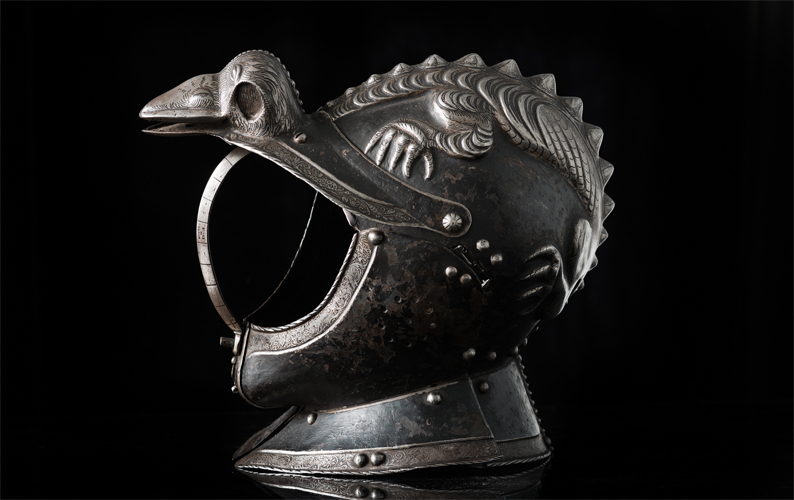
On June 16, the Royal Games exhibition opens in Moscow, at which Western European weapons and armor of the period of the XVI -XVII centuries from the collection of the State Historical Museum will be represented. Fedor Panfilov, a medical historian and weapherman, explains why they should be seen even by those who are completely not interested in the armament of the Middle Ages and the early New Age.
The Flemish from Antwerp in the middle of the 16th century receives a special order from the Swedish king. He coordinates the iconographic program with the customer - it was decided to include scenes from myths about three and the exploits of Hercules. A carefully thought -out choice should reflect all the advantages of the monarch, create his heroic image. After all, Hercules in the ideas of the late Middle Ages and the Renaissance are not so much the embodiment of power as the allegory of virtue, triumphant over vices and low passions. Despite the scale and complexity of work, the master successfully copes with it. Only now his work is not destined to get to the customer. The hostile Sweden Danes capture the ship heading to Stockholm. Eric XIV unsuccessfully tries to rescue the master and his work. As a result, the Flemish remains at the court of the Danish king for many years, and his creation, having changed several owners, goes to the Saxon Elector and is currently in the Dresden Museum. Agree - if the heading of the article was not said about armor, then you would most likely think that we are talking about a picture, a tapestry or sculpture. The only difference is that for the Swedish king, ceremonial armor in both direct and figuratively had more value than a ceremonial portrait made on canvas or marble.
Nowadays, the armor, of course, is not so often perceived as a work of art. But the image of the knight in a complete lance armor has taken root so much in mass culture that it became almost a visiting card of visual medianism, ideas about the Middle Ages. The languid paintings of the pre -Raphaelites and countless computer games, cartoons and television series, Hollywood blockbusters and enthusiastic brawls of reconstructors - he dlays with a hare and accepts heroic poses everywhere. Artists, inventing quasi -star or semi -fantastic armor, most often turn to the front armor of the XVI -XVII centuries. Here, to be honest, you don’t need to invent anything. The mannerist armor of this time, decorated with a gold and silver notch, can give odds to the most daring fantasies of a modern designer. In popularity, more ascetic in the decor, but magnificent Gothic and Maximilian armor compete with them. Sometimes experts directly draw parallels between historical and fictional armor - for example, in the Paris Museum of the Army found prototypes of armor from the popular series “Game of Thrones” .
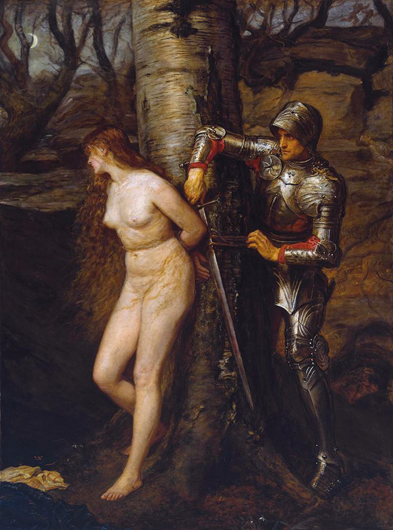 © Tate Britain, London John Everett Mille. The wandering knight. 1870
When such things find themselves in the space of the exhibition hall, they always attract the attention of visitors. Another thing is that this attention can be quite superficial. Run among mannequins, laugh at the grotesque helmet or wide lance “boots” with sabatons, read a couple of explications on the signs and immediately forget them-it's okay, the business is everyday. True, in this case, a multiple viewer deprives himself of a fair amount of pleasure. The exhibition becomes a truly interesting exhibition, if you remember that before you are not just well-processed pieces of metal, not cloned plate idols and not even “wonderful monuments of decorative and applied art”. The armor has its own living story, which does not come down to the typology of protective weapons, the change of artistic styles and the evolution of production techniques. To begin with, it is worthwhile to figure out where the tradition of collecting and studying came from.
In the 16th century, which can be called the golden age of Western European arms art, armor played a crucial role in the arsenals of rulers and smaller private collections. But already in the 17th century, the collections of armor, even belonging to the monarchs and nobility, often had a hard time. They were completely desolate, sold out, and sometimes simply went to scrap. About the same state in Western Europe was knowledge about the protective weapons of previous centuries. Even if someone was interested in the armor, they usually found themselves in the assembly of Dicky among stuffed animals, statues and fossils. Only in the next century, the state of affairs began to change simultaneously with the revival of interest in the Middle Ages.
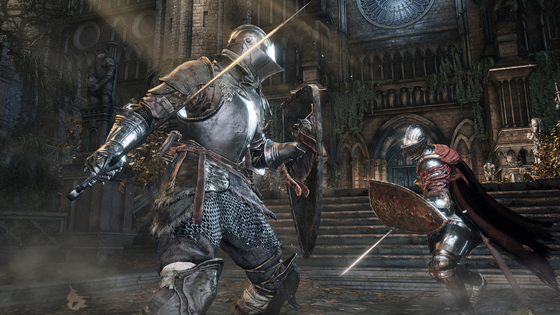 © Bandai Namco Entertainment Screenshot from the game Dark Souls III (2016)
Even before the birth of Sir Walter Scott, in 1764, Count Horace Walpol published the “Otranto Castle” - as it is believed, the first Gothic novel. At the same time, Walpol at first issued the plot of the “Otranto Castle” for a real medieval tradition, which brought the novel a great success. When the count nevertheless recognized his authorship, critics reacted to this without delight, but the matter has already been done. By the beginning of the 19th century, the new genre was as popular among readers as Neogotiks - among customers of mansions and churches. The same Walpol built himself a cozy Gothic (in his view) castle, which gave the name to the new architectural direction,-Straberry-Hill. The ideal medieval dwelling of Walpol would not be perfect without knightly armor, shields and swords. Therefore, in 1753, a special room designed for a collection of weapons appeared in Strogerry Hill. Of course, the author of the Otranto Castle saw in armor and weapons primarily artifacts of his beloved era, another means of reconstructing the atmosphere of the Middle Ages.
In the 19th century, the Middle Ages finally came into fashion. Half armor have become tidy objects for collectors. Soon was a wave of copies and fakes, sometimes very high quality. The Napoleonic wars distributed many ancient weapons in Europe, filling the antique market with armor. This was the origin of the fair part of the collection of Sir Samuel Rush Meyric, another British lover of the Middle Ages. Meyric was one of the first to try not only to collect armor, but also to study them. His “critical research in the field of ancient armor”, published in 1824, covered the period from the Norman conquest to the reign of Charles II Stuart. Like Walpol, Meyric was the owner of a neo -Gothic castle, where his collection of armor was located.
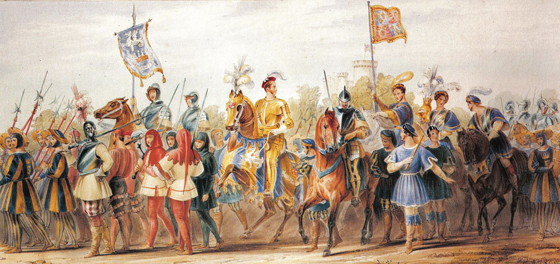 © Roger Griffith / Wikimedia Commons James Henry Nixon. Tournament in Eglinton Castle. 1839
The already mentioned Sir Walter Scott, one of the most famous writers - the popularizers of the Middle Ages, of course, also started his own weapons room since 1813. Please note that all the mentioned collections of weapons were not historical, passing from generation to generation. Passionate collectors who created them did not belong to aristocratic childbirth. Walter Scott is the son of a wealthy lawyer, Meyrik-a lawyer, Walpol, although he was a son of a powerful politician, came from a petty jentie nobility.
The colossal interest in the Middle Ages was not limited to the construction of neo -Gothic mansions with the arms chambers and the publication of novels about knights. Enthusiasts literally wanted to feel like knights and break spears in tournaments in honor of beautiful ladies. Like modern reconstructors, they wanted a realistic reconstruction of the past. Another thing is that this past was perceived through the romantic prism of the Gothic revival of the 19th century. Perhaps the largest games in knights were arranged in 1839 by Lord Eglinton. The armor of the fighting and their retinue was the same mixing of times and styles as the armor of the characters from computer games. All this looked very magnificent and “medieval” and the modern viewer probably would like no less than that time. In truth, Eglinton’s tournament almost ruined his organizer. But he became truly international, gathering in Scotland participants from all over Europe-including an honorary guest, nephew of Napoleon I, in the future of the emperor of France Napoleon III.
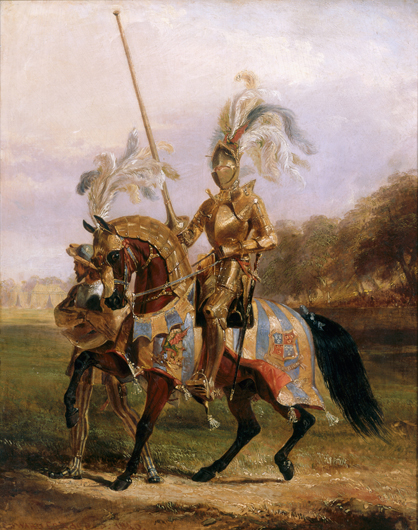 © Victoria and Albert Museum, London Edward Henry Corbound. Lord Eglinton in the costume of the Lord of the Tournament. OK. 1840
Having become the emperor in 1852, Napoleon III - the great lover of armor and weapons - brought closer to himself a group of weapons collectors. These included Eugene Emmanuel Violle-le-Duk, known to us primarily as the famous architect and ideologist of neo-Gotics, but also a fortification specialist and expert in military history. The largest private collections of the second half of the XIX - early XX centuries subsequently made up an important part of museum meetings. For example, the Jorge Polesk collection became part of the Army Museum in Paris, and William Riggs gave his collection of weapons to the New York Museum of the Metro.
The Russian Empire in the XVIII -XIX centuries did not remain aloof from the game in the Middle Ages, who had fascinated Europe. Not without Russian Gothic (having even less in common with the Western Middle Ages than the European Neogotik), the Russian Gothic novel - from Nikolai Karamzin to A.K. Tolstoy - and, of course, without collecting weapons. Knightly armor with the same enthusiasm was collected by emperors and representatives of the Russian aristocracy. The modern meeting of Western European weapons and the armor of the Hermitage, for example, includes both the Imperial Assembly from the Tsarskoye Selo Arsenal and things from private collections, including from the richest collection of Counts of Sheremetevs. The best weapons of this period were museum employees - for example, E.E. Lenz (1856-1919) in the Hermitage or assistant director of the Moscow arms chamber L.P. Yakovlev (1829-187?). True, now the historian P.P. von Winkler (1866 - c. 1937). His book “Weapons. The guide to the history, description and image of hand weapons from ancient times to the beginning of the 19th century ”has been repeatedly reprinted over the past 25 years, although it has already been hopelessly outdated in many respects.
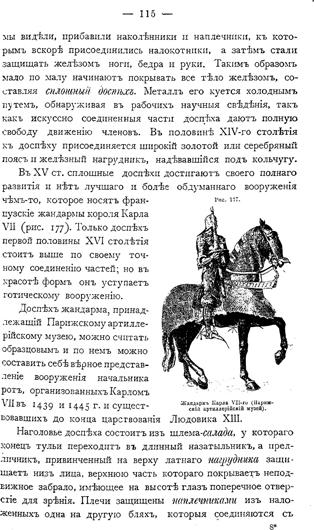 Page from the book P.P. von Winkler "Weapon. The guide to the history, description and image of on -scientific weapons from ancient times to the beginning of the 19th century. ” SPb., 1894
One could still talk about collecting and studying medieval weapons and armor throughout the 20th century. For example, about the use of medieval helmets for the development of helmets of the German and American armies of the First World War - some options practically copied their historical prototypes. But, it seems to me, it was the Gothic revival of the 19th century, with all the fantastic of his ideas about the Middle Ages, that laid the foundations of further serious collecting and the study of armor and weapons. It also created that romantic image of the Middle Ages, which now continues to fuel the genre of “high fantasy” and popular ideas about gallant knights in shining armor. In paradoxically, this ideal Middle Ages gets along with an equally popular idea of the Middle Ages as a wild and lag in time, complete obscurantism and monstrous cruelty. I already wrote about their coexistence in an article on the images of the Middle Ages in the cinema and television series .
Without delving further into the history of the preservation and study of armor and weapons, I only note that the fate of the arms assemblies has never been easy and serene. This was expressed not only in the sale or expropriation of collections in favor of the state. The military operations were of great importance for their fate - from the long -term wars of the early new time to the Second World War. It is enough to recall the fate of the helmet of the Russian Tsar Ivan the Terrible (John IV Vasilyevich), who is now in the royal arms chamber in Stockholm. Most likely, he was captured by the Poles in Moscow during the Time of Troubles. And half a century later, during the “Swedish flood” (the invasion of the Swedes in the Commonwealth in 1655-1660) was taken from Warsaw to Sweden.
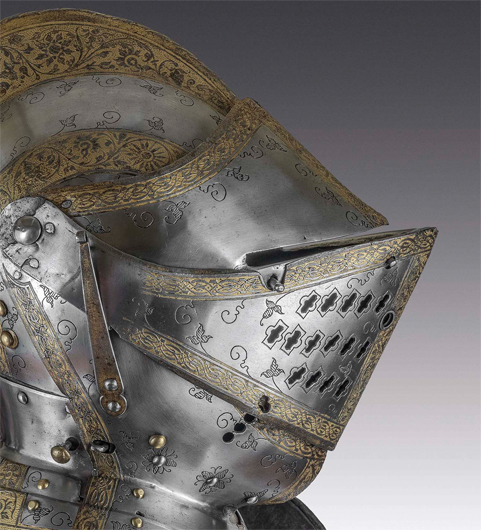 © State Historical Museum Master Jorg Zoyisenhofer, artist Degen Pirger. Field and tournament set, belonging to Francis I, King of France. The Holy Roman Empire of the German nation, Austria, Tyrol, Innsbruck. 1539-1540 years. Steel, leather; forging, gourmet, etching, engraving, gold aim
Weapons and knightly armor, which will be presented at the exhibition in the historical museum, are mostly also related to military trophies. Many of them entered in 1946 from the Berlin Ceikhgauz as objects of compensatory restoration. It is not surprising that these are mainly the work of masters from the Holy Roman Empire of the German nation and the possessions of the Habsburgs - court gunsmiths of the Gabsburg court, princely courts of Dresden and Braunschweig, masters from Augsburg and Nuremberg. Moreover, we are not talking about faceless things, but about weapons and armor of specific historical characters-the Duke of Legery and Bzheg Frederick II, Archbishop Albrecht Brandenburg, Elector of Brandenburg II Hector, Duke Brown-Werlefenbutta Julia and others. A special exhibit is the armor of the French king Francis I, donated to him by Emperor Charles V. One of the brightest monarchs of the 16th century, who was competing with Henry VIII Tudor in creating the image of the King of the Rishman during a meeting on the field of golden brocade , a nashed giant with a slightly crafty look with a portrait of Jean Club. The creators of the exhibition, judging by its name and concept, decided to connect the exhibits with the practice of their existence - the court ceremonial, tournaments and hunting. In a word, the armor and weapons presented are a means of representing power, and personal things of historical characters, and very good samples of weapons art.
The main argument in favor of visiting the Royal Games is the fact of the exhibition. The fact is that the whole collection of Western European weapons and armor is exhibited for the first time in 60 years. In the meetings of many world museums, thousands of objects are never exhibited due to a banal absence of space, time and means, poor knowledge, political conjuncture, considerations of safety and many other reasons. In addition, in order to prepare for the exhibition a large group of never exhibited objects of the XVI -XVII centuries, you need to do a tremendous work. Therefore, in any large museum there are things that seem to exist, but in reality they are not: after all, no one except the keepers has the opportunity to see them. “Royal Games” provide just such an opportunity - and this is a rare chance that should not be missed.