
Translated material
We will free the president from garbage
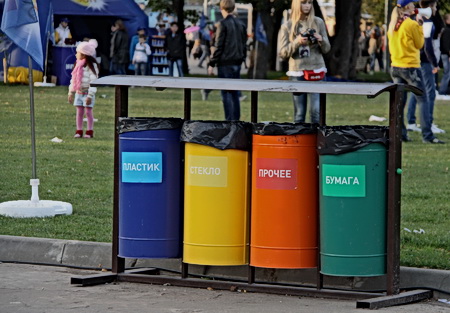
In early April, the acting Governor of the Moscow Region Andrei Vorobyov asked the president to give an order to the Government of the Russian Federation on the closure of 24 out of 39 landfills of solid household waste (MSW) located in the territory of the region entrusted to him. It turns out that it is the federal authorities that are licensing garbage dumps. However, why in a country with a federal device to solve these issues in the center is a separate issue.
With his initiative, the head of the region seriously saved up the bridges and did not leave the way to retreat. However, firstly, this was one of his main election promises given in the program “Our Moscow Region: Development Priorities of 2013-2015”; Secondly, rising in all directions, like a pot of pan, garbage doughs cause fair indignation of citizens, resetting in some cases the market value of their suburban real estate, and something needs to be done.
Here are a few digits.
The area of the Moscow region is 0.27% of the area of the Russian Federation, while it houses 20% of all waste formed in the country. It looks like this in numbers: About 10 million tons of household and industrial waste arrives annually to the territory of the Moscow Region, and about 150 million tons have already been accumulated. Currently, 39 training grounds with a total area of 700 hectares are operating in the region. Until the end of 2013, 24 are subject to closing from them, due to the fact that their resource has been exhausted.
As they say, there is something to grab behind the head. At the beginning of the year, the main reason, which was not allowed to ensure the vital economic growth of the country in 5% of GDP, was recognized as infrastructure restrictions. So, the problem of garbage, along with transport, is the main restriction that impedes the development of the Moscow Region.
Of course, at the modern level, this old -made problem can only be created by the creation of a high -tech industry for waste processing both in the region and in the territory of neighboring regions. Such a program is being prepared, but this requires time and serious financial sources. And the problems of garbage grow daily.
In response to the appeal of the acting governor Vorobyov, the president instructed, including holding a number of events to resolve this topical issue. On May 20, I took part in one of them - an exit All -Russian meeting on the disposal of dangerous industrial and household waste. A very representative meeting with the participation of the President of the Central Federal District President Alexander Beglov, the head of the Moscow Region Andrei Vorobyov, the head of Rosprirodnadzor Vladimir Kirillov and a number of officials and generals.
Observing the course of a 2-hour discussion, I involuntarily recalled the director of my state farm, from whom I started the work by the chief agronomist 30 years ago. He, under the portrait of Lenin, hung an unpretentious slogan: “He who wants to do business is looking for ways. Whoever wants nothing is looking for reasons. ” The entire course of the discussion of this high forum could be marked with this short formula.
The governor was energetically pushed for officials, offering them the methods and options for solving the garbage theme. Servant people preferred to come up with different reasons why this task for them is unresolved. In the end, the usually restrained and even cold -blooded Andrei Yuryevich exploded: “Is it for you, a flight to Mars? Let's make a step by step, ”he exclaimed irritably, turning to the main police officer General Golovkin, and to the head of Rosprirodnadzor Kirillov, and to other participants in the meeting.
I absolutely agree with the governor. Let's try to reflect on this topic consistently.
As an economic fundamentalist, I want to say that it can be solved by translating it into the plane of personal interests of people. This is again about the "egoism" of citizens. Deep, intercourse interests that are to be directed in the state direction.
I'll start with industrial waste - this is about 6 million tons per year. Basically, this number includes the production of land during the construction of metro and buildings. They need to be stored somewhere, but, as a rule, they are environmentally friendly.
But among them there are others. For example, only old tires in the Moscow region are disposed of about 150 thousand tons per year. At the same time, notice, the total production capacities for the processing and disposal of tires, excluding the introduced, can process 190 thousand tons per year. Now look at the report of the Department of Nature Management and Environment of Moscow and the Ministry of Ecology of the Moscow Region. You will see that the annual volume of tire processing in the Moscow region does not exceed 20 thousand tons per year. Unprocessed tires (and this, by the way, non -biased waste) arrives at the landfills of solid waste or simply lying on the sidelines of roads and in cuvettes?
I do not want to be a bad prophet, but due to the restriction of the movement of freight vehicles along the Moscow Ring Road in the daytime and the absence of slurry places, the number of abandoned wheels within the near suburbs will grow, you will see.
In countries where the economic interests of citizens are taken into account, this problem is easily resolved: Portugal and Japan-a 100 percent collection of utilized tires, Italy - 97%.
In order for private capital to show interest, it is necessary to provide a guaranteed state order for rubber crumb, or a modifier is the main product of processing their wheels. When the modifier is added to the asphalt concrete, the quality of the road surface is sharply improved and the consumption of the asphalt concrete mixture by 10-15 percent is reduced. We know that in a market economy it is harder to sell than to produce. If the state helps private capital with sales, and the volume of road construction in the Moscow region allows, then we can say with confidence that all tire processing products will be in demand.
Then, I assure you, no tire fitting, not a single transport and logistics company, and not a single roadside will be left without entrepreneurial attention.
I personally saw in the Lyubertsy district a plant of environmental services built for private money was impressed. Its owner, Vladimir Alengsin, expects a clear position from the state.
I am sure that the collection and processing of household waste requires a different approach.
Of course, citizens should begin to be called to separate garbage, starting from kindergartens, to use the Internet and social advertising. Of course, it will take time. And now it is possible to support the experience of Naum Veksler, who at the training ground in Torbeevo installed an inexpensive garbage car and took up recocaling. With a smart approach, a very profitable business.
The proposal of Andrei Vorobyov quickly make several such lines at the already active garbage training grounds near the Moscow Ring Road quite justified. This will not only use the most valuable recyclable (aluminum, glass, plastic, cardboard, paper), but also seriously optimize transport logistics in garbage removal.
In Moscow, there are about 40 thousand residential buildings on the cadastral accounting. The lion's share of the household garbage from the capital is about 2 million tons per year. At the same time, it is very difficult to organize separate garbage collection in houses equipped with garbage chips. And if possible, then only in the area of the garbage cell.
I am convinced that there will be people who are ready to do this ungrateful, but very necessary work. And a simple press set there will allow you to form small batches of recycling and significantly reduce the amount of garbage training to the landfills. The objections of one of the officials of Rosprirodnadzor, present at the meeting, about the inadmissibility of manual disassembly of garbage, I do not accept. In any case, it is not an obstacle for homeless people.
It is necessary to resolve the issues of economic incentives, standards, regulations on overalls, requirements for fencing the territory, etc. To do this, it is necessary to delegate serious powers, together with financial mandates, 1.5 thousand recently elected municipal deputies, each of which is of an average of 15 thousand Muscovites. There should definitely not be template approaches. We need a thin setup, and in each case its own recipe.
In the same logic, I think, you need to act in the field.
For example. A number of respected heads of districts: Dmitrovsky-Valery Gavrilov, Naro-Fominsky-Alexander Baranov, Lyubertsky-Vladimir Ruzhitsky,-the question rightly raised the question of the return of the right to licensed the export of garbage to the municipal level.
I completely agree with them. Today, any vehicle has a vehicle can come, load garbage, put several thousand in your pocket and bring it to the nearest forest. And for this it is impossible to deprive him of his driver’s license. If they catch, a small administrative fine.
So the abolition of licensing in this area was not liberalization and not the fight against corruption, but simply stupidity.
The format of the article does not allow discussing the topic of garbage collection from cottage villages and country partnerships. Today, only half has a contract for garbage collection. And the rest, the rest poison life to others. The usual picture is the stops of public transport and roadsides littered with garbage bags, connecting SNT and cottages with the "large land".
The time has come to transfer serious powers to the level of constituent entities of the Russian Federation, municipalities, industry unions, self -regulatory organizations.
But the beginning of work on separate collection of garbage should be preceded by a powerful explanatory campaign. People have to make a conscious decision: from tomorrow we begin to collect and take garbage humanly. I think that the question of separate collection of garbage should be the issue of local referenda in the suburbs and the issue of a referendum of the city of Moscow. We are ready for such referenda to a much greater extent than the rest of the regions, and the problem is overre there: almost every municipality has environmental initiative groups that are already trying to solve this issue in one form or another.
The preservation of the vertical in a constant form, in the same garbage topic, becomes unbearable for both the authorities and for citizens. And if the governor Vorobyov had the relevant authority, then, building administrative and economic models, he could balance the interests of various layers and groups. Part of these powers to transmit down. And then it would really be possible to attract private investments and build modern garbage processing plants.
Along the way, having freed the president from garbage, in the literal and figurative sense.
Author - Chairman of the Commission on Economics, Ivdom Development, Energy,
transport, road economy and housing policy of the Public Chamber of the Moscow Region