
Translated material
Who won the first round?
Around Russia
 Who won the first round?
January 19, 2010 Inna Bulkina
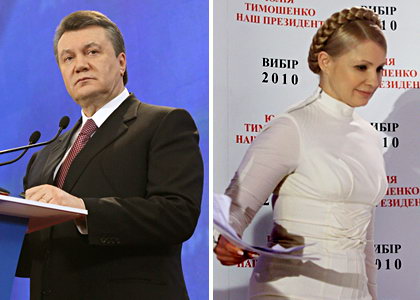 The first round of elections of the President of Ukraine brought the results expected and unexpected at the same time. Today (when it would be calculated , the official figures are not declared) we can say that the main sociologists were not mistaken. Viktor Yanukovych and Yulia Tymoshenko enter the second round, and the gap between them is about 10%. If, with final calculations, this gap is less, Yulia Tymoshenko has good chances to win in the second round. Tymoshenko herself assures that he will win, because in the second round voters of the so -called vote will give her votes “Democratic camp”, in other words, those who voted for Yushchenko, Yatsenyuk and Tigipko. The last (i.e. Latent "Butov sympathies" of Tigipko voters) is doubtful. However, in the western regions of Ukraine, most likely, this will happen, and Yulia Tymoshenko will certainly add, but whether these votes are enough to win in the second round is a big question.
But the results of the first round that were not so obvious are much more interesting.
Firstly, in these presidential elections there was a record low turnout: about two-thirds of the total number of voters came to the sites. Probably, those who stated on the eve of the election were likely to vote “against all”: according to the polls, there were more than 15%, but the real figure turned out to be an order of magnitude less. Will the turnout change in the second round? Will the voter “against all” come to vote for “less evil” or, conversely, who voted for Tigipko, Yatsenyuk and Gritsenko will stay at home (thereby, by the way, leaving no chance of Yulia Tymoshenko)?
The second and main result of the first round is the triumphal return of Sergei Tigipko. It was Tigipko who became the hero of the “Electoral Night”, it was Tigipko who endedly asked about “political plans for the future”, it was Tigipko that were immediately invited by negotiators from the headquarters of Yulia Tymoshenko. It is characteristic that Tigipko accepted the invitation, but categorically refused to “cast votes”. The result of Sergei Tigipko (more than 13%) makes a high and stable at all stages of calculations and, without exception, the result of Sergei Tigipko. However, his “political geography” is even more impressive: without his own party, i.e. In fact, without having any administrative resource “on the ground”, Tigipko entered the first three in almost all areas of Ukraine. He reached 1st place in Dnepropetrovsk (in the homeland of Tymoshenko!), On the 2nd (pushing the same Tymoshenko) in the southern regions, Odessa, Nikolaev and ... Kyiv: in the capital of Tigipko he was ahead of Viktor Yanukovych, gaining about 19%.
Tigipko himself invariably repeated that the reason for his success was an honest pragmatic program and that those who were tired of populists voted for him. He is partly right. Populists are really tired. But it seems that today's triumph of Sergei Tigipko is most explained by his timely departure from politics. At the known moment-after the 2nd round in 2004-the head of the election headquarters Viktor Yanukovych suddenly disappeared, and most of the then observers considered this the end of his political career. Others call the current success “the return of the old-new politician”, but for Tigipko himself, it seems, all starts at first. On the night of the 17th to January 18th, Tigipko looked a happy person who knows firmly what he should do next. “We need to create a party and prepare for local elections,” he said. Local elections will be held in May, and the name of the party is already known - “Strong Ukraine”. To the direct question, whether Tigipko will take part in the elections of the mayor of Dnepropetrovsk with his phenomenal Dnepropetrovsk result, he answered vaguely negatively. But to the next question-whether he will go to the election of the mayor of the capital (since they will take place), Tigipko answered vague-positive. “The laurels of Jacques Shirak haunt you,” the host told him, and Tigipko smiled shyly. An unambiguous refusal to “share” the voter and decide on the sympathies to potential presidential candidates is explained by the same confidence in the present reasons for his own success. They did not vote for Tigipko because of some special “program”-Ukrainian voters do not read programs. They voted for Tigipko, because five years ago he left politics and today there is no negativity of the Yushchenko-Timoshenko era. In fact, Tigipko became a protest candidate of those who, for a different series of reasons (age or social), are not prone to total disappointment. The voters of Tigipko were mostly people under 45 years old with education above average. It seems that Tigipko really correctly disposed of his political past and from now on he has a political future.
Photos of RIA Novosti