Translated material
Monitoric data of the Ministry of Internal Affairs
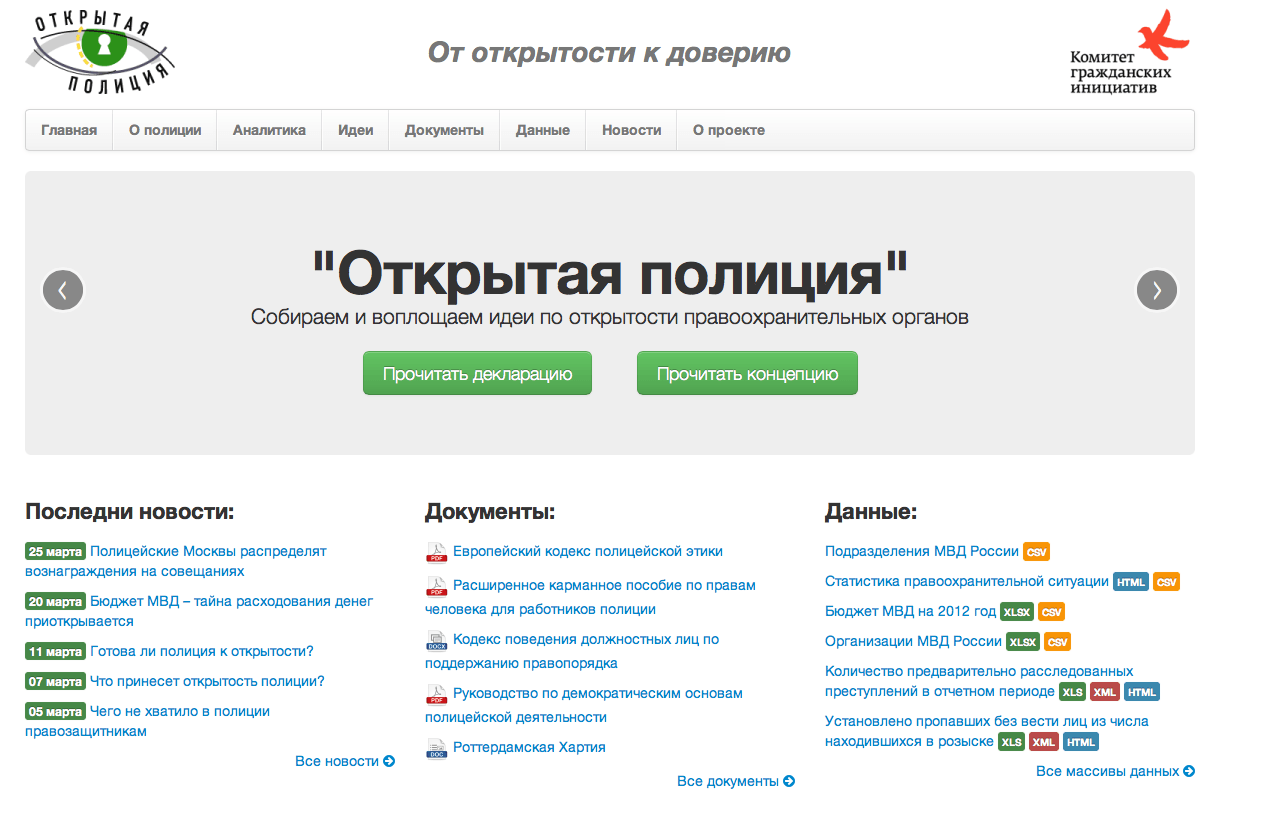
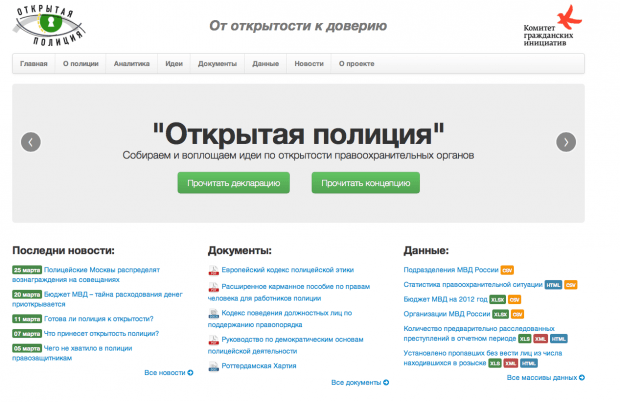
“Open Police” is a draft “Open Data” format. The site has gathered and published information from the internal affairs bodies. The authors of the project are emphasized not on ordinary users, but on civilian activists. “Open Police” is ready to share data from the media and enthusiasts.
The head of the Open Police, Ivan Belytin, in an interview with the greenhouse of social technologies, spoke about the reasons for creating a project, the features of the site and how users will be able to create mobile and civil applications on the basis of these data.
Interviewed by Evgeny Voropay. March 2013.
E.V.: “Open Police” is not the first of your open data project. When you work in this direction, what is primary: content or format?
I.B.: There are both approaches, and both are fair. In some cases, the data with which you have to work insufficiently open, but publicly and available for analysis and create a certain product.
It happens vice versa, when experts do not have data, but the sources from which they can be obtained are very clear. Of course, if the information exists in the public domain, this greatly simplifies the task. And situations in which the data is either absent, or access to them is limited, already require other methods of work and implementation formats.
E.V.: Often the initiatives of the “open data” format are local in nature or, on the contrary, work with centralized data. Why did you decide to do a project in the field of law and order and why only now?
IB: The Open Police project did not arise now. The idea has been over a year, and starting from the second half of 2012 we have actively worked on its implementation. As for “why now”, probably because the critical interest of society in the security and activities of law enforcement agencies grew to the extent that this allows us to talk about the relevance of the project.
E.V.: “Open Police” - a project, the implementation and maintenance of which requires the creation of an entire infrastructure. What is the project mechanics: who is engaged in the collection and adaptation of data and how do they get into the system?
I.B.: Before the launch of the Open Police, we conducted an informational audit of the Internet resources of the Ministry of Internal Affairs, which publish open data. These are about several hundred sites of the federal and regional levels; We also “captured” part of the municipal resources. The data that could be used gradually selected and at the next stage we loaded this information into the open police system.
All this happened manually. To do this, we attracted volunteers, freelancers, something was done on our own. Actually, this is how we began to collect the open data of the internal affairs bodies in machine -readable form. In the future, we expect that our users will begin to offer some ideas that we will convey to the leadership of the Ministry of Internal Affairs.
E.V.: The project was well perceived by journalists, public activists. The interest of this audience is quite understandable, but why should the internal affairs bodies experiment with open data?
I.B.: The Ministry of Internal Affairs is now time to start experimenting with an open dialogue with society. Even, probably, not to experiment, but to start doing it closely. The thing is that now the internal affairs bodies receive a rather powerful stream of criticism. And the public has formed a tremendous demand for the reform of law enforcement agencies. The Committee of Public Initiatives, a number of state and non -state organizations is now engaged in this topic.
In total, all this boils down to the fact that if the internal affairs bodies themselves do not begin to change, do their work more open, then the critical discontent of the public will reach the level when any proposed reform will not be needed. It is necessary to create conditions in which the transition of the Ministry of Internal Affairs to open data will be as painless as possible.
E.V.: According to statistics, the Ministry of Internal Affairs for 2012 considered 26.24 million applications. Given the wide agent network of internal affairs bodies, what resources are needed for the implementation of such a project as an “open police”?
IB: The basis of our project is data. In fact, working with them does not require large resources. We are quite a small group of qualified specialists who can collect and analyze large streams of information.
That is, the main task is to obtain this information and in a machine -readable form to present it to the public. Based on these data, media products are created that will complement the “open police”.
Our next goal is to involve users who have the necessary technical qualifications in the process of creating new services and applications based on these data.
Suppose if criminogenic statistics in the districts of cities appear in the public domain, this may become a prerequisite for the creation of a series of municipal projects, which can also be complemented by data from other or related sectors.
For our part, we plan to hold competitions in order to hold the audience’s interest in the topic of open data.
E.V.: The website of the Open Police has a very complex architecture. At the same time, you insist that any data should be presented in machine -readable form, will this information be visualized to work and familiarize yourself with a wide audience?
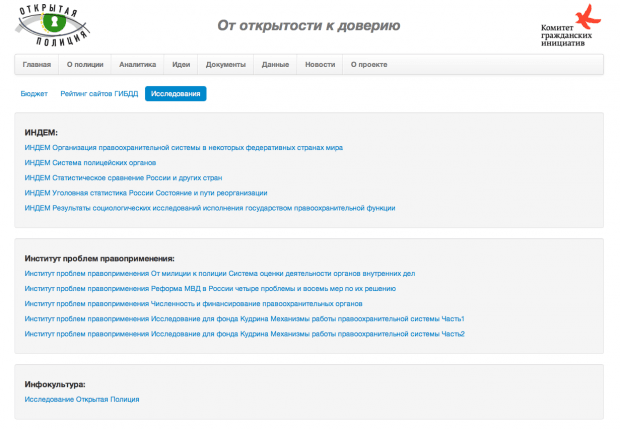
IB: Of course. As part of the Open Police website, several such tools have already been implemented. Among them, the visualization of the budget, the ratings of the traffic police sites (the resources of this department are complex for rating, because they exist on a common CMS).
We are going to continue working in this direction. Perhaps in the future there will be visualizations in districts, police branches, and district police officers. But this is not an end in itself. We focus on citizens who can create products yourself. In this, “Open Police” can help systematized open data.
E.V.: In Runet, two platforms of the project are presented: one - informational, the second - with databases and documents. Why did you decide to make two resources within the framework of one initiative?
I.B.: Systematic resources in Runet even three. The first is a presentation project in which all materials and visualization are collected. The second site is the Portal Open Data. Here are files for familiarization and download. The third part is a service for developers. Since each of the sections of the project works on special engines, we decided not to integrate them into the general site.
E.V.: “Open Police” observes not only the work of the internal affairs bodies. But also for each of their employee. You have made a proposal to remove police in case of complaints. Can this be implemented or controlled as part of the Internet project?
Probably you can. But in order to describe the mechanism, it is necessary to understand how this will be implemented by the Ministry of Internal Affairs itself, and organize an open dialogue.
E.V.: “Open Police” will be implemented into the work of the Ministry of Internal Affairs?
IB: I still do not see the need for this. We did not pronounce such interaction options. Today, “Open Police” is a public statement for a public request.
It is likely that in a dialogue with the internal affairs bodies, this issue will arise on its own. It will be necessary to say the opportunity to open data directly by the Ministry of Internal Affairs. But we are ready for any constructive cooperation within the framework of the principles we set out.
E.V.: Publishing open data is only one of the possible areas of work. Are you going to check their reliability within the project?
I.B.: Right now this is not included in our plans. It is primarily to create a systematic database that will exist in the public domain and which will make it possible to become the basis for future civilian projects.
E.V.: Projects with open data are engaged in monitoring and supervision. “Open Police”, among other things, took a very tough position in the reform of law enforcement agencies. What part do you intend to take in this process?
I.B.: The degree of our participation is presented in the declaration and concept of the “open police”. We believe that the dialogue with the Ministry of Internal Affairs and the adoption of at least part of the principles we have stated will be a significant progress in the reform of the department.