
Translated material
Petersburg as the capital
St. Petersburg was not too “lucky” in terms of its representation in traditional peasant folklore. The point here is not so much in the negative attitude of the peasantry to the capital of the Russian Empire, but in the extremely small presence of St. Petersburg theme in folklore texts as a whole. “The reckless capital,/ the glorious city of Pitinbryukh”; Peter, who “the people of the sides of the sides” (or: “To whom the Jew wiped the nose”) and similar manifestations of the “folk voice” [1] In general, the contrastation of the capital and provinces for the imperial culture fit into an ordinary for imperial culture (cf. modern “Moscow does not believe in tears”, “Moscow hits from the toe”, etc.). The most clearly this opposition is expressed in another version of the paradise saying about St. Petersburg, I recorded in the east of the Novgorod region in the mid-1990s:
Peter, Peter, you wiped me. But I was afraid of you: I went through Nevsky in Nevsky in the bast shoes.
As for the notorious image of the “damned Petersburg”, “cities on the bones”, St. Petersburg, which is waiting for “desolation” or death from flood, they, apparently, have little to do with the peasant folklore itself and mainly owe their appearance to the literary tradition of the 19th century. Of course, the inclusion of the image of St. Petersburg in the Old Believers about Peter I - Antichrist is really recorded by a number of sources, but the widespread existence of these legends is limited to the first twenty or thirty years of the XVIII century. In the future, the “St. Petersburg theme” is gradually eliminated from peasant eschatological narratives.
However, the question of the role of St. Petersburg in the history of Russian religiosity of the XVIII - XX centuries seems more complicated. It is obvious that the religious culture of the Petrine capital was most consistent with the spirit of the “synodal” Orthodoxy - bureaucratized religious ideology, whose initial goal was, by the apt expression of A. S. Lavrov, “to solve the problems of which in the West was“ divided ”between the reformation and enlightenment” [2] . From the point of view of the religious and mythological reception of the landscape, St. Petersburg is focused on the type of hierophany unusual for the Russian tradition: it is not a city of miracles, but a city of secrets. Therefore, the number of sacred landscape objects traditional for folk Orthodoxy in St. Petersburg compared to other Russian cities is negligible: one tomb of the local saint-patron (chapel of Ksenia Blessed in the Smolensk cemetery) and one place of the miraculous phenomenon of the icon (chapel of Paraskeva Fridays) [3] . This situation made the reproduction of traditional models of peasant religiosity in virtually impossible for the St. Petersburg mass culture, since the main semiotic resource of the latter is the sacred landscape [4] .
At the same time, starting from the turn of the 18th - 19th centuries and ending with the era of John of Kronstadt, Petersburg played a noticeable role in ideology and folklore, as well as in the ritual and proselytics activities of a number of common religious movements. However, the “Petersburg myth” was of particular importance for the Section of Skoptsov - for a number of historical reasons. I know only two Russian author, who paid attention to the specific theme of St. Petersburg in skopic folklore. One of the first researchers of the domestic sectarianism, V. I. Kelsiev, who reprinted N. I. Nadezhdin in London in 1862 “The Study of Skoptic heresy” (1845), wrote in the preface to this publication: “Peter III was before the legal Russian sovereign, that he was even forgiven for St. Petersburg, in which the majority of the schismatics even be considered sin. Petersburg (hereinafter it cruised Kelsiev. - A.P.) became Jerusalem for the sake of the folk king! The fate of this Northern Palmyra is good, rotten by the sewage pipes that have not been cleaned since the time of Anna Ioannovna, - the window forcibly cut into Europe, the city of emperors becomes the capital of Skoptsov !!! ” [5] V. N. Toporov, who, noticing several skopic songs, was less emotionally speaking out on this occasion, where Petersburg is mentioned, and for some reason dubbed their Old Believers, noted that “these and similar“ sectarian ”texts should be considered as a special version of the“ Petersburg ”historiosophical myth-a blissful state at first, a catastrophe (or crime), a disgust Nowadays, repentance. The topic of contrasting St. Petersburg Moscow deserves attention intensely emphasized in these songs " [6] .
What, in fact, are interpreting Kelsiev and axes? In order to answer this question, it is necessary to briefly dwell on the history of Russian skope [7] . The religious movement of the crystands arose at the turn of the 1760s and 1770s in the central Russian provinces. Its founders were primarily the followers of Christ, also known as the “Sect of the Hlysts”. Skoptsy not only retained most of the specific features of the Khlystov cult (ecstatic practice of “at work”; the veneration of sectarian leaders “Christ”, “Theotokos” and “Holy”; strict asceticism, which included the rejection of meat food and alcoholic beverages, as well as prohibitions on any forms of sexual relations and the use of swearing words and participation in The daily ritual life of the peasant community), but also supplemented it with the ritual amputation of the "shameful" parts of the human body. Another characteristic feature of the skopic tradition is its connection with the mass socio-political mythology and utopia of the late 18th-early 19th centuries. If the leaders of Christ were limited to religious imposture, then the skopic leaders are also gravitated to political self -procreation. Thus, one of the founders of the scope and the permanent leader of this movement for almost half a century - the peasant Kondraty Selivanov - was considered not only a new embodiment of Christ, but also the miraculously saved from death by Emperor Peter III. In this sense, Selivanov and his close associates, wandering in the early 1770s in the cities and villages of Central Russia, are quite comparable to the leaders of the Pugachev riot-with the difference that Pugachev affirmed his power with the help of military force, and Selivanov through ritual castration and ecstatic prophecies.
Around 1775, Selivanov was arrested in the Tambov province, punished with a whip and exiled to Siberia. Some of his associates were sentenced to imprisonment, others were given to the soldiers. However, judicial persecutions and harsh sentences did not stop the victorious procession of seniority, in the first quarter of the 19th century, which became one of the most numerous and influential Russian sects. Selivanov returned from the Siberian link at the end of 1796. According to contemporaries, the initiator of this return was Emperor Paul I himself, apparently influenced by the legend that Peter III happily escaped death and was hiding somewhere in Russia. However, the conversation with Selivanov and his associates did not satisfy the new emperor: at the beginning of 1797, six subop-capacity followers were imprisoned in the Shlisselburg fortress, and Selivanov was placed as a “secret prisoner” in the Obukhov Sunny House in St. Petersburg. He came out of there only five years later - at the command of the new emperor who visited the Obukhov hospital on March 6, 1802. It is hardly worth thinking that Alexander I, following his father, suspected that Selivanov is really Peter III. Most likely, the romantic mysticism of the young emperor, mysticism, which had such a noticeable influence on the first years of his reign, played its role here. According to F.P. Lubyanovsky, shortly before the Austerlitsky battle, Alexander even specially visited Selivanov to ask him about the outcome of the war with the French [8] . By the way, it is likely that it was this story that served as one of the sources for the Pushkin’s “Fairy Tale of the Golden Cockerel” [9] .
One way or another, the first twenty years of the XIX century can rightfully be considered the "golden age" of Russian sqopicism. At this time, the slander, their strange rites and a mysterious mentor were popular not only among the common people, but also in a privileged St. Petersburg society. As a matter of fact, this ruined Selivanov and his followers: in 1819, two guards officers-cousins of the then St. Petersburg governor M. A. Miloradovich, entered into the Skoptsov sect, and one of them even agreed to undergo ritual castration. When the authorities became aware of this, the scandal erupted, and in the summer of 1820, Selivanov was exiled to the Spaso-Evfimiev Monastery in Suzdal, where he died twelve years later. Despite the defeat of the St. Petersburg community and the skopic trials of the middle-the second half of the 19th century, St. Petersburg remained one of the major centers of Russian skope until the 1920s. Selivanov’s teaching was in great honor among wealthy metropolitan merchants, and they rarely became a target of government persecution. The Solodovnikov merchants in Kovensky and the Oblodevy merchants in Baskoye Lane were especially revered by the scoopers of the house of merchants - it was in them that he lived and arranged the liturgical meetings of Selivanov. One of the “professional” classes of the capital's scodzers was minor financial operations: the image of the scodpel - the owner of the channel shop firmly entered the memoir and fiction pounds of the “St. Petersburg text” of the 19th century. Dostoevsky, describing in the “Idiot” “Big, Gloomy, Three floors” the house of “Heritage Honorary Citizen Rogozhin” at the intersection of Sadovaya and Gorokhovaya streets, several times mentions the “Khludyakovs Skoptsy”, who hired part of the Rogozhinsky house almost from the first day of its construction and enjoyed special respect for the late father of the hero. It is worth adding that the skopic communities were widespread in the suburbs, as well as in the rural environs of St. Petersburg, and they appeared here at the end of the 18th century: so, in 1791, a group of scotzers who supported intensive contacts with their like -minded people in different regions of Russia was discovered in 1791. About the middle of the 19th century, the ecstatic prayer practice of scopets, as well as ritual castrations, gained popularity among the Ingermanland Finns-Lutheran. It must be said that it was the Finns of the Western part of the St. Petersburg province that turned out to be the most persistent followers of the sodium. At the Leningrad trials of the turn of the 1920-1930s, which actually laid the end of the sect of the crystands as such, most of the defendants made up the Ingermanland Finns.
The "political mythology" of Russian scoopers of the 19th century was also closely connected with St. Petersburg. Skoptic songs and prosaic legends were not limited to the statement of tsarist origin, as well as the divine nature of Selivanov and deployed the “sacred history” of the sect into a prostrate narrative of a historical and political character. The genuine or fictional dates of Selivanov and Paul and Alexander served as the basis for the scopic songs about the meeting of the “printer” with the “king Pavlushka”, about the refusal of the latter to recognize “cleanliness” (i.e. icion) and followed by the tragic events of March 1801:
Our father, the Redeemer with a meek voice held: "I would forgive Pavlushka: turn up to me Pavel, I would fix your life." And the king proudly answered, did not notice the deity, did not listen and left. Our priest sighed with his heart, waved his right hand: “O earthly slandin, in the evening your death! <...> And I will give the earthly tsarsk to the molery king: I will bless the whole throne and palaces of Alexander, will be correctly governed, not to give the authorities the will ... " [10]
Alexander I was portrayed in the skopic legends as a meek and gracious king, which allowed the "his grandfather" to "sit on the throne" and "reign over Israel." Even Selivanov’s expulsion to Suzdal was explained not by the will of the king, but by the machinations of a certain villain “Senator”: “And after the senator became proud and did not ask the king and took him, the king of Israel, from the throne at midnight and sent him. The king then Alexander Pavlovich found out about him, sank his eye that: “I have no prophet now”; He sent him not far, to Suzdal Grad, to the Spassky Monastery " [11] . In the later sectarian legends, Alexander himself finds out the scheme. So, the skopic version of the folklore plot “The Tsar demands to the Senate” says: “... suddenly come behind him [Alexander I] late at night - to demand to the Senate. The king was surprised, but dressed and went: “What,” he says, “business, gentlemen? Why do I need me?” And they say: “Is it true, the sovereign, that you are a man? The Senate wants to make sure and asks you to undress.” The king sees that everyone was embittered against him, begins to undress, and it turned out that he was a man. <...> At that time, his brother Konstantin, a man of extraordinary power came home: “Where,” he says, “sovereign?” They say to him: they called to the Senate. He is to the Senate - the sentry does not let him in. Konstantin grabbed a saber, and once - Vma demolished the head of the hour. He runs into the palace, and the king is naked in front of the Senate. As he began to crumble, he chopped everyone, and then he addresses Alexander and says: “Oh, you, chicken were frightened” ”” [12] . Finally, from the spiritual verse about the death of Alexander II, which was in the sectarian environment, it turns out that this Russian king was a secret supporter of the teachings of Kondraty Selivanov:
The red Sunnyshko rolled up, the soul with the flesh was divided. The Lord took his soul to his soul, the angel exiled behind him, with the seven -sided crown, what spent his life in an income. Stay Peter Grad, I will not come back now; I leave my body, I go to my father boldly [13] .
However, for skopic mythology, Petersburg is important not only as a place where the main events of Russian history of the 19th century occur, but also by itself - as a sacred center of the Universe, “Spiritual Jerusalem”, where Kondraty Selivanov once reigned and where he will soon return again - to “open an universal court alive and dead”:
From the eastern from the side to the western, to the western, the cypress tree was taken, on that tree there are five hundred gold branches; These branches are Israeli children. <...> They brought that tree-kiparis to St. Petersburg, they became a tree from the ground to the sky. They will build a city of Jerusalem with the Father and the Son and the Holy Spirit, and with the Trinity, with the Virgin ... [14]
At the same time, the expectation of the second coming of Selivanov and the new glorification of St. Petersburg is mixed in skopic folklore with nostalgic longing for the “golden eyelid” of Alexander I (it is these motives of axes and calls the “special version of the St. Petersburg historiosophical myth”):
And you are the light of our famous Peter Grad, you were a helicopter refuge for Christ, a green paradise bloomed in you [15] ; As in St. Petersburg in the city lived righteous in Otrada, in all of God's house our father lived in his royal rank. [16] .
So, Petersburg of the 19th century quite earned the nickname of the "capital of the crystands" given to him by Kelsiev. Of course, one could say that we have another metamorphosis of the specific “St. Petersburg deviation” and that the scopic myth of St. Petersburg belongs to the same semantic field as the freaks of the Petrovsky Kunstkamy, “Petersburgsky diseases”, “St. Petersburg longing”, etc. I think, however, that the literary mythology of the “damned Petersburg”, the very literary mythology, Reproduced repeatedly by various authors, is not so much related to the real features or phantoms of urban culture as such as to more or less ordinary socio -historical circumstances. For the first two centuries of its existence (and especially in the 19th century), Petersburg was the center of imperial power, the focus of the state bureaucracy. The same Skoptsov was attracted to St. Petersburg and in St. Petersburg precisely a kind of folklore reception of the Russian autocracy. It is possible, in such a way that in the case of a literary myth about the “damned Petersburg”, we are not talking about a monster city, but about the monstrousness of the authorities, which is projected to the capital of the empire and symbolized by this capital. It is significant that in the 20th century - after the transfer of state power to Moscow - St. Petersburg, as it were, loses its monstrousness, or rather, delegates it to the new capital. While in St. Petersburg the GPU trains and puts the last scraps in prisons, in Moscow they build mausoleums for the mummy of the head of state, conceive and erect unprecedented buildings and monuments, and also try to cross the monkey and man. So, from a certain point of view, the “provinciality” of St. Petersburg was only beneficial, at least - as an antidote from monstrousness.
[1] See the selection of materials given in this connection by V. N. Toporov: Toporov V.N. Mif. Ritual. Symbol. Image: Research in the field of mythopoetic: Favorites. M., 1995. S. 262–263. I do not agree with Toporov that the “description of St. Petersburg by the People’s Word” is built on the emphasis of something like “Petersburg to be a road” (Ibid. P. 262).
[2] Lavrov A. S. Witchcraft and religion in Russia. 1700-1740 M., 2000. S. 445.
[3] There were, however, some other St. Petersburg shrines, but their cult, as a rule, was not a massive nature. See: Yudin N.I. Pravda of St. Petersburg "shrines". L., 1966; Panchenko A. A. Research in the field of folk Orthodoxy. Village shrines of the north-west of Russia. SPb., 1998. S. 97.
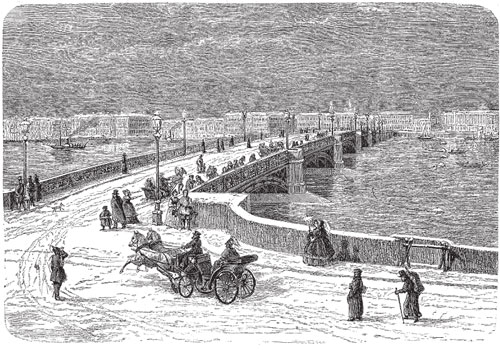
[4] См.: Панченко А. А. Исследования в области народного православия… Николаевский мост
[5] Кельсиев В. Сборник правительственных сведений о раскольниках. Вып. III. Лондон, 1862. С. XVI.
[6] Топоров В. Н. Миф. Ritual. Symbol. Image. С. 322–323.
[7] Подробнее об истории и религиозной культуре секты скопцов см.: Панченко А. А. Христовщина и скопчество: Фольклор и традиционная культура русских мистических сект. М.: ОГИ, 2002.
[8] См.: Воспоминания Федора Петровича Лубяновского // Русский архив. 1872. Стб. 474–475.
[9] См.: Панченко А. А. Христовщина и скопчество… С. 181.
[10] Мельников П. И. Материалы для истории хлыстовской и скопческой ересей. Отдел I. Соловецкие документы о скопцах // ЧтОИДР. 1872. Кн. I. С. 92–93.
[11] Мельников П. И. Материалы для истории хлыстовской и скопческой ересей. Отдел V. Правительственные распоряжения, выписки из дел и записки о скопцах с 1834 по 1844 год // ЧтОИДР. 1873. Кн. I. С. 213.
[12] Волков Н. Н. Секта скопцов. Л., 1930. С. 40–41.
[13] Солосин И. И. Стихи Ахтубинских сектантов. СПб., 1912. С. 158–159.
[14] Рождественский Т. С., Успенский М. И. Песни русских сектантов-мистиков. СПб., 1912. С. 40.
[15] Там же. С. 57.
[16] Рождественский Т. С., Успенский М. И. Песни русских сектантов-мистиков. С. 59–60.