
Translated material
Primaras
At the preliminary vote for the candidates of United Russia in Moscow, the laws of logic and mathematics are grossly violated. Investigation of "New"
“Electronic preliminary vote for candidates for the subsequent nomination from the United Russia party with candidates for deputies of the State Duma of the Federal Assembly of the VIII convocation, as well as deputies of legislative (representative) bodies of state authorities of the constituent entities of the Russian Federation as part of a single voting day of 2021,” as it was officially called, on May 24 to the use of the state platform of electronic voting. The registration of voters took place through the public services portal (in Moscow also through the portal mos.ru), the vote itself - on the website pg.er.ru.
Actually, the idea, how much it can be understood by the external observer: to run into the State Duma of administrative mobilization technology before the elections to the State Duma (see “Crazy Voting” , “New Gazeta”, May 27, 2021, long before the start of the real campaign for the State Duma elections to demonstrate to voters of administrative candidates, to create the appearance of “folk support” of winners.
Devil in detail
The surprises began on May 31, when the results of the will began to appear on the voting website with details to the “accounting sites”, which coincided with the usual selective sections of the state electoral system of the Russian Federation. Attentive observers-the first, apparently, was an activist of the Voice Association ( the law demands to indicate that the organization is included in the list of foreign agents ) Roman Udot-noticed that
The results in Moscow look strange: a lot of coincidences of the results of different candidates, a strong range of numbers between the sites.
By 15.00, the details were removed to the sites from the site, leaving only the results in the districts and lists, but the data on candidates for deputies of the State Duma, which were published at this point on the voting site (55 regions and 128 constituencies), were collected and preserved.
Moscow results are of particular interest. The capital is the leader in the introduction of electronic voting: it was here that it began and rolled up. According to the Constitution to the Constitution in 2020, more than 1 million people took advantage of the correction to the Constitution in 2020. At the same time, the candidate for deputies of the Moscow City Duma of 2019, Roman Yuneman, who lost the elections precisely at the expense of electronic voting, collected evidence that it was under strong administrative pressure. In addition, unlike other regions, Moscow uses its own voting platform with authorization through the website mos.ru.
The current vote of United Russia for the first time gave a chance to get acquainted with the results of Moscow electronic voting with detailed geographical details - still votes in the elections of deputies of the Moscow City Duma, and a million votes on voting throughout the Constitution were given out in the form of a single giant electronic site.
Strange victories
And the results were really strange. For example, one of the “sensations” of the current primaries was a loss in the Central Partural District of the Veteran of Moscow Politics of Nikolai Gonchar to the municipal deputy Karen Apereyan. The result -
Gonchar scored 13,117 votes,
Apereyan - 14 507 -
It looks like a result of an active political struggle. However, if you go down to the level of polling stations, the picture is changing.
In the above fragment of the votes table for candidates in the areas of the Central Electoral District, it is clear that in each individual site the confrontation of the Avopan -Gonchar looks either as a crushing victory of one of the parties (with an advantage of more than a hundred votes), or as a combat draw with almost equal score (more than a hundred votes on both sides), or as a zero draw.
In the football language, this is called a "contract match."
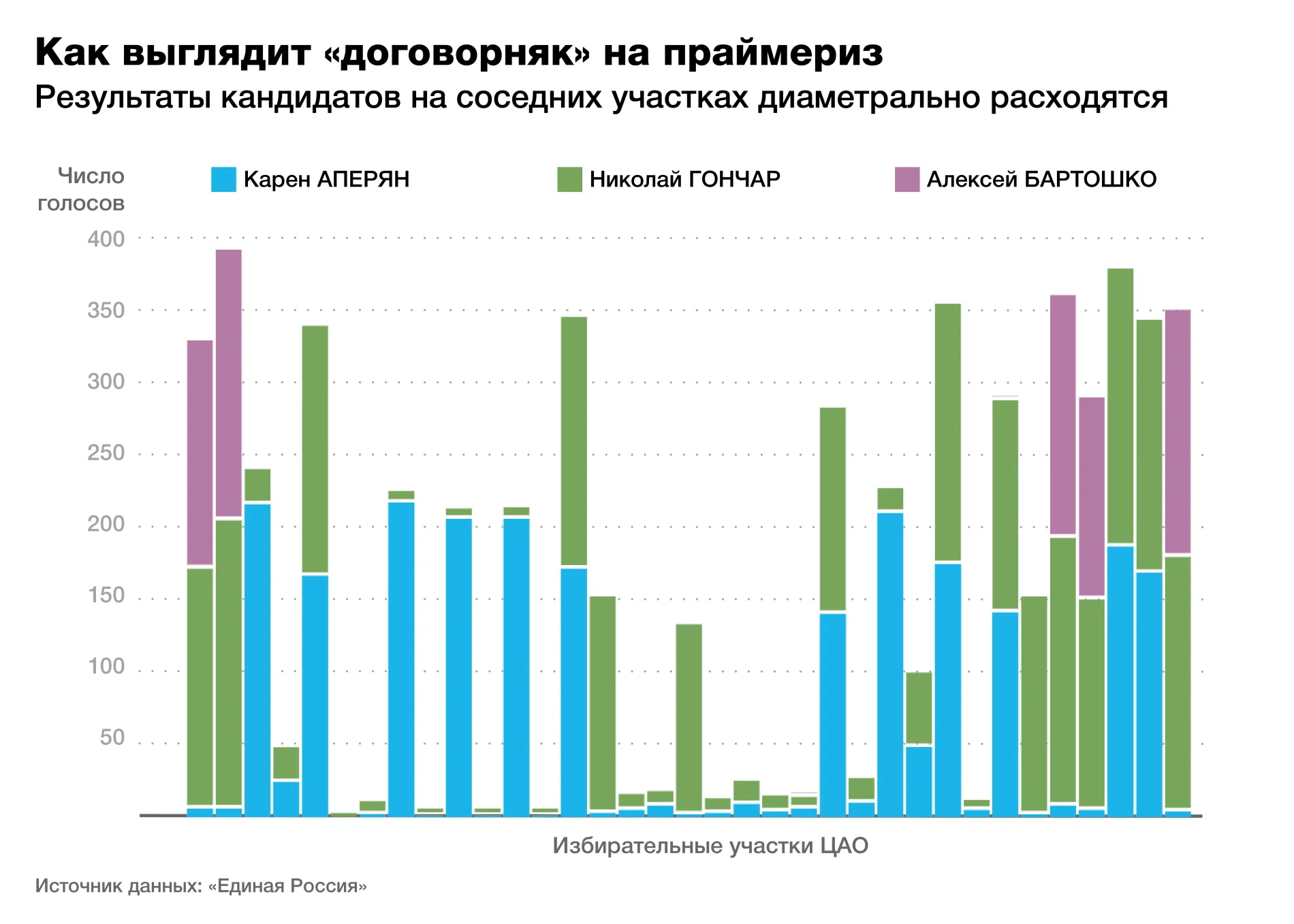
At the same time, other candidates who look much weaker are on equal terms with voting leaders are also much weaker (for example, a candidate Bartoshko, who received almost the same amount of votes in areas on 77.076.1 and 77.076.2, as a result, he scored 2558 votes - five less than a potter - but he was surprisingly lucky in these two sites).
According to the fragment of the table, the results can be seen that all candidates show the results in about one range - 170+–30 votes - or close to zero. If you look at all the results that candidates from the “List of 22 Leaders” in all sections of Moscow showed, such a picture will be obtained.
The frequency of appearance for candidates from the "list of 22 leaders" in all sections of Moscow.
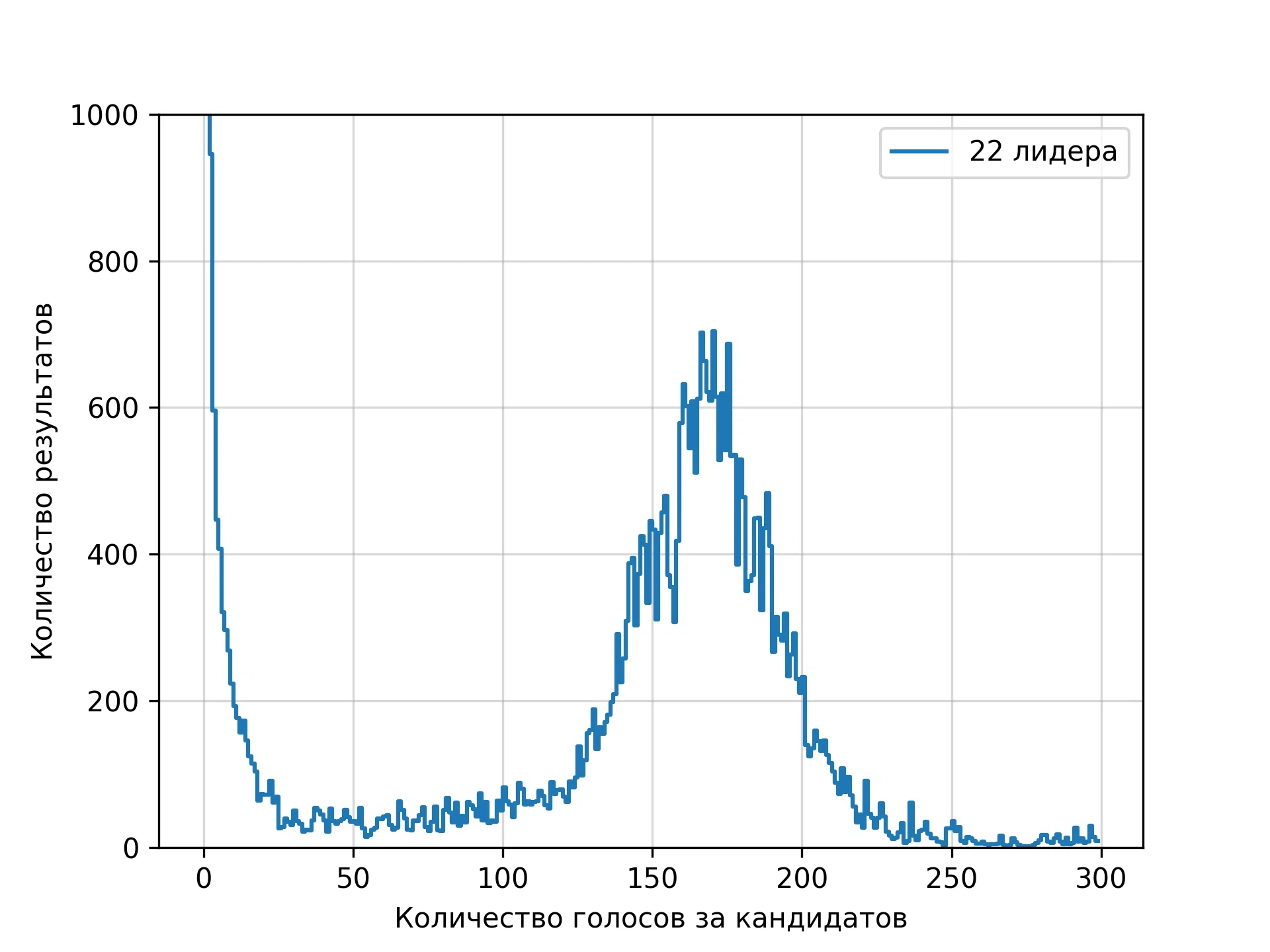
Paradoxically, the most popular result even in this group of leaders -
0 votes, he met 23,644 times,
1 vote - 6644 times,
2 votes - 2004 times,
3 votes - 946 times.
The next most popular result -
171 Voice (704 times),
behind it 167 votes (702 times)
and so on.
Intermediate numbers (50-100 votes) are much less common.
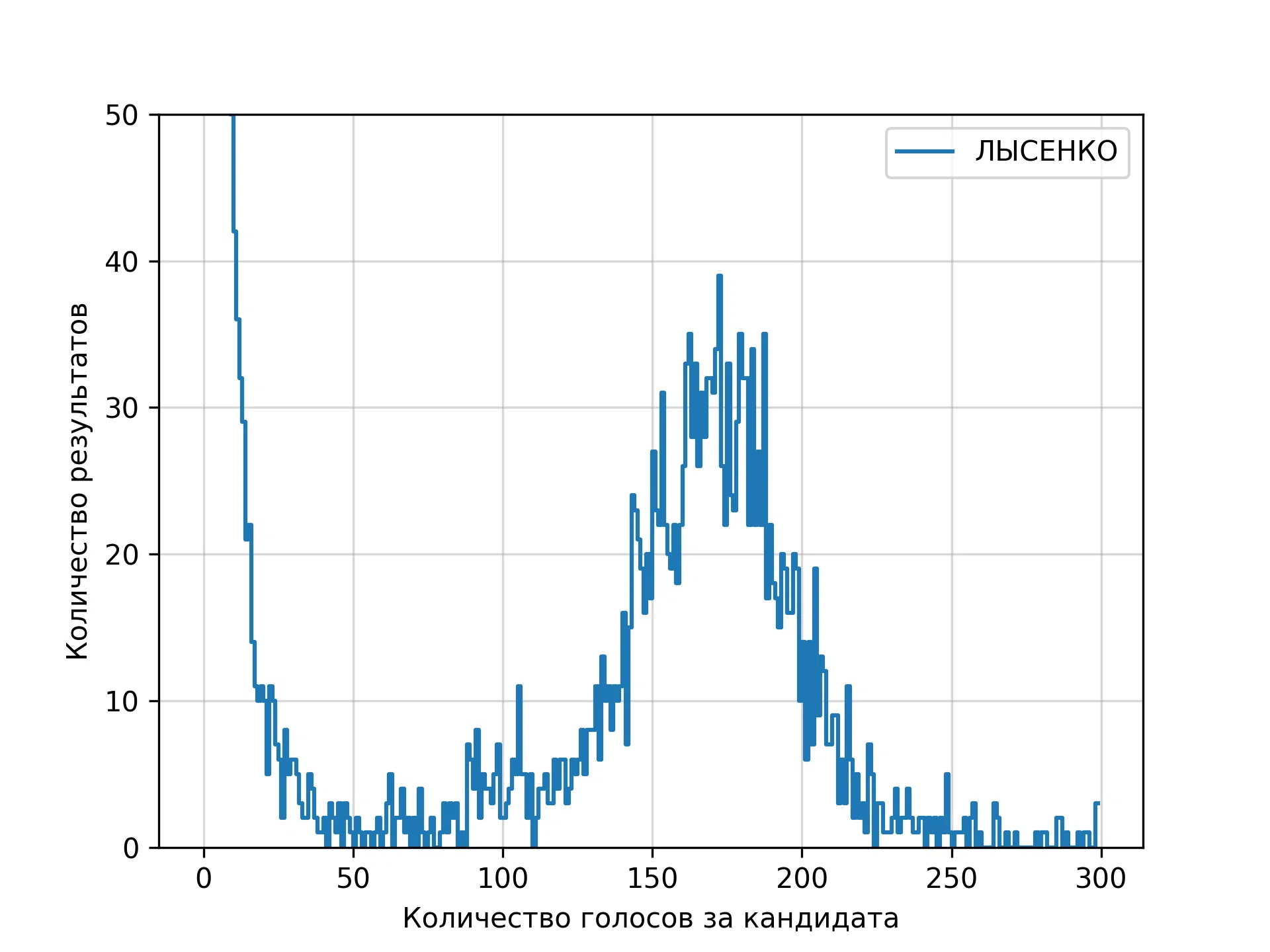
Typically, the distribution of results does not depend much on the "strength" of the candidate.
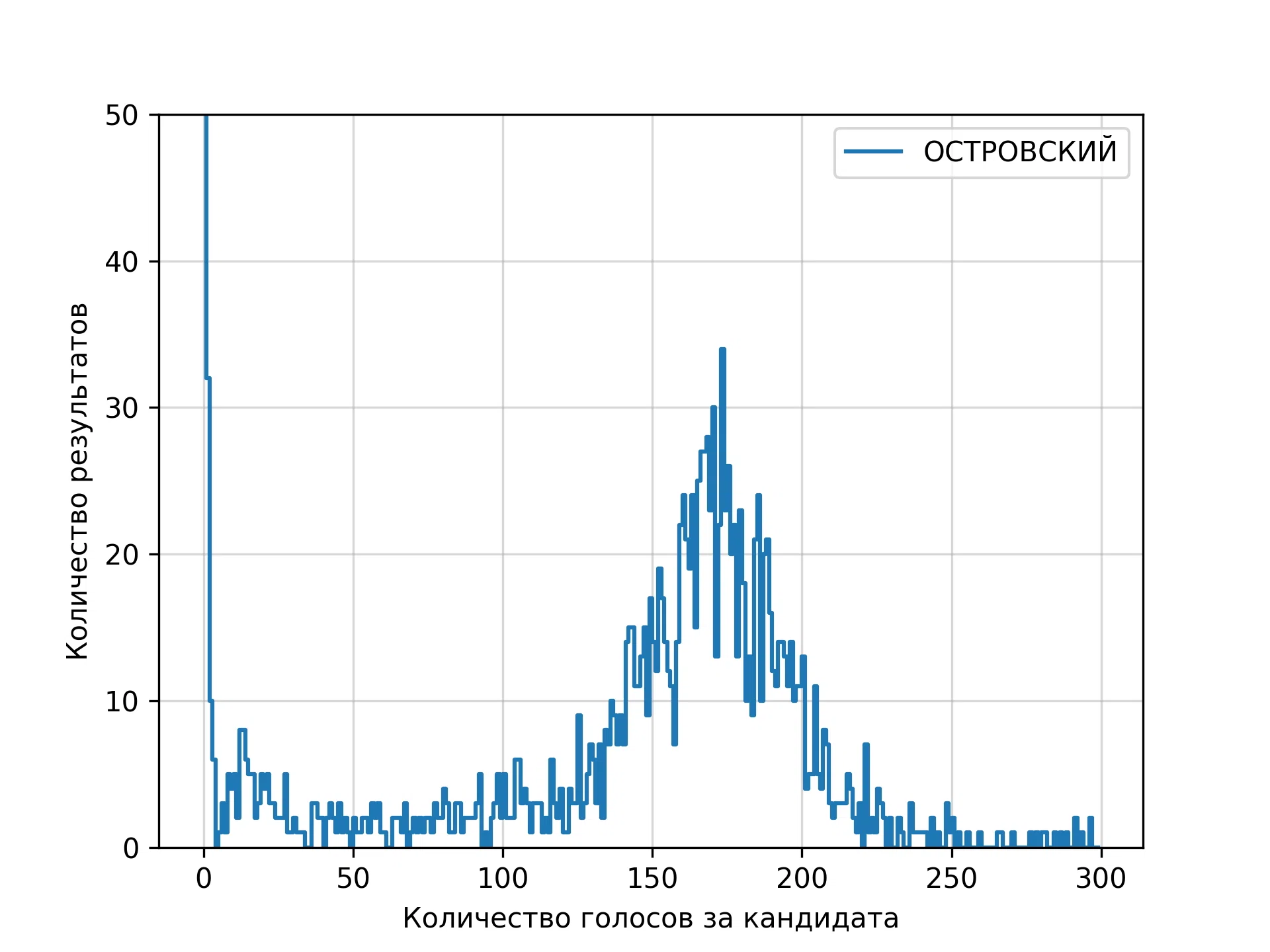
The results for the strongest candidate (Maryana Lysenko, 358 thousand votes) and the weakest of the leaders group (Mikhail Ostrovsky, 242 thousand votes) have a peak in the same area around 170 votes. That is, Ostrovsky, who received one and a half times fewer votes in total than Lysenko, received them not due to the fact that his result was lower in each site, but due to the fact that he had fewer sites with a high result and more with zero or close to zero.
The distribution of results in the areas of Moscow for the strongest (Lysenko) and the weakest (Ostrovsky) candidates from the group of leaders.
Voting in orderly rows
A similar situation in other Moscow electoral districts. For example, in the Tushino election district, where the rector of the Russian chemical and technological university Alexander Mazhuga (23,157 votes against 11,886 at the nearest rival-the secretary of the Mitinsky branch of United Russia, Anna Zagainova), he wins with a defeatous score with her pursuer, then performs a flush, then with no less crushing. It loses in an account. Sometimes this happens literally in neighboring rooms. For example, in plots 77.069.47 and 77.069.48, located in the Mitino area at the address: Novotushinsky passage, house 8, building 2 (school No. 1538), Majuga -Zagainov account was 12: 130 and 145: 0, respectively.
Why residents of neighboring houses of one microdistrict with such unanimity gave preferences to different candidates - a riddle.
The same oddities are observed in the vote according to the citywide list of United Russia. Of the 238 candidates appearing in it, a group of 22 leaders who received at least some significant number of votes are clearly standing out (literally units voted for the rest). This group has a variety of candidates-from the leader of the head of the head physician of the Moscow 52nd hospital, which was known as “Covid”, Maryana Lysenko, to the popularly famous actor Vladimir Mashkov and the little-known chairman of the Bibirevo-4 Homeowners Association Mikhail Ostrovsky.
Inside this group, leaders are not divided by the number of votes received at the level of individual polling stations, but by the number of polling stations where they received their hundred or two votes. For example, the mentioned Mikhail Ostrovsky in 1346 areas in different areas of Moscow received more than 100 votes (Matuas with other candidates from Group 22), and at 1896-less than 20 votes. At the same time, in 92 sites (not only in his native Bibirevo, but in different areas of Moscow), he won the head physician Maryan Lysenko with a devastating score, at 90 - the famous Vladimir Mashkov. It is interesting that Mashkov lost according to the total number of votes to another theater person from the “List of 22”-the director of the theater of nations Marina Revyakina. Among the 3398 Moscow polling stations there were 234, where Revyakina had more than a hundred votes (on average 150), and Mashkov had less than 20 (on average 1.2).
That is, it turns out that the popular actor was outright lost in a variety of places in Moscow to a non -public theater figure, whose name before these primaries was hardly known to the general public.
Finally - and this is also more than strange from the point of view of common sense - for 700 out of 3398 polling stations in Moscow, i.e. At about every fifth, the primaries seemed to be not noticed at all - on each of them for all 238 candidates of the citywide list (including 22 leaders) less than 119 votes were presented in total, that is, an average of less than 0.5 votes per candidate.
For example,
On the site 77.001.32 (Boulevard of Marshal Rokossovsky, 6 building 1, the preschool building of school No. 390) was not given a single voice for any candidate, while
On the site 77.001.31 in the same building 3683 votes were presented for all candidates,
And each of the 22 leaders as a ruler was measured from 167 to 169 votes.
What was it?
The fact that some candidates receive high and the same and the same with accuracy to units of votes, and the rest - almost nothing, and the set of “leaders” changes from the site to the site unpredictably, suggests that these voices were formed not as a result of the will of the expression of voters who, in order to achieve such an effect, would have to enter into a group conspiracy about which candidates to vote, and to vote, and For which no. The picture of the distribution of results fits into this hypothesis: it is not the candidate who voted less, but the one who received dubious voices in a smaller number of sites.
The question is what is the nature of this phenomenon.
It could be assumed that this was a vote stolen or received under administrative pressure of real citizens on public services or mos.ru. However, in this case, the distribution of votes filed in areas would correspond to the distribution of these citizens to their real residence addresses, and the situation when in neighboring areas located in the same building, the number of votes set is ten times, and here are hundreds of such cases.
It remains to assume that the voices presented to us were “drawn” directly in the Moscow electronic voting system without reference to the accounts of any real users. Apparently, there is no other explanation for the observed picture. Thus, it is worth fixing for the story that
We witnessed the mass falsification of the will using the state electronic voting system -
Although not within the framework of the official election procedure.
Data for research
Tables of voting data on candidates for State Duma deputies in districts and regions can be downloaded here .
Comment
Dmitry Nesterov
Electoral observation coordinator
- There are oddities not only in the results, but also in the events preceding the primaries of “United Russia” in Moscow.
In February-March of this year, the Moscow Budget Sector was undergoing an order about the need to start or fulfill accounts in the Moscow State Service of Mos.ru. Which indicated contact with Internet voting in the upcoming elections, since only users with “full accounts” can participate in electronic voting. An unusually early campaign time made it possible to connect administrative mobilization to voting on the primaries. However, unlike the regions, there was no noticeable coercion to participate in the primaries in Moscow.
The sensation was the publication of data on mobilized voters on the second day of the primaries. Allegedly in Moscow, 633 thousand voters - an unrealistic number, especially in the absence of a powerful admin resource and the information campaign in the region, were enlisted on the intra -party procedure.
Published (and then hidden) results in the areas confirmed that the real turnout was most likely more than an order of magnitude less than the declared.
A possible explanation of the unnaturalness and anomalies of the results of the primaries of the “EP” in Moscow is to simulate voting using these accounts of real voters without their notification.
It is important to note that in the systems of electronic voting in real elections, a similar mechanism of verification and authorization of voters is involved. Since 2019, independent experts indicate the vulnerability of the current electronic voting systems due to the lack of control of this mechanism. Neither commissions, nor observers, nor election participants have the opportunity to make sure that transactions of Internet voting systems correspond to the vote of real voters. This vulnerability poses a real threat in the context of the September elections to the State Duma.