
Translated material
Where did the homeland start
The film shown on the Russian State Channel and, therefore, reflecting the position of the state, even more tears Russia from the world
The film shown on the Russian State Channel and, therefore, reflecting the position of the state, even more tears Russia from the world
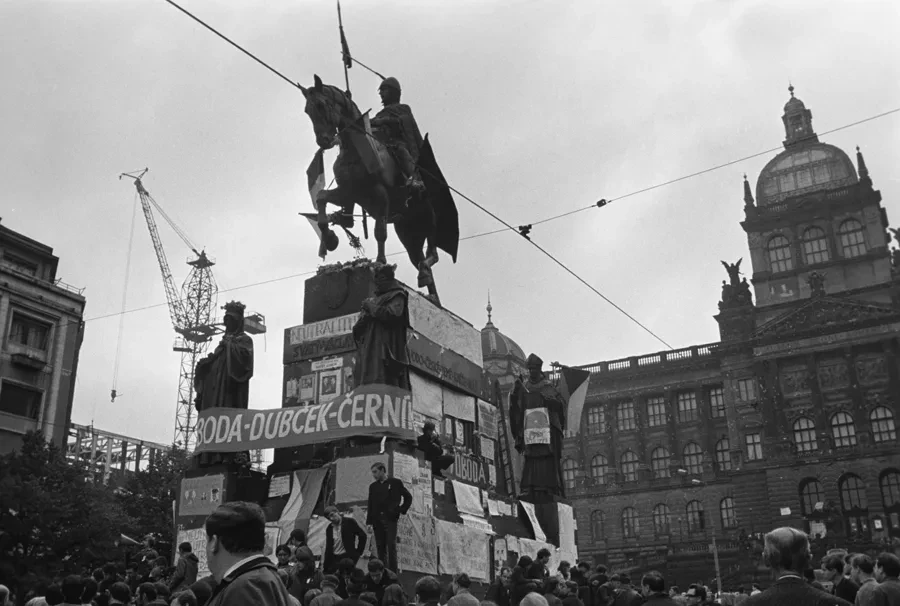
A demonstration of cinema for the 60th anniversary of the creation of the organization of the Warsaw Treaty countries (May 1955) ended with an international scandal. From the Russian ambassadors in the Czech Republic and Slovakia demanded an explanation. Prague and Bratislava saw in the film an offensive distortion of history. According to the authors of television, the peace -loving, but armed to Zubov, the organization of the Warsaw treaty saved Czechoslovakia from Western enslavement.
But Czechoslovakia did not ask to save herself, she asked to leave her alone. The Soviet Union responded to the request by occupation. And she moved the Kremlin sidelski to provide “international assistance” of the fraternal country is not a threat of NATO (what the authors of the film are trying to succeed in), but an attempt by the Czechoslovak communist leadership to reform socialism (no one knew then that this was not reformed). Be that as it may, a moment of hope turned into a protracted national catastrophe in August 1968, the desire for freedom - a humiliation of the dignity of the people. For the attention of the creators of the cinema: this is not forgotten.
Before reminding the methods of strangulation of the “Prague Spring”, we will make a reservation: everything that happened in 1968 in Czechoslovakia is the meanness and betrayal of one state in relation to another. The performers of the highest evil will are soldiers and officers of the Soviet Army. Our state never hesitated to make its citizens hostages, giving them criminal orders. The soldiers believed that they were right, that they fulfilled the duty to the authorities. It is only in a military oath that it is written in front of the homeland. But after all, the homeland is not needed (let's hope) neither the occupation of Czechoslovakia, nor the massacre in Chechnya, nor the "hybrid" war in eastern Ukraine.
We can’t get out of this vicious circle if the authorities will continue to give criminal orders. And the performers will always be found.
"Provide military assistance to healthy forces"
Contrary to the laws of nature, the thaw in Czechoslovakia began in winter. At the January Plenum of the Central Committee of the CPC, the Communists-Reformers prevailed over conservative party comrades. With the coming of the leadership of Alexander Dubchek Czechoslia, it began to actively demonstrate independence from the Soviet Union.
Censorship was canceled in the country, free discussions took place, the creation of a multi -party system began. Reformers have announced the desire to ensure complete freedom of speech, assemblies and movements, establish strict control over the activities of state security bodies, facilitate the possibility of organizing private enterprises and reduce state control over production.
Dubchek’s political reforms (building “socialism with a human face”) were perceived by the leadership of the USSR and a number of socialist (GDR, Poland, Bulgaria) as a threat. On the fourth of May 1968, the Secretary General of the CPSU Central Committee Brezhnev adopted a delegation in Moscow, led by Dubchek and sharply criticized the situation in Czechoslovakia. On August 17, the leader of the Hungarian communists, Janos Kadar, warned Dubchek: the situation becomes critical. On the same day, the Politburo of the Central Committee of the CPSU decided to “provide military assistance to healthy forces” in Czechoslovakia. On the night of August 20 to 21, the troops of the Warsaw Treaty were invading Czechoslovakia. The united group (up to 500 thousand military personnel and 5 thousand tanks) was commanded by the Army General I.G. Pavlovsky.
The invasion was carried out in 18 directions from the territory of the GDR, Poland, the USSR and Hungary. Within 36 hours, the Warsaw Treaty countries were completely occupied Czechoslovakia. Czech sources report that during the intervention the losses killed among the civilians amounted to 72 people, hundreds were injured.
Long before the invasion of the Soviet leadership, there was information that the United States would not do anything in the event of an invasion of the troops of the Warsaw Treaty in Czechoslovakia. At the end of July, US Secretary of State Dean, in an interview with the Soviet ambassador to Washington, Anatoly Dobrynin made it clear that America did not intend to participate in the solution of the “Czechoslovak issue”. According to the show, the administration of President Lindon Johnson “does not want to create the impression that the United States stands behind the events in Czechoslovakia,” as the Soviet press claimed. In addition, the American command in Europe in early July received an order forbidden to increase ground and air patrolling along the Czechoslovak border and take any actions that could be interpreted by Moscow as the support of the Prague Spring.
In 1969, Alexander Dubchek was replaced by Gustav Gusak as the head of the Communist Party. The so -called normalization process began, during which about three hundred thousand people emigrated from the country for political reasons, half a million communist regime were “deleted” from the party.
The Soviet occupation ended in June 1991 - with the withdrawal from Czechoslovakia the central group of troops (more than 100 thousand military personnel).
How we entered
The Czechoslovak Government Commission on the investigation of the events of August 1968 studied 100 thousand pages of documents. There were two five -kilogram folunts in this paper, transferred in 1992 to President of the ChSFR Vaclav Gavel, Russian President Boris Yeltsin. What recorded the protocols of secret meetings in Moscow by the leaders of Bulgaria, Hungary, the GDR, Poland and the USSR?
May 8, 1968, Grif "Top Secret". Czech historians drew attention to the performance of the Hungarian leader, Janos Kadar. He said, in particular, that in Czechoslovakia there is no counter -revolution! "Prague Spring", meanwhile, was in full swing. Later, already in August, on the eve of the invasion, Leonid Brezhnev will tell the “unreliable” cadar: “Yanosh, if you give at least one division, you will get everything you wish from us.” It was about oil supply, financial injections and other valuable “gifts”.
The decision on the invasion was made at a meeting of the Politburo of the Central Committee of the CPSU on August 17, 1968. On the same day, a plane with a special KGB unit landed at the Prague Airport Ruzin. The goal is to prepare the intervention.
According to Western military experts, the operation was carried out extremely effectively. Fearing a possible collision with NATO forces, the Soviet command deployed five divisions in the southwest direction along the highway of Karlovy Vara-Pilsen-Chechka-Budeovitsa. Within 36 hours of the Warsaw Treaty countries (only Romania refused to participate in the intervention), they established full control over Czechoslovakia.
How we left
The last echelon with Soviet soldiers left the borders of Czechoslovakia on June 21, 1991 at 16 hours 53 minutes in the Central European time.
The output of Soviet troops lasted 16 months took place without flowers and farewell wind orchestras. “We did not celebrate their parish, we will not celebrate the departure,” Miloslav Müller, the headman of Milovicova, from where the same train went to the Czechoslovak-Soviet border.
Since February 1990, when the foreign ministers of Dynstbir and Shevardnadza signed an appropriate agreement in Moscow, 113 thousand 421 people left the 91st Czechoslovakia, including soldiers, officers, their families and volunteers. In addition, almost 95 thousand tons of ammunition, 1220 tanks, 2505 infantry combat vehicles and other equipment were taken out, for which 33 thousand wagons were needed. If you clarify them, you will get a composition of 465 kilometers long. Yes, in addition, an entire Air Army flew on its wings. The protocol on the completion of the withdrawal of the troops was sealed by his signature by the commander of the central group of troops (CGV), Colonel General Eduard Vorobyov. The Czechs and Slovaks went to sign a document that contains a document that contains only 150 words.
The end of the occupation, newspapers exhaled. It is time to count the wounds. Only the damage caused to nature, Prague estimated at 2.5 billion kroons. Of the 83 seats of the CGV, only eight were recognized as environmentally friendly. Things were especially bad in the territories of military airfields. Fuel leaked from bulk tanks in some places covered with a three -meter layer.
Not only rivers, forests and fields were injured. The architectural monuments also got. The dechin castle in the eighteenth century belonged to the Czech kings, and at the end of the twentieth to Soviet soldiers. Over the years of their stay, the castle has "transformed." On the site of the art gallery, a coal warehouse was organized, the former library was adapted to the gym. The chapel, which in ancient times was decorated with frescoes by an nameless artist, was converted into a washroom.
I saw traces of unprecedented animals in Bruntal (Northern Moravia). In the houses where ours lived, even the pussuars were torn out with meat, removed from the loops of the door. In Franstat, the “Internationalists”, leaving, were burned part of the barracks, and some were demolished with tanks. This is in response to the requirement of local authorities to "take away." In the last days before leaving, the soldiers managed to destroy more than in the previous 20 years.
In general, the Czechoslovak side estimated the damage from our stay at 4-5 billion kroons.
But there was such that it cannot be evaluated with money. It's about the Czechs and Slovaks who died at the hands of the interventionists. True, the Minister of Defense of the USSR D.T. Yazov stated in 1991 in an interview with the Lidov Novina newspaper that there was no intervention, because no one showed a half -million resistance armade. According to Marshal, it was the entry of troops with the consent of the Czechoslovak leadership. And most importantly - "no one shot at anyone." Nevertheless, in August of the 68th, the “fraternal” bullets laid more than 70 people and another 280 were seriously injured.
... In November 1989, at the height of the “velvet” revolution, an elderly woman rose to the rostrum of a huge rally in Bratislava. This was the mother of Danka Koshanova, who died from a bullet in that August, when "no one shot at anyone." The woman said only two words: "Forgive them." “Forgive ...” - 200 thousand responded in the square.
History with a rake
From the time when the Prague Spring was crushed, almost half a century has passed. Nevertheless, today I ask: for what? “The doctrine of limited sovereignty ... proletarian internationalism is higher than national dignity” ... The whole people were put in a corner as a naughty schoolboy. I understand Chekhov when they say that they are irrevocably lost 23 years of occupation. A whole generation was born and grew - a generation of lost time.
But now we are talking about an even more serious call for us. It is about humiliation of the nation, about the violation of honor on the scale of the sovereign state. It will not be forgotten for a long time, it is a genetic memory. Perhaps that is why 54% of the Czechs consider Russia an “Empire of Evil” (a couple of such films - see above - there will be all one hundred).
But for our armored train there are no barriers. And today, sane (what can we say about insane) people whom I know for a long time, sullenly interpreted: they took Crimea correctly, otherwise there would be NATO bases there. There is no evidence. And why are they, if there is a faith in the leader and the conviction that he does everything right. But there was already - the leaders, and faith, and conviction ...
Maybe somewhere history develops in a spiral. But in the country of unlearned lessons, she walks in a circle dotted with old rakes.
Vitaly Yaroshevsky, "New"
Under the text
Vaclav Gavel:
“Distrust of himself necessarily gives rise to distrust of others, gives rise to a suspicion that the whole world is configured against you, and, in the end, causes aggressiveness, which can lead to the imposition of their domination to those who do not want it at all. This, unfortunately, is a fair description of what is the basis of relations between NATO and the Russian Federation. Of course, one of the reasons for this is the inertial method of thinking, preserved since the Soviet era. Then the totalitarian regime and its media depicted NATO as the main enemy of the Soviet Union. Although NATO had no aggressive intentions (in fact, the Alliance did not even want to help the European countries into which the Soviet "ally" introduced its troops). "
(From the article of the former president of Czechoslovakia in the Belgian newspaper " *La Libre Belgique *", 2001.)