
Translated material
Remote time
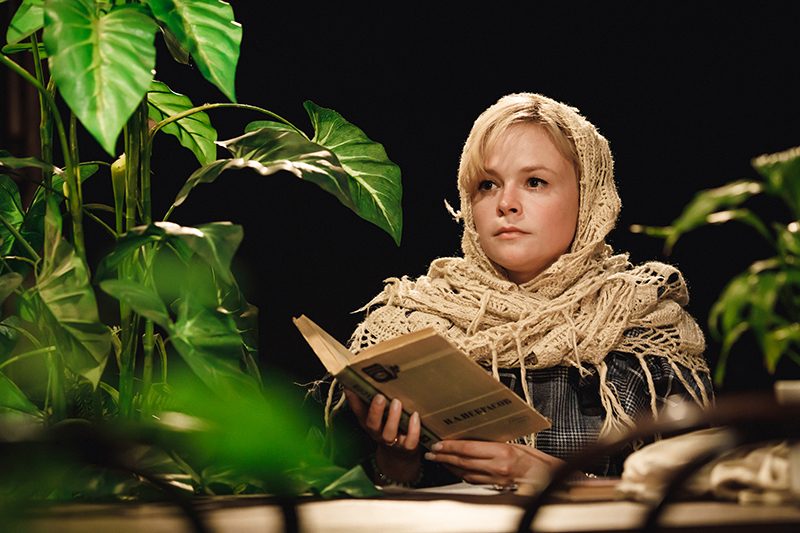
Dmitry Volkostralov was offered to put something from the classics. But he, as you know, does not engage in interpretation. Instead, he carried out the concept of Russian literature. More precisely, about the attitude of the director, characters and five actors to her - Alena Starostina, Ivan Nikolaev, Daria Rumyantseva, Boris Chistyakova and Anastasia Kazakova. Each of them offers its own version of the performance. So they alternate. I watched the opus of Ivan Nikolaev. This time it was he who chose 12 key events of Russian classics since 1799 (the birth of Pushkin) according to the 1904th (death of Chekhov). This campaign in the Russian world was once preceded by the Moscow performance (on the small stage of the Theater of Nations) “Russian Romance” . Then the director was interested in the possibility of intimate penetration into an domesticated field with birches on stage and piano, from which Dmitry Vlasik did not make romantic sound. Four actresses went out in jeans, skirts, dresses, preceded a vocal performance in historical costumes with a chitka of romance texts, designating the gap, involvement, the conflict of different times, lies and sonor context.
In the "Russian classics" of the vicissitudes of the misansen, sunbathing voices and credits on the backdrop are orchestrate more strictly, more tender, and more strange. (With the exception of the video that the characters shot, instructing the phone to each other: it seemed superfluous. However, the method of aleatoric, who, following the American classic, practices D.V., manifested itself in the “chance” so significant in his compositions.)
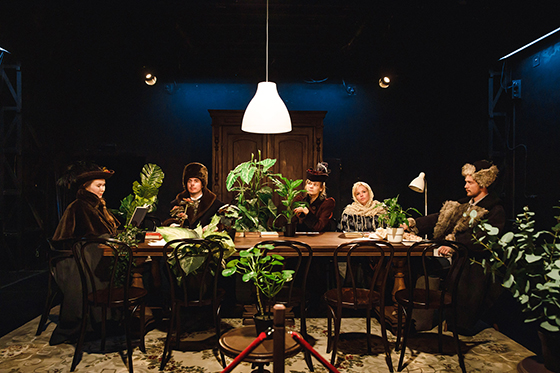
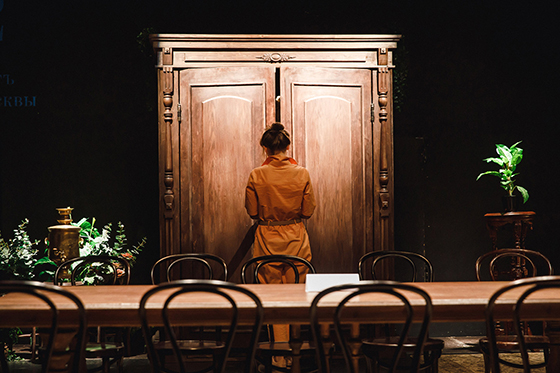
Ksenia Peretrukhina arranged a museum space on stage. And also-at the same time-the scenography of the academic theater-theater. Theater-house. Large rectangular table (hello to the fate -based oval table in the "Onegin" Chernyakov). A samovar, an old clock, a desk, a storyteller, an armchair, Viennese chairs, a multi -dedicated cabinet, a green cloth table, a console, etc. fenced with a red cord. On things - a postcard with a crossed palm: do not touch your hands. Actors in fashionable leather shorts, cotton overalls and other casual and in museum slippers are examined, curious, and they take a picture of the objective world. “And at this time” the years pass and the literary, memoir text with computer (synthesized) voices with slightly shot down intonation, orthoepic errors (“God, how the Russian Russia”, for example), sounds.
 © Natalya Korenovskaya
In the Austerlitz documentary, Sergei Loznitsa captured tourists in memorials - former concentration camps - places, in fact, unconsciousness in which they took off their selfies against the backdrop of gas stoves, barracks, chewed sandwiches and were in a hurry under the guide of the guide for lunch. The neutral camera, like the impassive directing of the “Russian classics”, fixed the endless crowds of the suffering with strollers, backpacks on a ruthlessly hot day, mainly a photo of a visit to this Disneyland.
The museum audio guide, coming in the “Russian classics” from the computer, from a remote (distant and erased from memory of spectators of different ages), sins with linings and enlightens. It formalizes the distance and tries to bring the subject-object echoes, responses. To establish touches.
“Russian Classics” is the most inconsolable performance of our (post) conceptualist.
Derzhavin’s love poems, the publication of “Dead Souls”, the marriage of Tolstoy, the creation of “Arzamas” - and go further, further. Run for an hour and a half. The actors, in the role of visitors to the museum, are stubborn, turn into a frozen zone, cross the forbidden territory and begin to equip it for themselves. And - to the Russian ancient music of Bortnyansky and other beautiful composers. Just visitors suddenly became rubbing. In a businesslike manner they rearrange chess figures, lay out a deck of cards on the cloth, start watching, raise countertops, bring an electric kettle, a lining, a table lamp, a computer, a floor lamp, a yoga rug ...
“And at this time,” Pushkin begins to write “Eugene Onegin”. And at this time, Alena Starostina exercises on the rug. The Ikeev lamp is suspended to the ceiling. Flaw. Someone writes a letter to a goose pen. And someone stretches the locks with electric power supply. Open the closet. Theatrical costumes of different eras are hidden there. And at this time, Slavophilism is born and those who have invaded the theater platform, to tea drinking are prepared. In peignoirs, caps, robes, with hoops for embroidery at a desktop lamp, in a coat with a fur a whip and a fur hat, in a sheepskin coat, earflaps and boots ... in a very warmly lit delirium. In the theater non -academic space. In Susynchron - say, the Pushkin reaction to the reading of Gogol "Dead Souls" and the date glowing in the titer.
 © Natalya Korenovskaya
Time failures. They cannot be filled with anything. Do not cancel. In the year of the abolition of serfdom, a rearrangement revives on the stage. Aim cord on metal supports, actors protect the hall from the scene mirror. Frame frames. They drag things, as if for loading, departure, farewell in the fourth act of the “Cherry Garden”. Pots with plants are stored on a long table. Artificial and magnificent, with some, possibly the only living flower, they accompany on the last journey this sensitive and/or an invasion of a Russian, at home , theatrical world. After the dying comedy of Chekhov - a replica of the early "Seagull". Playing in the lotto.
Before the performance, the actors in the lobby of the theater recorded the audience’s questions to Anton Pavlovich, Lev Nikolaevich, Mikhail Evgrafovich, Nikolai Alekseevich. Now, having changed the role of visitors to the museum and spectators to players, they read these and other questions, the answers to which are on the pages of essays that coincide with the numbers of lottery chips, pulled out - the principle of random numbers - from the bag of the host. It is clear that the answers for the most part correspond to the Chekhov Renyx 'E, nonsense.
The imaginary guidance of bridges between times, between readers and writers, actors and spectators (“Lev Nikolaevich, performance or education?”; “Alexander Sergeyevich Griboedov, are you satisfied with your own bright and short life?”; “Mikhail Yuryevich, and about what the performance?”) Is interrupted by the finished party in the lotto and the role of one, the third player, who retires behind the curtains. The party ended in the “Seagull” cited here - life ended. Not so at D.V., who projects Derzhavin’s dying poem - on his name “Russian Classic” began. “... takes away all the affairs of people / and drowns into the abyss of oblivion / peoples, kingdoms and kings. / And if anything remains / through the sounds of the lyre and pipes, / then the eternity of the burdock will eat / and the common will not leave fate. ”
The most inconsolable performance of our ( post ) conceptualist. The museum corner was still worn out of the very least cordially, sly or impudently beat. To exist in it naturally and a little in a dream. But he is only the scenery of oblivion. No illusions are fate.