
Translated material
Manege, 1962

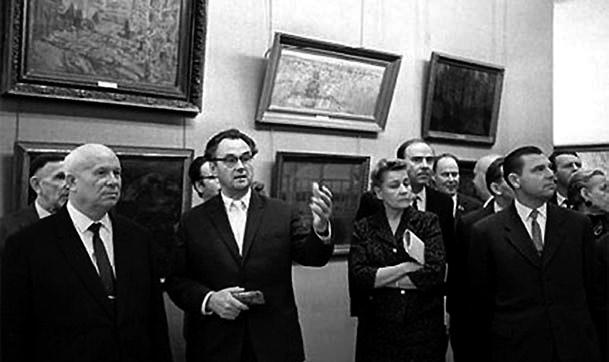
In 2002, the press and the public celebrated the 40th anniversary of the famous art exhibition of 1962 in the Manege. The corresponding event was called "40 years of non -conformist art ." It was supposed, apparently, that the meaning of this phrase is still obvious. But outside the artistic environment, not only the association of non -conformist art with the 1962 exhibition, but also the plot of the scandalous visit of this exhibition N.S. Khrushchev, which was once christened with a “hemorrhage in the Moscow Region”, remains in the boundaries of the artistic environment.
A little more-and this story will “be booked” and will be covered with a half-century patina, so that quite adults will ask “what actually could happen at the artistic exhibition“ The 30th anniversary of the Moscow Region ”?” Moreover, the certificates of direct participants and the records of witnesses made in hot pursuit, especially if they come from people of impeccable personal reputation.
Yu.Ya. Gherchuk, our most famous art critic, a specialist in the schedule and art of the book, in the carefully documented publication “Hemorrhage in the Moscow Region” (M., UFO, 2008) not only collected a lot of heterogeneous evidence together, but also tried to place them in the then social, political and spiritual context-I will note that not only as of poor persons, but often not well-known to those who, who are not known to those who, who, who, who are, who are, who are, who are not known to Like the author of these lines, he managed to see this exhibition with his own eyes.
Many years ago, Mael Isaev-on Feinberg, a famous publisher and rare talent editor, told me that the event described once -no matter how significant it may be-will be forgotten; Everything should be retold many times and from different points of view, otherwise it will not become a fact of history and will not enter the cultural turnover. This was her response to my replica "After all, they already wrote about it ...." .
There are also quite a few about Manege-1962. As emphasizes Yu.Ya. Gerchuk, these are mainly the memories of the participants in the “action”, recorded significantly later and, accordingly, transformed and polished by numerous retelling. Akhmatova called such texts “records” (today we must clarify that vinyl discs were meant).
The discussed book by Yu.Ya. Gherchuk, in the section “From the author”, says that, unfortunately, Khrushchev’s transcript with artists remained inaccessible. However, some version of this transcript was found on the Web, being published by the Rodina magazine No. 3 for 2004 (taking into account the fact that the magazine represents itself as a government of the Government of the Russian Federation, we can hope that this is one of the true options for the transcript, since there were several stenographs, see. www.istrodina.com/rodina_articul.php3?id=1081&n=57 ).
Among the known narratives about the 1962 arena, I can highlight two texts that occupy the extreme points in my personal perception. The best of me available is the memoirs of Leonid Rabichev, the artist and poet, the military officer of the Patriotic War, published in the Banner No. 9 for 2001 (see http://rabichev.narod.ru/ )
This is a great text, remarkable for genuine drama, accuracy of details, and simply perfectly written. The author with undoubted skill presented us with the majority of the actors of this story.
In his memoirs, Rabichev paid tribute to the well -known artist of that time Eli Belutin - the head of the art studio, a person of considerable scale and rare organizational abilities. This is significant, since the role of Belyutin in a complex of events related to the conflict around the exhibition itself and the visit of Khrushchev, as it is now customary to say, is “ambiguous”-accordingly, it is differently evaluated by participants and witnesses of this whole story.
Leonid Rabichev also analyzed the rather prudent strategy of Ernst Unknown - about his strategy and relations with Khrushchev have always circulated incompatible opinions. Yu.Ya. Gerchuk also considers the story of Leonid Rabichev most adequately reflecting the events of that time.
Another detailed description of the same events - with an emphasis on the role of Belyutin and the work of his studios - belongs to the pen of Nina Moleva, the famous art critic, the wife of Belyutin. Given everything that happened, it would be strange to expect impartiality from its texts - but the addiction is also different. Ernst is always addicted to the unknown person - but his hyperboles, in plastic, in verbal work, are designed for the artistic effect and therefore do not cause the feelings of the "knife on the glass." In general, Leonid Rabichev’s memoirs are designed for the direct perception of the reader, who does not have to know about Mosha and his history, and even more so about how the circumstances inside Mosch had developed after the visit of Khrushchev. We agree that this is really not everyone is interested in everyone.
 As the Manege of the G. Rezin wrote in connection with the 40th anniversary of the Manege of the 1962, the fact that the method of action of the Soviet bureaucracy from art first crawled out, we could first and for the last time evaluate their level. But in this story it is easy to judge how Soviet art developed before what intrigues turned there and what people worked there. ”
It is clear that this specificity cannot be described in several paragraphs. Gerchuk’s book just reconstructs the context of the then artistic life for an interested reader. Here, however, the question arises of the addressee of this book - this will have to be returned later.
For obvious reasons, Yuri Yakovlevich Gerchuk took upon himself the role of one of the "latest witnesses." Witnesses , not judges. (As he himself writes, “But are there many people who remembered this exposition well?” ) Hence the large number of archival links, the maximum restraint in the assessments and a relatively detailed story about how artistic life in Mosha was immediately before the exhibition, as well as after the “arena”. The composition of the book corresponds to this plan.
The introduction proposed - as necessary, the most brief - the outline of the era of the "thaw" with the mention of iconic political and cultural events. Part one “too good exhibition ...” is devoted to the preparation of the exhibition, the selection of paintings, the author’s impressions of the exposition and two discussions of the “arena”, which passed immediately after the opening.
Few people remember that this exhibition was opened on November 4, 1962, i.e. On the eve of the main public holiday. Already by virtue of both time and place it was an event of life , and not just an art exhibition. And on November 28, a prize of a hundred thousandth visitor was already awarded in the Manege. The people really burst - I don’t remember who took the turn with my husband ...
In November, two discussions of the “arena” took place: one - in the circle of professionals, art history from the Institute of Arts of Arts and Moscow State University - by the way, was gathered. The second discussion, as it was then accepted, “with the audience”, passed right in the room of the Manege. The official press was favorable, and in the “Week” (an appendix to Izvestia) a serious article of the famous artist Andrei Goncharov (1903–1979), a student of Favorsky, was printed the only article that came out before visiting the Manege Khrushchev.
Gerchuk talks about another “battle” - this is a conference at the Institute for the History of Arts of the Academy of Sciences of the USSR on the problem of “tradition and innovation”, which took place at the end of November and at first glance in no way related to the further development of events. This conference was such people as Lev Kopelev and Mikhail Romm, and their opponents were the then editor -in -chief of the October magazine, the Armed Forces. Kochetov (more precisely, not personally Kochetov - he was not there, but the whole pogrom policy of this magazine) and the skilled courtyre chairman of the Union of Artists Vladimir Serov. You can imagine the intensity of passions - and partly predict the possible consequences.
Documents show that Khrushchev came to the “prepared” arena, among other things, also on November 29, 1962 at the Presidium of the Central Committee of the CPSU (!) The discussion of the “Yabeda” of the group of artists who smashed formalism. In the partially preserved "Tsekov" draft of this discussion, in particular, there is such an eloquent record:
"T. Khrushchev N.S. <...> Mb,. Send someone . ”
I note that this draft is published in a book that probably deserves close reading, see: Presidium of the Central Committee of the CPSU1954-1964. T.1. Black protocol records of meetings. Transcripts. M., 2003. S. 649.
The first part of the book ends with this plot, and then the second part follow - “Khrushchev in the arena” and the third - “After the“ arena ”. The second part, from my point of view, will be interesting to the wide reader, while the third is more careful for specialists.
The drama of the scandalous visit of Nikita Sergeyevich has been described more than once and in great detail; At one time, I read about it, but I managed to forget the details. Many will be curious as the story of supposedly spontaneous, but in fact masterfully played inclusions of the work of the Mosha’s anniversary exhibition of artists of the Belyutin studio, nothing to do with the history of Mosch, who had not had a reset of Mosch. At the same time, the names of Yulia Zobolev’s Yuri Sobolev say little to today's reader-and then their work was in sight, because their constant “platform” were such superpopular magazines as “Knowledge-Strength” and “Chemistry and Life”, which were published in the 60s with huge circulations.
And this returns us to the question of the addressee of the book.
It seems to me that the book would have won a lot if, instead of a large number of photographs of Nikita Sergeyevich, the reader could see at least a graphics on the same tabs, for example the same poster. This would fill the significant remark of Gerchuk, that there was no scandal at all in the arena around the section, but not because only something traditional was hanged there - by no means! It was just that graphic art itself was considered not so important then. (Well, yes! Therefore, we tried not to miss the art exhibitions of the book in Kuznetsk, which, if my memory does not change me, in the “thaw” period were almost annual.)
The appendix published materials that are little or almost completely inaccessible to today's reader - these are some newspaper articles of that time, including the article by A. Goncharov from the “Week”, several unrelated essays about the exhibition and the memoir outline of the famous schedule Illarion Golitsyn.
In addition, thirteen characters, including Nikita Sergeyevich himself, were awarded the short, but expressive “personalities” written by the author of the book. At the same time, Yuri Yakovlevich noted that these portraits (they are united under the title “Actors”) are just runaway sketches, perhaps biases and, if necessary, are short.
A bibliographic apparatus is included in the notes, including numerous links to archival funds. In general, everything that has been done is done very carefully (by the way, the editor of the book “Hemorrhage in the Moscow Region” Galina Yelshevskaya is an known art critic, the author of articles and books).
And what would I like to see what were done differently?
The book by Yu.Ya. Gherchuk was published by a circulation of 1000 copies: today it is a “massive” circulation, i.e. The addressee of the book is just not experts. And then at least a nominal index is needed: a wide reader, most likely, does not know not only the works of A. Drevin and K. Histomin, but also their fate; He cannot correlate in the time of the names of V. Favorsky, A. Goncharov and I. Golitsyn and certainly will not be able to understand why there were passions to boil around the painting of David Sterenberg shown by the viewer for the first time after a long interval of the painting of David Sterenberg.
P. S. You better understand what I mean, if you look, for example, here: www.artsait.ru/art/sh/shterenberg/art3.php