
Translated material
Two victories
Around Russia
 Two victories
November 12, 2012 Julia Latynina
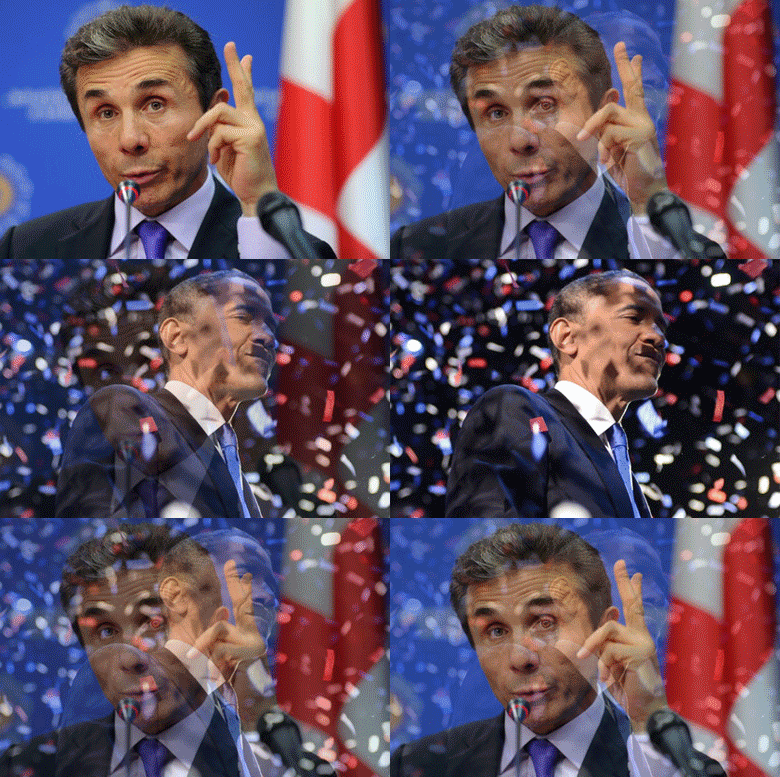
In Georgia, in the Georgian Dream elections, Bidzina Ivanishvili defeated the ruling party of Saakashvili, and in the USA in the election of Barack Obami won Romny.
An experiment was delivered in Georgia: are radical market reforms compatible in a poor country with universal suffrage? It turned out - not compatible.
It turned out that the Georgian voter can be bought with promises. Bidzina Ivanishvili promised to reduce gasoline and housing and communal services, cancel interest on loans, increase his pensions and invest a billion dollars in agriculture.
It would seem that this crazy set of populist promises is a sufficient reason not to vote for Ivanishvili. But - they voted, and it is easy to see that three social layers contributed to the victory of Ivanishvili. The first is people who are used to, that the state should take care of them. Yes, Saakashvili gave freedom to business, but a minority is engaged in business.
The second is the intelligentsia. People who, by definition, exist parallel to the economy, and any layer, money is not earned, is inclined to absolutize their life experience and talk about how good it would be to provide everyone with happiness.
And finally, not all businessmen were satisfied with Saakashvili. After all, not all businessmen want minimal taxes . Many people want maximum preferences.
Of course, America, with its richest public humus, with its great tradition of civic responsibility and self -organization of citizens, cannot be compared with the post -Soviet Republic, where the self -organization and responsibility of citizens burned with a hot iron as an anti -people's phenomenon. And if Obama simply told that he would add money and reduce prices, then it was too much for MSNBC.
But alas, in the US elections, the country was divided very clearly: those who pay taxes, and those who receive one way or another from the state.
Amazingly, but the fact: the Obama campaign was built, first of all, on criticism of the opponent (“with Romny it will be even worse”) and promises. The president, who was in power for four years, like Putin in 2011, did not report in success-he promised.
Because there was no success. The US debt over four years of Obama reign increased by 50% and amounted to 50 thousand dollars. From each, including the baby. Because the number of those sitting on Food Stamps increased by 46% and amounted to 46.7 million people.
Moreover, President Obama was the first president in the history of the United States, who built his election campaign in fact on calls for class hatred. Only he did not appeal to the poor. He appealed to the parasites. It is to the complexes of the parasite that his famous speech is addressed: "If you have a business, it is not you who created it."
Despite all the dissimilarity of poor Georgia and rich America, the motives, according to which one or another social layer voted for Obama, is the same. The first such social layer is those people who are pleased to hear that if someone has done a business, then this is not his merit, and who are pleased to know that everyone owes them.
The second is a huge number of intellectuals, which sometimes earn very well, have the most distant ideas about economic realities, but control most of the media and university centers. Amazing, but the fact: in this campaign, Romny could not even ask Obama the most pressing questions, because any such question, thanks to the instant flock of the liberal media, turned against him. When Romny only tried to ask what Obama did during those seven hours, while al-Qaeda terrorists stormed the consulate in Benghazi (and Obama still does not know what his administration (not terrorists) did, as Putin still does not know what his administration (not terrorists) did in Beslan)-campaign was immediately organized, reminiscent of tears, reminding him of tears. The Kremlin campaign against Bolotnaya-"as-no-no-west-good-laugh-laugh."
And finally, the third is business. I don't want to simplify. Oh no, the US corporate sector felt a danger, and for the first time in many years, donations of corporations of the Republicans exceeded their donations to the democrats ($ 533 million against 445), which in itself is unique, because there is a hard trend in the US election campaigns: they always give the most money to the one who won.
But the horror is that a large state always forms a large business dependent. No, no, the machine of American business is so great and effective that it will not soon reach the state of corrupt petrocracy and even socialist Europe. But still, the fact remains: BP-a foreign company-in the USA at Obama divided and produced; And its own General Electric, having received a profit of $ 14.2 billion in 2010, paid zero taxes and received $ 3.2 billion in tax deductions.
The bankrupt Solyndra produced excessively expensive solar panels and hoped to survive, receiving orders from the government. And when the Chinese reduced the prices for batteries three times, Solyndra died completely, not only taking with them 535 million dollars of taxpayers, but also generating the co -owner of the Caiser, a prominent sponsor of Obama - future tax deductions for the mother’s campaign in the amount of $ 600 to 800 million.
No, this is not corruption, but this is no longer the market. The whole economy generally loses from state surgery, but George Kaiser (and GE Head Jeffrey Immelt, heading President's Council for Jobs and Competitivence) clearly won him.
In principle, there is nothing wrong with the poor help. The problem is that under the guise of helping the poor, the state increases its own influence and does not engage in help, but an increase in their number .
A large state takes money from those who have earned it and turns it into a drug, which is injected to those who have not earned money. A large state turns into a large drug dealer, who is beneficial for the majority of the population to keep populist promises on the heroine of social assistance and LSD.