
Translated material
"Khudvor"
Where did the strange legend come from about the “isolated economy of the USSR”?
In any “projects” and “plans of the future”, which many were allowed to compose now, a story invariably pops up about some new “USSR 2.0”-with closed borders, “production of everything in the world” (and what is not possible to do-so “industrial espionage”). They supposedly lived grandfathers in the USSR for an “iron curtain”, under “sanctions” and “cut off from the whole world”, and we will live. However, before discussing the new construction of the “isolated USSR”, it would be nice to figure out how socialist industrialization actually passed, and to understand how the idea of an “isolated economy” came to the authorities.
From "concessions" to "technical assistance"
Complete Comrade Stalin or Comrade Dzerzhinsky a hundred years ago to hear about the “self -sufficient USSR”, they would probably order what kind of provocateur is a wrecking line across the victorious entry of socialism (only his class enemy taught!). The history of the economy of the USSR is a greatly history of skillful involvement in the country and the use of the most advanced technologies of the Western world.
The Bolshevik-Leninets must be able to combine Russian scope with American businessiness, he taught Comrade Stalin in his famous lecture “On the Basics of Leninism”. But the Bolsheviks combined the “Russian scope” not only with American businessiness, but also with the “German order”, “sharp Gallic genius”, and most importantly with technologies, machines and equipment, as well as with the experience and knowledge of foreign specialists. Foreign firms participated in the design of Soviet enterprises, sent consultants to them, and helped to master new production technologies.
In the 1920s, during the NEP, the bet was made on a joint business with "capitalist predators." Foreign companies were invited to rent certain production with an obligation to establish their work (concession), enter into contracts and organize joint ventures. The first agents of the modernization of the Soviet economy were entrepreneurs from Weimar Germany. By the end of 1923, 16 German concessions operated on the territory of the USSR. The largest was the forest concession of the Mologa Society, which received about 1 million square meters. The tower of the forest along the railway line Petrograd - Rybinsk. The largest Germanic companies AEG, AG Krupp, Hugo Stinnes GmbH, Junkers entered into business contacts with Soviet economic organizations. True, despite the officially proclaimed policy of “open doors”, Western capital was weak in the USSR: entrepreneurs did not trust the Soviet regime fighting private entrepreneurship.
The great economist John Meinard Keynes, who visited the USSR in 1925, explained to the leaders of the Soviet "national economy":
QUOTE
“You cannot create an economy completely isolated from the rest of the world. You need a technique - cars, guns, need capital. You can get the necessary funds for the development of the economy, for example, by loans. But it is unlikely that anyone will give you a loan now. The second path is concession. But when concluding concession agreements, the capitalists will impose their conditions for you if they still risk investing their money in your country. The concession case is very risky. Not for you, of course, but for the capitalists who risk their money ... "
Gradually, concessions were replaced by technical assistance agreements. Capital and labor were Soviet, and a foreign company was hired for the design of the enterprise and (or) construction and installation works. The company developed documentation, transmitted its licenses, patents, technologies, sent specialists for technical supervision of construction and accepted Soviet engineers and workers to study production experience. Foreign partners no longer risked their capital and received a reward for services.
The first step into space

The most significant project in the field of Soviet-German technical cooperation was an agreement signed in November 1922 with the company "Junkers", on the organization of metal aircraft and motor construction in the RSFSR. The German firm was transferred to the plant in Moscow Fili (formerly Russobalt). At this plant, from the details produced in Germany, for the Air Force of the Red Army, Yu-20 reconnaissance aircraft and the modernized Yu-21 reconnaissance gathered. By the beginning of 1925, more than a thousand people worked at the factory in Fili, the area of industrial premises was 15,000 m2.
In total, with the participation of the Germans by the end of 1925, 170 aircraft were built. Up to 30% of the funds allocated for the development of aviation in the USSR took the payment of “Junkers”.
True, in March 1926, the contract with the company "Junkers" was terminated.
The official reason was the failure to fulfill the obligations of metal aircraft and the development of motor production taken by the German company. All property of the plant, including drawings, turned into the ownership of the USSR. At the same time, the Soviet government paid the Germans a penalty of 3 million rubles in gold.
In the development of the Soviet aircraft industry, French experts played a significant role. As the famous Soviet aircraft designer Vadim Shavrov said in his book “The History of Airpowers in the USSR”, in 1928, Paul Eme Richard , a French aircraft engineer, a specialist in hydraulic lines, was invited to work in the USSR. To ensure its work, a special design bureau of the sea experimental aircraft engineering of the All -Union Air Board at the plant No. 28 with a production base at the factory was created. A three -year work plan of the Richard Bureau, which included up to ten facilities, was drawn up in the Aviatrest. Richards received several dozen Soviet designers, among whom were many future stars of the Soviet aircraft industry - designers of S.A. Lavochkin and M.I. Gurevich, creators of the seaplanes G.M. Beriev, I.V. Chetverikov and V.B Shavrov, builders of the first Soviet helicopters N.I. Kamov and N.K. Skrzhinsky. S.P. Korolev - yes, yes, the same, future conqueror of space.
"American businessiness" in the service of the USSR
In the late 1920s, Americans joined Soviet industrialization. We quote Comrade Stalin again:
QUOTE
“American businessiness is that indomitable force that does not know and does not recognize the barriers that blur all sorts of obstacles to its businessary persistence, which cannot but bring to the end the work that has begun, if it is even a small business, and without which a serious construction work is unthinkable.”

Of the 118 technical assistance agreements concluded in 1920-1930 (mostly in 1928-1930), 64 fell on the share of American companies (54%). Of the 218 agreements operating during 1929-1945, 64% already accounted for American firms (German companies received 15% of the contracts).
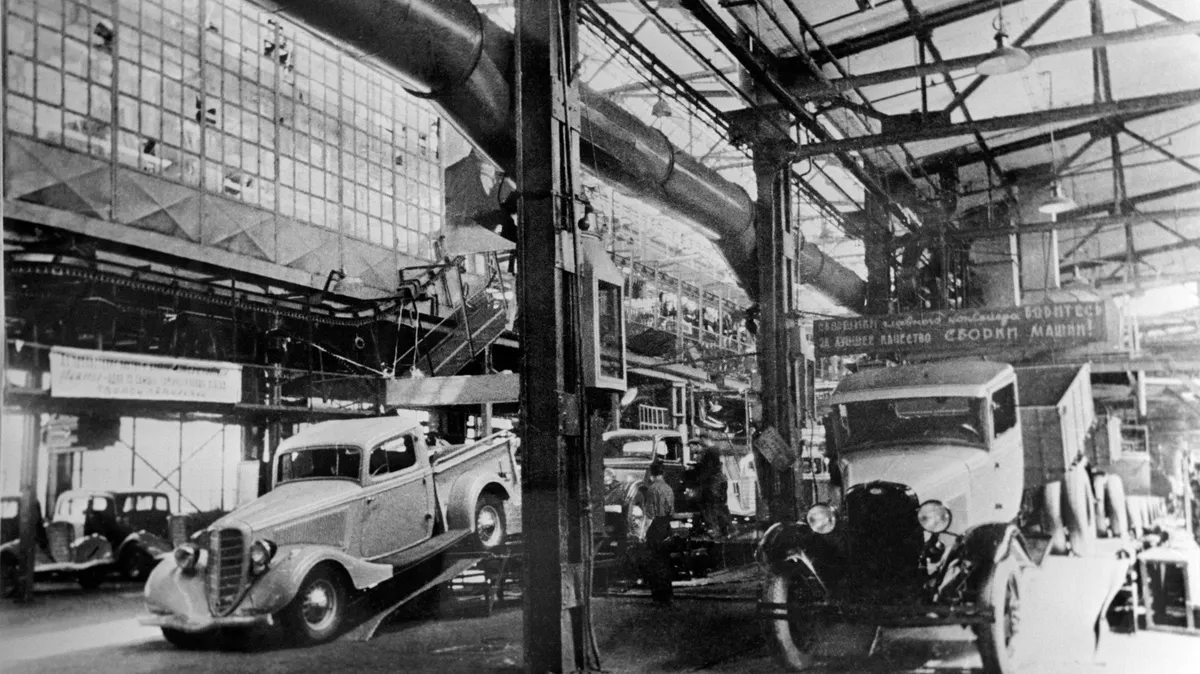
Within the framework of these agreements in 1918-1933, about two thousand American firms concluded agreements with Soviet foreign trade organizations. Some of them provided services to entire industries. So, the Radio Corporation of America established the production of radio equipment, General Electric helped the development of the electrical industry and supplied equipment on the Dnieper (70% of the equipment of this power plant was American production). Dupont de Nemurs helped the development of the chemical industry. The architectural and construction company Albert Kahn Inc, which built automobile, tractor and aviation plants in the United States, designed more than five hundred industrial facilities for the USSR, including the Stalingrad and Chelyabinsk Tractor Plants, and also prepared four thousand Soviet architects and engineers. A special head of the history of Soviet-American technical cooperation is the creation of a car factory in Nizhny Novgorod (future gas) with the participation of Ford Motor Company and The Austin Company.
The acquisition of know-how, services of specialists and equipment was carried out centrally, through specially created for this in all major European cities, trade missions. The most important role in the process of attracting foreign technical assistance in the USSR was played by amtorg (American trade), or Amtorg Trading Corporation-a joint-stock company established in the state of New York (USA) in 1924 in order to promote the development of Soviet-American trade and the intermediary in the implementation of export and importing surveys of Soviet foreign trade associations with American companies.
Since 1924, amtorg has published the monthly scientific and technical journal "American Technology and Industry" (American Engineering and Industry), who was sent to the USSR and spread to Soviet enterprises and scientific institutions. In addition, through amtorg, American engineers were hired to work in the USSR, and he took care of Soviet engineers in the United States. In November 1932, about five thousand foreign engineers worked in the USSR, the Americans among them ranged from 20 to 30%, and more than half came from Germany.
Soviet industrialization through the eyes of an American worker
However, not only engineers rode from America to the USSR, but also highly qualified workers. One of these masters, a graduate welder John Scott, became the author of an extremely interesting book “Behind the Urals: an American worker in the Russian city of Steel”. In these memoirs, Scott shared his impressions of his work in the construction of the Magnitogorsk Metallurgical Plant. Describing the activities of distributors, John Scott remarked:

QUOTE
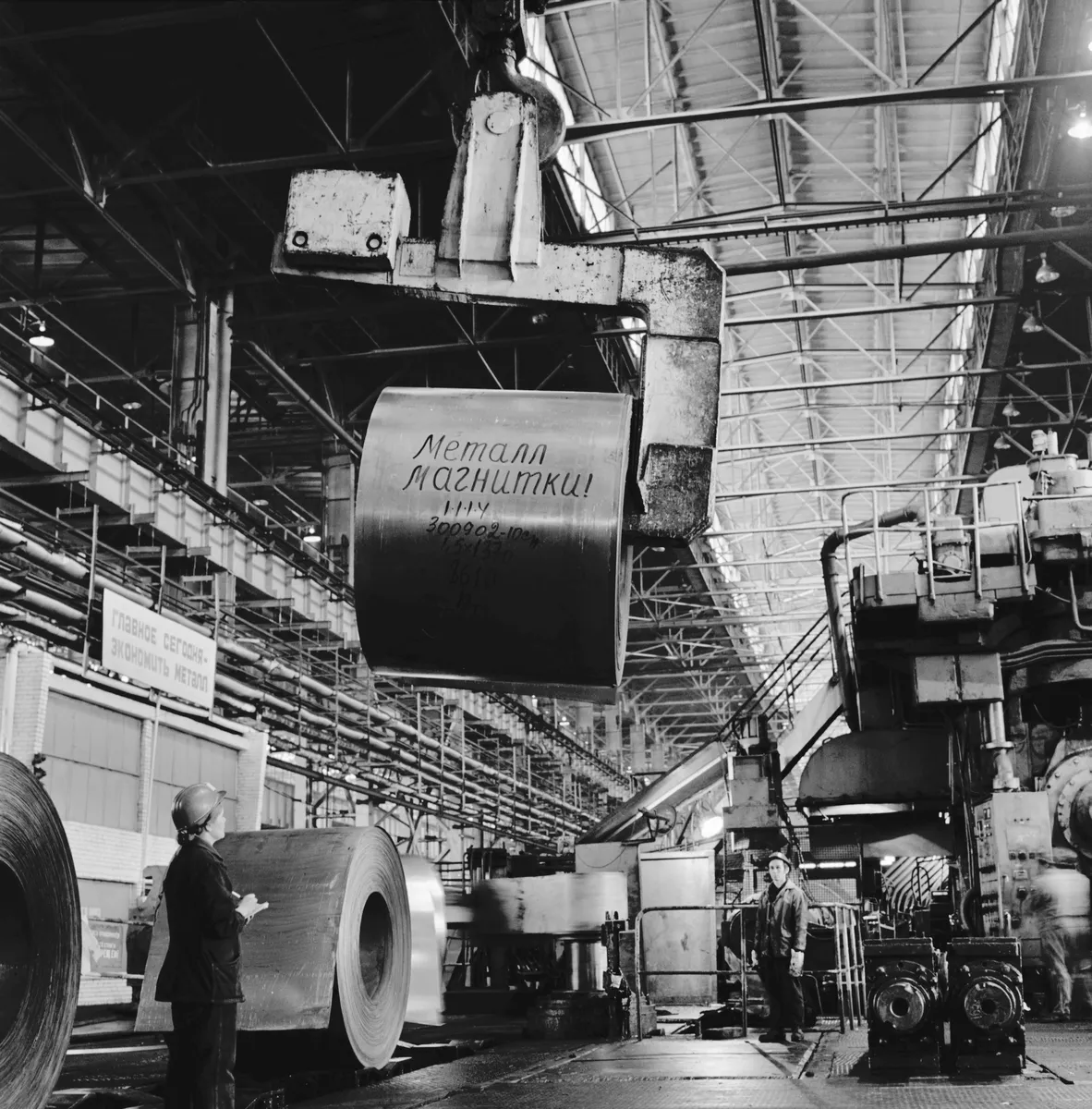
“The rental workshop consisted of a squeezing blooming camp, the mechanical parts of which were made by the German company Demag, electrical equipment - General Electric, and its performance theoretically amounted to 900 thousand tons per year. There were also a 450-mm and 630-mm leaf rolling mills, on which flying scissors and mechanical equipment of the Demag company, a sequential-type 500-mm varietal-on-box (the so-called Cross-Country), and a 300-mm average and 25-mm-rolling plant, were installed. As Skott added busily, “Stan -500 cost 12 million 240 thousand rubles. About 60% of this amount was paid by gold, for which the best equipment for rolling mills was purchased in the world. ”
Indeed, the main designer of the famous Magnitoga with all the infrastructure was the engineering and design company Arthur McKee Company of Cleveland. Part of the work was completed by Koppers Construction Company of Pittsburgh, and German specialists designed the rental workshop.
But that was not all.
Researcher of the history of Magnitogorsk A.N. Makarov wrote :
QUOTE
“Foreign technologies were used on the construction of the plant everywhere and for a long period. There are pictures indicating that most mechanized works were carried out through foreign equipment. For example, a tank for the German company Orenstein-Koppel, slag and cast-iron buckets of Duigerst and Bamag firms, as well as Khoper-Kara with ore on lifting overpass were recorded. <...> In addition, the assembly of foreign cars at domestic factories was practiced. The museum pictures recorded the 220-ton crane of Morgan and the 125-ton pavement of the Demag Famuline, collected at the Kramatorsky Plant. "( Makarov A.N. The history of the construction of the Magnitogorsk Metallurgical Plant in the reflection of the Soviet photo report ).
At the same time, foreign equipment was often used "for everything." Special correspondent of Komsomolskaya Pravda S.D. Narignani left a certificate of how inefficiently the American excavator “Marion” was used. According to him, “in the summer the excavator was forced to make long trips on construction. In the fall, Marion made a steam hammer, and he scored the openings. In winter, Marion was forced to play the role of a samovar on the dam and warm water for hot concrete. In the spring, Marion finally fell into the hands of the Komsomol members and, having received the serial number "Twelve", went to the blastes. "
Tale of "Closed Economics"
You can list the participation of companies from the most “unfriendly countries” in the creation of the Soviet industry almost endlessly. That's why the Soviet Union has never been closed is for the most advanced technologies.
“Iron Curtain” is about the fact that the Soviet person could not go to the west just so that there there is one to walk along the streets, but only as part of the group. But to bring something to the USSR and establish production-this power wanted this most.
Therefore, in the 1920s, German and Swedish machines were carried in the USSR, German engineers and French designers rode, in the 1930s American engineers, designers, architects went, even workers from American factories went to an alliance and “brought with them” conveyors and cars. In the first half of the 1940s, machines, vehicles, equipment entered the Lend-Lease from the United States, in the second half-machines and equipment were carried from Germany in reparations (also brought German engineers and scientists-physicist Nikolaus Ril received the Stalin Prize and the title of Hero of the socialist Labor). In the 1960-1970s, equipment and technology went from the countries of Eastern Europe, a car factory was brought from Italy, technical cooperation with Germany is a special topic, books can be written.
So where did the idea of some kind of heavenly USSR, which was closed in itself, have a fairy tale about the fact that “we are our own forces in the world” come from from the current “designers of the future”?
But, I think, where. From the "economic courtyards" that were arranged in many Stalinist camps.
QUOTE
“In some camps, the boss had a large economic swing, and he found an engineer with fantasy - and in the camp zone the mighty huddle was growing, already conducted by papers, already with open states and undertaken to carry out industrial tasks.But he could not squeeze the planned supply of materials and tools, therefore, having nothing to do, he had to do everything, ”wrote Alexander Solzhenitsyn in the Gulag Archipelago ( part three, chapter 22 ).
“We will talk about one Khozhor - Kengir camp. We will not even mention the tailor, binding, binding, carpentry and other similar workshops, these are trifles. Kengir Khozhodvor had his own foundry, his locksmith workshop and even - just in the middle of the 20th century - made his drilling and sharpener machines shrubly!
True, they could not make a turning themselves, but the camp lend was used here: the machine was stolen from a production facility in broad daylight. This was arranged like this: they adjusted the camp truck, waited for the head of the workshop - the whole brigade rushed to the machine, re -tossed him at the truck, and he easily went through the watch, because the security was agreed - and on the go brought the machine to the camp, and that’s it!
And what just did not undertake to do this Khudvor! “Not everything would have taken up for everything.” They were taken to make large clay pipes for sewage. Windmill. Solomes. Castles. Water pumps. Repair meat grinders. Sew transmission belts. Repair autoclaves for the hospital. Sharpen drill for trepanation of the skull.
Why, what will not undertake to do hopelessness! Hungry - guess.
After all, if we say: we will not be able to, we won’t be able to drive tomorrow for the zone. And in the Hudwor there is much volgum: neither divorce, nor walking under the escort, and to work more precisely, and you will do something yourself. The hospital for the order pays for “release” for two days, the kitchen is “added”, someone is a mahorka, and the bosses will also throw the official bread ... ”.
Here are those who are now sings about the “closed USSR 2.0”, just sings the stories of their grandfathers about what they had a noble “economic yard” in the camp! So they imagine the country's economy - a camp, a “Hudwor”, and they are the hosts in that camp. And we are in the courtyard to work on them, and “on the hospital” we ourselves also hunted for ourselves.
Will they be able to repeat?
So, the modernization of the USSR would not have been possible without “Western” technologies and machines. But the question is - where did the funds come from then? Indeed, at the start of industrialization, the share of GDP accumulation in the USSR increased from 13% in 1928 to 30% in 1932-this was the highest level of all any kind of economies comparable in terms of that time.
Where did capital come from in the Stalinist USSR? Answer:
Lack of capital compensated for labor, or rather, extreme taxation of people's consumption. People were paid much less than they earned, and the goods were roads.
But I did not have to choose - an alternative to work for relatively little money at the plant was almost free work on the collective farm. Неудивительно, что люди выбирали завод — если в 1928 году городское население составляло 28,1 млн человек, то в 1939-м — уже 54,7 млн. Экономисты называют это мобилизацией рабочей силы для промышленности — путем принудительного вытеснения ее из традиционной сферы занятий (в данном случае из сельского хозяйства).
Проблема в том, что сыграть этой картой в истории можно только один раз. Как только избыточная рабочая сила, которую можно черпать из деревни, заканчивается — а в СССР это произошло в конце 1960-х годов, — так экономическая модель индустриализации — «берем работника из сектора с низкой производительностью труда (деревня), ставим в сектор с высокой производительностью труда (завод) и получаем рост экономики», — перестает работать.
Попытка построить «СССР 2.0» по лекалам сталинской модернизации уже невозможна — для этого в стране просто нет такого количества дешевых рабочих рук.
Правда, «структурная трансформация экономики», о которой рассуждают власти, как раз и предполагает перемещение рабочей силы с высокопроизводительных рабочих мест с высокой оплатой на низкопроизводительные рабочие места с низкой оплатой, но в этом случае экономического роста ожидать не приходится — так, поддержание уже имеющегося. Элиты РФ продолжат купаться в роскоши, как они это делают сейчас, но экономического роста не будет.