
Translated material
Not to figure it out without programs
The success of public protest depends on the fact that its leaders will offer society, including in the field of economics
The success of the manifestation of December 24 last year raised the question with all its acuity: what's next? After all, it is impossible to forever gather with white ribbons and angrily denounce the “hated regime”. We need a program, but it is not. That is why during this year it is extremely necessary to conduct a public discussion about the ways of modernizing the Russian economy and the social sphere and, in its results, draw up an indicative plan of specific actions for the near and medium -term perspective.
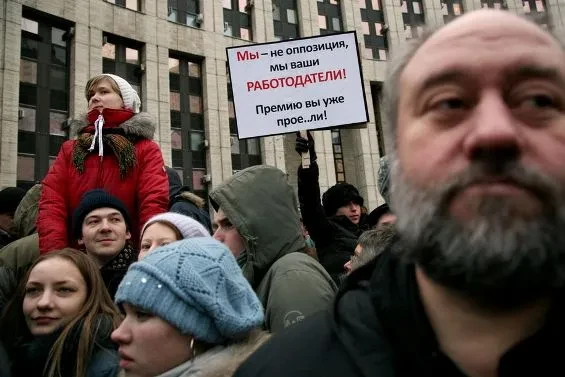
The success of the manifestation of December 24 last year raised the question with all its acuity: what's next? After all, it is impossible to forever gather with white ribbons and angrily denounce the “hated regime”. We need a program, but it is not. That is why during this year it is extremely necessary to conduct a public discussion about the ways of modernizing the Russian economy and the social sphere and, in its results, draw up an indicative plan of specific actions for the near and medium -term perspective.
As the beginning of the conversation, we present the author’s vision of the country's modernization priorities.
The first priority is a person, the protection of his health, creative potential . Here are just some measures that will contribute to the implementation of this priority.
Firstly, regional funds of assistance to seriously ill children should be formed, forming them by deducting at least 1% of all tax revenues of regional budgets, as well as charitable contributions (while donations should either be exempted from all regional and local taxes, or the amounts of taxes should be compensated from the regional budget). The management of the fund should be carried out by citizens of regions at a free basis.
Secondly, the most important regional task should be the reduction by 2020 to a 25% share of graduates who graduated on a budget basis full-time departments of state and municipal educational institutions and did not find work in the specialty. In 2009, in Russia as a whole, only 33.4% of graduates of secondary education institutions received areas.
Thirdly, it is necessary to contribute to the spread of the Internet, allocating funds not to providers, but to future users, compensating them for part of the cost of connecting to the Internet. At the beginning of 2011, only 43.9% of the population and organizations could count on the accession and passage of traffic.
The second priority is the development of the regional and municipal industry . The instruments for the implementation of this priority should be federal, regional and municipal support of industrial enterprises, the introduction of industrial outsourcing and the development of production infrastructure.
Firstly, the regions do not need to strive to become advanced in high-tech spheres (besides, in any country in the world, the innovative sector in isolation from real production is not a significant share in GDP). At the same time, many industrial giants are concentrated in each area, they are due to administrative, financial and fiscal measures and should become the basis of regional and local industry, which means budget revenues.
Secondly, regional economies need to develop both inter-regional and international industrial outsourcing, in other words, in every way to encourage the transfer of production from the regions, ideally-countries with higher costs per unit of products. Here, a decisive role can play the proximity to the capital, where rental costs, wages or logistics, the corruption component is significantly higher.
Thirdly, infrastructure projects implemented in the format of public-private partnership or PPP should be one of the main areas of budget expenditures.
One of the specific steps could be the implementation of the idea of Vladislav Inozemtsev on the creation of a regional energy efficiency fund. A fund that could be by order of enterprises to purchase and install more efficient energy and utilities. And the enterprises would have pledged for 5-6 years to transfer 90% of the saved cost difference for the spent fuel to the fund.
The difference between the proposed PPP scheme and the usual leasing is that the new equipment will not be paid by installments, but due to saving funds (and it can amount to 40% of the cost of fuel and energy) to reimburse the fund spent by the fund. It is possible that the funds will be profitable! And, of course, its complete transparency of expenses should be an indispensable condition for the work of the fund.
The third priority is to improve the business climate in society . We give only three possible measures.
Firstly, the participation of public entrepreneurial associations in meetings of regional administrations devoted to socio-economic issues, as well as in the work of relevant units of regional and local authorities, should be ensured. It would be reasonable to introduce the practice of coordinating decisions with entrepreneurial associations.
Secondly, it seems important to consider the possibility of compensation by the enterprises created by part of the costs of joining production and communal infrastructure (energy networks, roads, and solid waste disposal facilities). At the same time, the administrative regulation should be accepted, excluding the emergence of “new” enterprises based on existing companies, which, of course, may be.
Thirdly, it is necessary to develop a special program to counteract corruption at the regional and local level, creating special units with special functions under the regional and general prosecutors, the main task of which would be the operational response to entrepreneurs about corruption in power structures.
The fourth priority is to promote the introduction of innovative developments . The commercialization of innovation in the production cycle is the "Achilles fifth" Russian economy. Unfortunately, a significant part of innovative proposals does not find their application in Russia, “emigrating” along with their developers to other countries.
Firstly, it is extremely relevant to facilitate the administrative and tax burden for newly created innovative companies (Start-UP), freeing them for a fixed time from rental, utility bills, as well as deductions to regional and local budgets.
Secondly, it is necessary to develop a list of types of economic activity, enterprises of which can be considered innovative. At the federal level, there is no such list before their pore.
Thirdly, a significant part of regional budget resources should be directed to material support for commercialization of innovation, for which the regional innovation support fund should be created, whose consultative councils should include representatives of regional authorities, members of industrial and entrepreneurial associations, independent experts from Russia and other countries.
The fifth priority is to reform the economic basis of local self -government . Modernization at the regional and local levels is not so much in participating in federal modernization programs, but in achieving the advanced growth of basic socio-economic indicators in comparison with other regional entities. The formation of municipal modernization clusters should occur as follows.
Firstly, the increase in energy efficiency and the development of energy conservation within the framework of the federal modernization program by updating consumer equipment.
Secondly, the modernization of the economic basis of local self-government. The specifics of modernization should be the development of the economy of municipalities and optimizing the use of the municipal treasury in order to reduce lag behind the most developed municipalities.
Thirdly, the creation of institutional conditions for improving the effectiveness of municipal entrepreneurship, optimizing the financial and economic activities of existing municipal unitary enterprises and business companies with municipal participation, establishing new municipal business organizations and joint-stock companies. In this case, the emphasis should be placed on the maximum use of local competitive advantages.
The proposed measures, of course, are not the only ones, and their list should be supplemented and expanded. One thing is clear: the discussion carried out in a short time (and the opposition has funds) will contrast the folk program for the official modernization. It will become clear whose stronger.