
Translated material
The shelter of a wretched Chukhonets
In the New Helsinki Museum of Contemporary Art of Kyasma, you can join all the latest museum trends
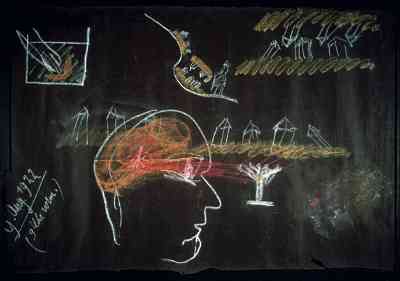
In Chiasm, art can be found and not very modern. For example, drawings to his lectures by the philosopher-anthroposopher of the beginning of the century Rudolf Steiner. A huge Swiss exhibition of these drawings, allegedly influencing many contemporary artists, takes place in Kiasme until mid -September (Kiasma: The Central Art Archives)
The name "Chiasma" (this is how the Finns themselves offer it to write in Russian on their Internet website www.kiasma.fi ) was invented by the author of the museum building Stephen Hall.
Now his plan is explained by souvenir T -shirts, bags and daddy in a museum store: an article from the dictionary is placed on them - in the spirit of the main conceptualist in the world Joseph Koshut, who turned excerpts from dictionaries into his paintings. I also bought a branded T -shirt and now, not understanding medical subtleties, I carefully translate the text from my own abdomen:
Hiasm 1. (Genetical) The exchange of parts between two of the four chromatids of paired chromosomes during late profane and metaphase.
2. (Anatomical) intersection, e.g. Optical nerves at the heart of the brain.
Chiaismatia (genetic.) The process of formation of chiasma, which is the basis for crossing.
Kiasma (art.) Museum of contemporary art, meeting place, Mannerheim 2, Helsinki.
Chiasma (Chiasma) became Kiasma for the convenience of pronunciation, but the physiological laws of "exchanges", "intersections", "crosses" indicated by the term remained in force, moving into the architectural and artistic area.
“The concept of the Kiasma involves the plexus of the mass of the building with the geometry of the city and the landscape, which in turn are reflected in its outlines ... Kyasma hopes to prove that architecture, art and culture are not individual spheres, but inherent parts of the city and landscape,” the chalp in the 93rd year, presenting his project for an architectural competition. By the way, the fact that the Finnish competition was won by an American from New York is also a sample of plexus and crossing, in this case - cultures.
However, such crossing was not easy. The Helsinki’s intelligentsia opposed the Hall project: well, maybe not because the author is a foreigner, but precisely because his architecture, no matter what Hall declares, has nothing to do with the traditional and beloved people by Scandinavian modernism, which surrounds the city building in the city center. And also because the national shrine will be right next to the museum of strange forms and incomprehensible content - the equestrian statue of Field Marshal and President Karl Gustav Mannerheim.
But now Finland has come to terms with a strange neighborhood. The author of these lines, scoring the arrow in front of the keys and missing the morning sun aimlessly, even watched the scene that was amazing by Moscow standards. At the door of the closed museum, they have been naughty - obviously from the evening - two hipping lovers of the beautiful with unfinished banks of beer in their hands and working radio receiver at the head of the head. Suddenly, Mannerheim was drawing an honorary guard, a bus with the rank of “jackets” drove up, and the police appeared. While the Finnish patriots laid their Sunday wreaths to the foot of the monument, the policeman guarded ... alcoholic guides, not disturbing their sleep. Then Kyasma opened, and young people, having finished beer, went to watch contemporary art, and the jacket grandfathers with grandmothers plunged into the bus and drove away. To everyone - his own, as they say.
And Kyasma in two years became no less pride in Helsinki than the old Mannerheim on a horse. 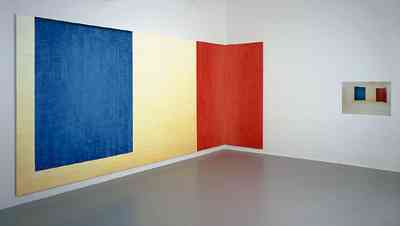
At the Scandinavian postmodernism exhibition, you can also see the mocking triple of Aino Sirpa Alalekkele, connecting the motives of classical Finnish painting, and the style of punk rock, and the meditative installation of "without name, the real" Yussi Niva (in the picture), pushing painting and her photographic reflection (Kiasma: the Central Art Archives)
The house built by Hall
We started with Stephen Hall not only to immediately explain the meaning of the strange name of the museum. Architecture is the main pride of the keys; The building was even the reason for its creation.
Indeed, in Helsinki, the Museum of Contemporary Art has been since 1990, but it was lodging in the Athenum - the Museum of the "old" art. It was absurd to live there and closely (ten years ago, the museum’s collection was about three thousand exhibits, and after grandiose purchases before the opening of the keys in it there were more than four thousand things). Therefore, in the 93rd, as already mentioned, a competition for a new building was announced, which ended with the emergence of a new museum. 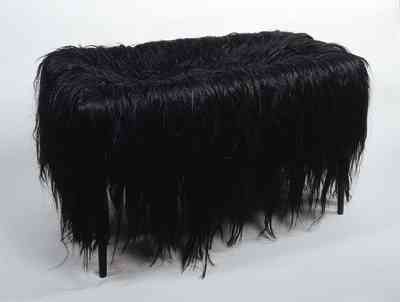
Modern female art from Finland from the exhibition "Scandinavian postmodernism". The "donkey milk" of the group from Turku "Salon 3+", trying to destroy the conventions of everyday life. “Warm table” Kaisu Koyvisto (in the photo), including fur, wool, skin, etc. In its sculptures, in order to rethink the traditional contrasts of “human/ animal”, “culture/ nature”, etc. (Kiasma: The Central Art Archives)
The 1st lesson for Moscow : modern art (that is, art that begins in the 60s) is better to live separately from the "parents", even from the masterpieces of the first half of the century.
What is the impression of the building of Kiasma? Dual or even triple.
At first - in general, no, except for the feeling of strange compactness and inscription in a small, as it seems, island between the main Helsinki street, named after the same Mannerheim, on the left and the Soviet -brick headstorm on the right. Then, when you go around Kiasmu and, squinting from the sun, gleaming on aluminum and glass, you begin to consider the details, you understand that it is all very different, wrong, made as if according to recipes of philosophers-deconstructors. In the evening and at night, a translucent and radiating light building looks different again - the most attractive. And finally, there is a keys on the plans, in booklets, in photographs from a bird’s height - beautiful, harmonious, despite the assembly, similar to a ship with a cut nose, not to a strange piece of the pie, but most of all, they are going to cover with a thick -and -character layer of Finnish oil.
The Museum of Contemporary Art is a metal parallelepiped with many windows, to which a mighty dough wave crawls from the east of the same aluminum with a zinc top. (What is this, a hint of the threat of correct Western civilization from the walking around the eastern elements?) A granite canal is dug in the foot of the keys, through which a stream begins at Mannerheim, piercing an aluminum wave and creeping a pool at the northern tip of the building. This part is composed of translucent hemispheres and rectangles (for each - a view of one of the floors of the museum) and a glass vertical intestine - a stairs translucent at night.
The internal structure of the museum is just as intricate. At the entrance - a hall -shelter to the full height of the building, so that the visitor, lifting his head, saw all five floors. A wide ramp leading to the second floor. Blinded walls, glass roof. Stephen Hall, explaining the plan of his hall, refers to the "golden section" and Zen enlightenment. But it is worth climbing the ramp, you find yourself in the maze of small and large halls, steep and gentle descents, stairs and elevators. It’s impossible to finally get lost, but the schemes are better to use. The interiors are simple to minimalism - white walls and gray in black. Real Western Museum.
The 2nd lesson for Moscow : the building of the Museum of Contemporary Art should be a work of contemporary art and the audience attraction - both externally and inside. The lesson is important on the eve of the competition announced by the mayor for the reconstruction of the new Tretyakov Gallery building on the Crimean Val.
Kiasma is a museum, only in his case to describe the building is easier than the exposition. 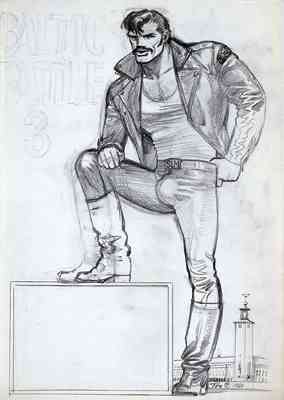
Polor-pour-graphic drawings of the deceased gay cognition of Tom of Finland will be shown in the new exposition complementing the exhibition "Scandinavian postmodernism" (Kiasma: The Central Art Archives)
Whatever you grab - there is nothing
Kiasma has a constant collection, but there is no constant exposition. The museum created under the moan “We have nowhere to show all our reserves!”, As soon as he received appropriate spaces, categorically refuses to show them all and constantly, as in the Museum of Classical Art. Kiasma thinks and operates in the categories of the exhibition, small or large, brought or invented and made on the spot, from work taken or extracted from his meeting. Everything that can see on the four floors of the museum (first floor - an economic -service) viewer, these are just an exhibition. The museum also shows its meeting only at exhibitions.
So, two years ago, at the opening, the exposition was multi -time, multi -ghost and international. Her goal was to demonstrate the most indicative and interesting things in the collection. Now, from January 1, 2000 to the beginning of 2001, an exhibition of works from the Museum Assembly entitled "Scandinavian postmodernism"-only artists of the northern countries, mainly Finns, only the art of the 80s and 90s. At the same time, the exposition lives an active inner life: something is removed, something is hung out, there is a separate compartment of the latest receipts.
In short, if you imagine the situation that you suddenly want to advise a friend who is gathering in Helsinki, to see some kind of cunt or Alvara Gullixen (the situation, frankly, is fantastic, but you never know ...) and explain exactly where they hang in a potion, there is always a danger that completely different in their place hangs in their place. It seems to be very inconvenient for sluggish spectators. But if you think about it, museum mobility works for the visitor: he will go into a long -familiar museum as if for the first time, much more interesting than wandering through the very exposition that he had seen under his mother’s supervision. And the museum from the increased visits only benefits.
In accordance with amazing exposition mobility, the structure of the keys is built. It all consists of gas compartments, each with its own name and specialization. In the darkened "Printi" on the second floor shows only graphics and photography; In the Studio K, overlooking the statue of Mannerheim, the invited Western curators represent their projects; in "Conti" - media projects; In the Gallery X - something relevant -productive. I have not met such "gallerysentrism" in any museum of the world. Although replacing a constant exposition with conceptual temporary exhibitions, including work from its collection, is a fashionable museum trend around the world.
3rd lesson for Moscow : the Museum of Modern Art should be mobile. While the Tretyakovka - after the opening, she is most proud of the new alarm for each work - is made for centuries, so that now you can’t outweigh anything on the wall.
On the national modesty of the Belofinnov
“Scandinavian postmodernism” - a project that the inhabitants of the northern countries feel and appreciate and appreciate, first of all. Kyasma made a conscious bet on national and geographically close art (in this sense, the Peterburians who are actively going to purchase), while at the same time, being an international museum. The Finns have, of course, an inconspicuous number of international stars gathered in the "do -time" times and purchased on the eve of the reproach. There is Boyce, Warhol, Cindy Sherman, Yves Klein, Kabakov (which is more likely than ours) with the installation of the "Toilet in the corner". But they love more.
And this is not national pride, but national modesty. There are good Western art in most large museums in the world, but neither in the New York Mom, nor in the Parisian Center Pompidus, nor in the London New Tate you will see many Finns, Swedes or Norwegians. Their work gives the specifics of the newly opened museum and makes it not like others. Kiasma is not Moma, and that is good. Moreover, she is not lonely in her "patriotism": now all the novice museums do this
The last lesson for Moscow: our Museum of Modern Art, which has not yet been created, can now only be a museum of modern Russian art. Time is missed, there is no way out.
Incidentally, the original building, mobility and love of roots are the generic features not of Kiasma, but every new and advanced museum. The Finns here ended up at the forefront, for us so far unattainable.
On the other hand, the creation of Kiasma was a national affair, and its budget amounted to 227 million Finnish brands (approximately $ 34 million). Whether the poor Tretyakov Gallers, Andrei Erofeev, can afford with his homeless state collection of contemporary art, the HCSI with a modest and chaotic meeting, even though he recently received the building of the abandoned factory. Some Alexander Glezer, who appeared in Moscow and also claiming his own museum?! Even an artistic ceremony? .. 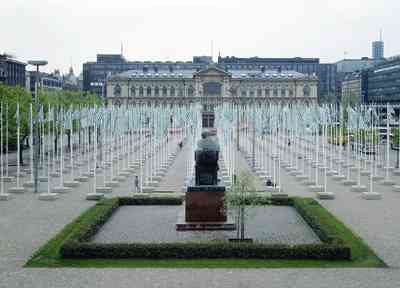
View of Athenum, where the Helsinki Museum of Contemporary Art used to be located - in honor of its discovery in 1991, French artist Daniel Buren tired of the square in front of the Flag Museum. Now the photo documentation of the action "Place for flags" is in Kiasma (Kiasma: The Central Art Archives)