
Translated material
Katyn: Just the truth
Around Russia
 Katyn: Just the truth
April 7, 2010 Alexey Makarkin
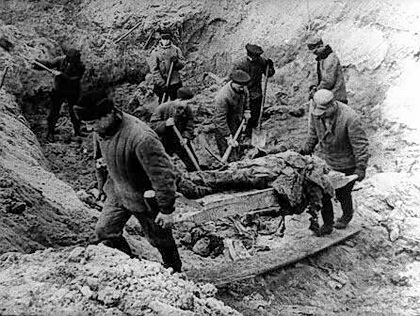 One of the main problems of modern Russia is attitude to facts. Society is reduced to minimize the role of facts and pay the main attention to their interpretations. Katyn is a vivid example of this.
Indeed, the main discussion in the Russian media space until the very recent time was conducted not on what happened in Katin, but about how to justify this Stalinist crime. Some a priori claimed that those who talk about the guilt of the USSR are the satch of Dr. Goebbels. Immediately an associative series appeared: Goebbels - fascism - lies. On the other hand, the report of the commission of the wonderful doctor Burdenko, although working under friendly control of the state security bodies, but still ours, not a Nazis of some. In this situation, any arguments against the Stalinist version faced a psychological rejection and questions such as “for whom, for ours or for Goebbels?”. Of course, in some cases, supporters of this approach appealed not only to emotions, but the arguments they cited were divided (among other things) about a simple question: where were the dead Polish officers and officials from the spring of 1940 to the summer of 1941? Why wasn’t a single document that could be presented, for example, in the Nuremberg process, to achieve the inclusion of the Katyn case in the court verdict? Whereas other camps in which the Polish prisoners of war were located, we know a lot. But, I repeat, the arguments and in these cases played a purely subordinate role. The main thing is emotions and arbitrary interpretations.
Other supporters of Stalin's excuses are more careful. They admitted that the crime is the work of the NKVD, but then they paid the main attention to the description of what bad the dead Poles were. And in the weaning of Teshin in Czechoslovakia they are to blame. And in the throwing of the pre -war Polish authorities between Paris and Berlin. And in the Soviet-Polish war. These issues are not only possible, but also need to be discussed when it comes to foreign policy actions of states (for example, about the Molotov-Ribbentrop Pact), but not when it comes to the cruel execution of thousands of people. And Stalin, it turns out, took revenge for those who died in Polish captivity during this war, either 60 or 80 thousand Red Army soldiers, whose fate (as well as their real numbers), most of those who raised this topic had an extremely approximate idea. The discussion of Katyn turned into an indictment in relation to the victims and the lawyer in defense of their killers. It is interesting that the version of the Avenger-Stalin, not supported by any evidence (but psychologically comfortable for its authors and part of the audience), even fell into one of the school textbooks. Although the “leader of the peoples” Soviet prisoners were indifferent - and did the war with Poland 1920 differ from the Great Patriotic War?
In Soviet times, the Iron Curtain made a discussion on this and similar topics with it impossible. The event could be silent, that is, to make "unprecedented" for society. The themes of Katyn, for example, was not in the Soviet mass consciousness at all - the official version nominated by the Stalinist “Burdenko Commission” in 1944 was advanced in public space to a minimum, so that in Poland the USSR was ready to disavow it. In other cases - when the silence was impossible or inappropriate - the society was imposed on the only correct interpretation of events, whether it was a matter of collectivization or Afghan war.
Perestroika brought down to the heads of Russians not only a lot of new information for them, but also an unusual variety of interpretations. Only they are accustomed to the fact that Bukharin is “good” (protested against collectivization), how he turned out to be “bad” (glorified the “red terror”). Only they realized that a good Zhukov opposed the bad Stalin, as publications appeared about the cruelty of the most famous Marshal of the Great Patriotic War, about how he did not spare his soldiers. At the same time, Soviet education required the clarity of assessments (on the principle of “black-white”), which was extremely difficult to achieve. The analogy with the parliamentary elections of the 90s begs, when voters received huge lists of candidates and parties in which they frantically tried to figure it out. It is not surprising that many Russians believe that now democracy is no less than then (or maybe more) - it became clear to them who needs to vote for.
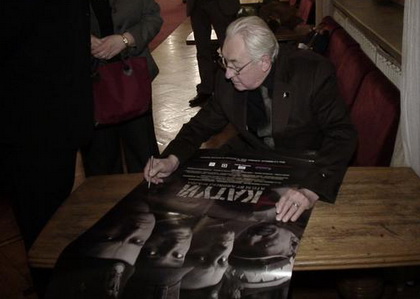 Perhaps that is why a confused society also perceived a new propaganda technique that became familiar in Russia ten years ago. Namely, it is important not what happened in reality, but who is beneficial to this or that interpretation of events. If it is beneficial to Russia (which is usually understood as state power), the better for it - then it must be promoted in every way in public space. If this interpretation is unprofitable, the worse for her, even if it relies on facts. It is clear that Vaida’s piercing film does not fit into such a system of values - on the contrary, it is perceived within its framework as a hostile, disorienting society worthy of a ban.
This approach is not just immoral. He also causes the image of Russia much more harm than honest recognition, it is simple true, without a direct lies or cunning ruling. He disorients the population of the country, introducing the principles of moral relativism into his mind, the feeling that “we can do everything”, “we are always right”. It is good that in the case of the Katyn tragedy, the reverse process occurs and respect for the memory of dead people prevails over politicism and propaganda.
Author-First Vice President of the Center for Political Technology
Photo by RIA Novosti