
Translated material
Ethics and corporations
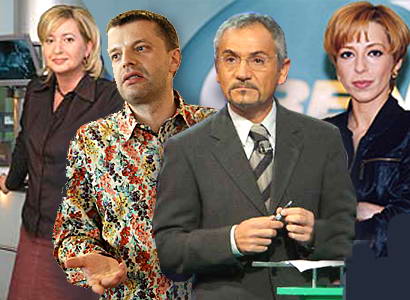
The scandal around the exile of Olga Romanova from the air, followed by squeezing from the television company of her and her colleagues, who led the Ren TV information service, caused a new one in society
A wave of disputes. But not about freedom of speech and not about the essence of news programs - they have long figured out on television.
After a series of interviews that Olga Romanova gave the radio, newspapers, magazines and online publications, the phrase “corporate ethics” again surfaced in a public vocabulary. The last time, I remember, it was heard in the summer of 2004, in connection with a loud dismissal from the air Leonid Parfyonov.
A year and a half ago, Parfyonov made public the fact that from the broadcast of the program of the Pacema the NTV general director Alexander Gerasimov, an interview with the widow of Zelimkhan Yandarbiev was removed. The leadership of the TV channel decided that Parfyonov “took out the IS of the hut”, for which the famous presenter was fired. However, people understanding realized that the Parthenov was dismissed, as they say, "in combination." And in the list of these “combinations”, the first places were far from the widow of Yandarbiev, but the Sorder-Transfer of Putin’s meeting with the security forces during the Nord-Ost, the report on the annual presidential message to the Federal Assembly, when, upon the wave of computer graphics, the presidential persons turned into an audience from the Putin alone, as well as a report from the second inauguration, colorful From the Siberian Barber. However, the widow of Yandarbieva was a successful reason for provoking the response. The reaction followed, and the Parthenov was safely fired.
And if the dismissal of Parfenov was unequivocally perceived by the journalistic community as the fact of the final twisting of all nuts on the air of federal channels, then the comments of the not yet dismissed Parthenov in the printed press and on the radio were evaluated differently. I remember even such a democrat as the editor -in -chief of Echo of Moscow, Alexei Venediktov, argued that the norms of corporate ethics are holy and that he would personally dismiss any employee who decided to comment on the internal decisions of the radio station in the media.
The reason again to recall the “corporate ethics” could be the removal from the air of Savik Schuster on the same NTV, which happened a month after the Parthenov incident, but already with the new leadership of the channel. However, disputes did not happen at that time. It did not happen precisely because corporate ethics were observed. Schuster, unlike Parfenov, did not take out the hut. He did not comment on the decisions of the leadership, did not argue about the allegedly obsolete and lack of demand for “freedom of speech”, did not answer Kulistikov’s statements that only marginals came to his program. For which he lasted a little more than six months in the mythical position of the head of the NTV documentary broadcasting.
This continued until Savik Shuster, not in demand by domestic TV, along with “freedom of speech” (in quotation marks and without) was not in Ukraine. And from there, to my question, again asked in the program “Telezer” on “Echo of Moscow”, answered differently than immediately after expulsion from the air. Now Schuster admitted that "he did not act professionally and politically," that "it was necessary to say that" freedom of speech "was closed because there is no freedom of speech, and not for some other reasons."
Two examples of Parfenov and Shuster Libra of Russian media corporate ethics seemed to be balanced. Although the very fact that in the end Schuster was in Ukraine, nevertheless outweighed and proved a new Russian axiom-observe, do not observe corporate ethics, everything is one: they will want to expel you from the Russian media-they will expel you.
Examples of Parfenov and Shuster showed that in our media market there is nothing more than formality. That is, we know nothing about the inner cuisine of those media, where this ethics as a written or unwritten rule. If there are no rotten and runaway aromas from it, then the public consuming media pies baked in that kitchen, to know kitchen secrets. But what to do if they can poison the client with a dish made in that kitchen?!
No one claims that corporate ethics is bad. Many publications built in the western manner or are the Russian part of Western corporations live by this principle. In fairness, it is worth saying that the old, which existed even under the Gusinsky-Malashenko-Dobrodeev-Kiselev NTV, which was a model of advanced democratic journalism of its time, followed the corporate ethics very strictly. There were no leaks from the inner kitchen in that corporation. As a person who wrote tons of articles about NTV and interviewed all the noticeable characters of the channel, I can confirm this fact. Not a single word against their company, not a single comment addressed to management or colleagues then stars and just NTV officers did not utter all their stellar years. Maybe because there was no need to take out the CRU from the hut. This GOR was somehow utilized inside, and unprocessed waste crawled out only when the corporation fell apart. Multiplying the broken heroes of that NTV began to find out their relations publicly-through newspapers, open letters, books of memoirs, statements to the police and applying from the stage during the presentation of the TEFI award-already on the second (TV-6), or even the third (TVS) breakdown. However, this was no longer related to corporate ethics, since the formal corporation of the old NTV was long destroyed, and the informal corporation of friends-male-minded friends did not survive it for a long time.
But in December this year, Olga Romanova reminded of Corporate Ethics.
Could Romanova, still in the structure of Ren TV, publicly evaluate the actions of her own leadership? Is there such a thing in the Russian media space as “corporate ethics” and should exist? These issues sounded so often also because it would have already been completely indecent because to appeal to freedom on television, and it was somehow necessary to comment on Romanova’s departure from the air.
When last Sunday Olga and the former editor -in -chief of the REN TV information service Elena Fedorova were guests of my program at Echo of Moscow, the notorious “corporate ethics” surfaced in matters of listeners. Olga replied that all the same Leonid Parfyonov told her a phrase, which is now especially clear to her: “So, they beat you, and you are silent?”
Olga, like Leonid, did not stop. I considered that the viewer has the right to know what kind of information he, the viewer, was deprived of on the air. And she explained that with the former head of the channel Irena Lesnevskaya, disputes about the plots of correspondents had almost every day. But it never occurred to anyone to bring these disputes to the public, because the conversation was in the same language, and the requirements and decisions of Lesnevskaya were always professional and argued, which cannot be said about the requirements and orders of the new leadership.
Now the former Olya boss Elena Fedorova added that the situation with corporate ethics is the same as with the laws: “There are local laws, but there are federal ones. Which law is more important? Federal! There are internal laws of the corporation, and there is the Constitution of the Russian Federation, article 29 on freedom of speech. And I believe that if there is a restriction in the presentation of information that we are forced to do, in this case the internal charter of the company is less important than freedom of speech. ”
Lena TV Lena Fedorova is right. Probably, there are still corporations that are not entitled to bake first of the head about their interests. This is corporations on which human life depends. If the doctor, following the internal charter of the medical institution, will remain silent about the epidemic in the hospital, then he will remain within the framework of corporate ethics, but beyond the human ethics. If the ecologist, based on departmental instructions, will be silent about infection of water or air, then which of it is an ecologist? If the builder does not make publication information about violations during construction, and then people will die under the wreckage of the collapsed roof, as in a transval park or in the basin of the city of Chusova, then what laws will justify such a builder?
The journalist, of course, is not a doctor, not a builder or an ecologist. Not a single Ren TV spectator will die of the plot of the son of the Minister of Ivanov, who knocked down a woman, and about the multimillion -dollar budget expenses for the construction of another ceremetele masterpiece. Today. But what will happen to this viewer tomorrow? And should the journalist keep silent about the silence, or does he have the right to tell the viewer and the listener, what information he was deprived of?
History is always repeated twice. After Parfenov and Shuster, the story shows us the female version of the same conflict. On the air of Radio “Freedom”, Marianna Maksimovskaya said that she was working on Ren TV until the broadcasts are broadcast on the air that she considers necessary and socially important. But in the event that such plots can not reach the viewer, the presenter promised to act as follows: “First I will write a statement to the shareholders, then I will either receive or will not receive an answer to it. If not, I will write a letter of resignation. And then I’ll go to comment on this situation. ” Only after dismissal, and not earlier.
The “standard of corporate solidarity”, who has known on the old NTV, Marianne is ready to adhere to her principles to the end and endure the CROs from the hut only after dismissal. Whether her experience will be more successful than the experience of Romanova and Fedorova - let's see. I don't want to be a cassand, but I'm afraid we will see it soon ...
The collage uses photos from sites: Newizv.ru, Novayagazeta.ru, PressClub.nstu.ru, SMI-NN.ru