
Translated material
The cookies are not that
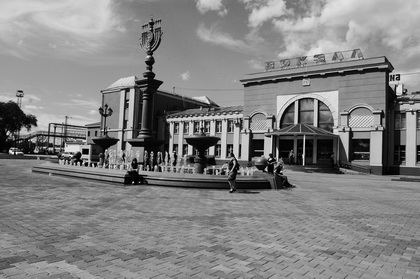
Such a city lives, the existence of which is usually learned only after meeting one of its inhabitants, at the same time taking this resident for a button to make sure of his realities.
Such a city lives - Birobidzhan. And in it people. And among them, oddly enough, you. Life here is a dashing existential experience: almost always, falling beyond the limits of the place, you feel like some kind of outlandish beast. At first, however, even sincerely interested will think that you live in Khabarovsk (“Oh, you got a good job there, on a five -thousandth bill!”) Or Vladivostok (“Oh, you have a sea there, you have the end of the earth there!”). Such a pattern, which is even corny to mention: for some reason, for a fair part of the inhabitants of our country to the west of the Urals, the entire Far East is a pure abstraction. There are a lot of Chinese, cold winter and everything at an extended arm - meanwhile, from Birobidzhan to Vladivostok, 15 hours on a maximum train.
Then, when everyone is convinced that your city with a strange name is still not in Azerbaijan and not in Tajikistan, but even in the Jewish Autonomous Region, the usual jokes about the small number of Jews per square meter and vodka Aunt Sonya will begin.
Such a city lives - Birobidzhan. A huge shopping center has recently opened - now this place of the evening promenade, and at the opening there was a pure Bulgakovshchina. Unless they torn their heads to anyone and naked women did not run along Sholom Aleichem Street. And so - people like people ...
Such a city lives. And, it seems, lives a completely separate life. In the notorious Khabarovsk and Vladivostok, let the crowds go to the administration and glue their mouths with tape, advocating for honest elections, and here-only a couple of the Communists does not freeze for long at the monument to Lenin, which, as usual, stands to the city with a back.
And so, delaying this picture, you go to the store for cookies, and the saleswoman is a middle -aged woman in a blue dressing gown - she grieves under her breath: “Azokhn Vay” ... And today it is especially clear how damn law. This phrase on the Yiddish-a language that is always declared deceased, but the patient is still more likely alive than dead-is familiar not only to those who live in Birobidzhan. “Azokhn Vay” - tautology, oil oil, embodied passion of the Jewish people to world sorrow, non -transient accent: painful pain? grief bitter? Alas and ah? None of the interpretations in the exact extent conveys the meaning ... But everyone is quite close to the truth. Which, in general, has such a task-to slip away.
The grief of the bitter journalist in Birobidzhan is that even here he is no longer able to quietly plant flowers in the front garden, introduce a culture, hang pictures on a raw plaster. It becomes impossible to write texts “without politics”, even if you live in a city in which there are no politicians. In fact, not to consider politics agitation calls in one of the local newspapers. The Communists solemnly expose: “Russia suffers twenty years - tell me“ United Russia ”.” And next to him, a voice from the beautiful far: “Say“ no ”to the communist system that destroyed thousands of lives of the inhabitants of the EAO!” Such things are not enough for all poetry.
The grief of the bitter opposition in Birobidzhan is that he is engaged in what is not.
The bitter cinema in Birobidzhan is hidden in the cinema (only) with the touching name "Homeland", hangs on the poster, lurks in tickets - on gray leaves, it is not known from which time the inscription "50 kopecks" remained. The last cinema shown here, having at least some attitude to art-“inglorious bastards” Tarantino. Two years ago.
But by the way, all this is not quite a geographical story, and bitter grief not only with us. Around there is no certainty, no bread and spectacles to everyone according to the needs, no common world, and it does not always go along with individuals.
What is the grief of the bitter saleswoman? In cookies. And they bring the wrong one. And they choose the wrong way. And, in fact, this is a rather distinct metaphor for our life.
Birobidzhan
Photo of the author