
Translated material
Putin's visit
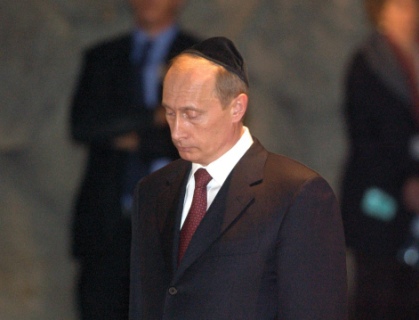
When Bush and Obama flew to Israel, they did not talk about these visits with aspiration. Visits and visits. Interstate, important. They flew, visited, said, performed, briefing, flew away. Everything is different with Putin. There is a certain sense of sacredness of the upcoming. Although the Russian president has already been on the Holy Land, and with a herald against the wall of crying was photographed. True, it turned out ugly with Medvedev - the local Foreign Ministry went on strike and refused to coordinate the visit, which offended the Kremlin a lot. Now is the time of rehabilitation. And Israel in the eyes of Russia, and vice versa. Aspects of the visit, as usual, are declarative and practical. And it is not entirely clear which one in the situation that has developed for both countries is more important. The declarative is such a "who, whom, to whom, where." The east is a thin thing, full of nuances. For example, Putin’s arrival is positioned precisely as a visit to Israel in the first place, and only then there will be Palestinian territories and Jordan. The official agenda is more cultural, emphasizing “deep historical ties” with all parties: in Israel - the opening of the memorial to the memory of the soldiers of the Red Army, the first similar monument built abroad from the moment of the collapse of the Soviet Union; in Bethlehem - the opening of the Russian Cultural Center; In Jordan - the opening of a living yard for pilgrims in the immediate vicinity of the place of Baptism of Jesus. The main thing here is not to offend anyone - to emphasize the common one, independent of the moment of the conjuncture of the moment. The Great Patriotic War, on the one hand, the Orthodox tradition on the other. Everyone is happy. Nevertheless, in Israel, Putin will stay for almost a day, with Palestinians and Jordanians will bend in less than a day. He will visit Jerusalem, but not in Rammala or Amman - no ... For our places - this is symbolic ....
The present is true for which of the vectors of the Russian multiverse foreign policy will pull - the confrontation with the West in Iran and Syria or, nevertheless, the course to stabilize their own interests while trying to be in a winning position, when all the perturbations of the Arab Spring will end. Jerusalem will again try to convince Moscow not to sell/provide warranty services for missile and air defense systems of Syria; Palestinians - to demand a pressure on Israel in connection with a stalling peaceful process; Jordanians - to express their serious concern both with their own stability in the light of the current Syrian events, and in the light of the possible coming to the power of the Islamists after the fall of the Assad regime.
Middle Eastern layouts never differed in particular rainfulness, but now especially. From the point of view of Russia, you have to choose a smaller of two evils-to hold on to the “principles of the world device” in the person of Assad, restoring the Sunni world against itself and trying to strength with the West, or to go at the cost of his own ego for a compromise with the same West, trying to keep at least some positions in the region. From the point of view of Israel, you can still sit on the fence, hanging your legs, and observe what is happening. Palestinians realize that their attempts to expose themselves as a fundamental problem of the region, the solution of which depends on stability, crashed and that they, by and large, are not present to anyone, however, they can’t simply draw up to the troubled times and are obliged to periodically remind themselves of themselves, threatening either one -way proclamation of their own state, then self -observation of autonomy.
The visit of the Russian president is unequivocally designed to show that Russia sees itself as a key player in the region. And that any development of events should take into account the position of Moscow. The Kremlin adheres to the principle of open communication lines with all players - with radicals, and with the opposition, and with the governments. Nevertheless, it is difficult to please everyone - the interests contradict, and diplomacy and negotiations do not always bring results.
Most likely, Assad is really not important to Moscow, it’s just very difficult for the Russian side to allow the West to decide the fate of the next regime again. There is no doubt that the Arab coups and revolutions are unequivocally regarded in Moscow as a Western conspiracy. Hence the attempt to minimize the loss of positions in the Arab world and not lose self -esteem.
In foreign policy Israeli circles, they are increasingly stated that Russia is looking for a new main vector of its multi -sector foreign policy. Israeli Minister of Defense Ehud Barak in an interview with Washington Post last week noted that nothing would work out without Russian participation with Syria, and for a positive dialogue and an agreement between Moscow and the West, it is necessary to take into account the interests of Moscow in the post-Asadian period.
For Russia, the wrong one would be preferable to the Yemenic scenario of events in Syria - hence attempts to prevent external intervention and convene an international conference. If Assad goes away himself, and at the same time remains at the very least, but the functioning government that controls the army, and the opposition militants under the pretext of achieving goals will lay out weapons-everyone will add headache. In this case, Russia will undoubtedly retain both economic interests and political influence on Damascus and indirectly on Lebanon ... However, such a scenario is unlikely. Firstly, the involvement of Saudis, Lebanon, Iraq, Turkey, Syrian opposition and government, states, the European Union, the League of the Arab states and Iran in itself implies an absolute dead end due to diametrically opposite interests. Iran will try to protect the last friendly regime in the Middle East by all means, on the contrary, the Sunnis will require the displacement of the Alawit regime to weaken Iran. Lebanon will once again refuse to participate in negotiations against the background of the Shiite-Sunni squabble. Secondly, if an agreement was not reached through the lag, the UN and the Security Council, then for what reasons should it be born in Geneva? Due to the miraculous properties of Swiss air? Thirdly, the conflict in Syria from the political has long grown into ethno-religious. Assad will not leave voluntarily, and they will not give him their own. The provision of personal guarantees of inviolability for the Syrian president will not solve the problem of the Alawitic minority and the highest military leadership. If Assad receives a shelter somewhere, then officers of the Syrian army after the bombing of cities can no longer live. In the literal sense. Therefore, they are fighting for survival. The opposition also understands that a political compromise is unlikely to be possible and therefore there is nothing to lose. How many times have the Syrian government has promised to withdraw troops from cities? So it turns out that without external intervention there will be a slow bloody civil war; In the presence of external support a la Libya, the results “on Earth” are also unlikely to be positive, because democracy does not suddenly come in the Arab countries. And for all that, the question hangs in the air what will happen to the arsenal of Syrian chemical weapons, missile potential and heavy weapons. If Assad, who is attached to the wall, decides to suddenly transfer part of the rockets and chemical warheads of Hzballa in Lebanon, then the columns transporting the weapons will probably be attacked from the air. Israel will be blamed for this, as usual. Nevertheless, one gets the impression that, despite the high-profile statements about the invariability of the course and mutual accusations between Moscow and Washington regarding the support of Assad and the opposition, there is a kind of backstage understanding between the West and Russia about the future fate of the Syrian regime. Russia, probably, in the end, will still prefer to be on the side of the victors, whoever they are, and not the loser of Assad. The fact that at some point the Syrian regime will come to an end, at least in Israel, do not doubt either defense or diplomatic circles.
As a lyrical digression and an example of the statement of Assad, and with it Iranians, one can cite the brilliant publication of the Iranian news agencies about the joint Syrian-Russian-Chinese exercises preparing in Syria with the involvement of 90,000 military personnel, hundreds of aircraft and tanks ... The Russian Ministry of Defense took a day to refute publication, but the essence of another. Fars, the Iranian agency, which published a note, is close to the leadership of the Islamic Republic and to the Corps of the Guardians of the Islamic Revolution ... That is, both were aware of such an absolutely impudent misinformation. What do you need to think about Russia and China, which in general restrain the use of force and the sanctions regime both against Syria and against Iran itself, so that such nonsense so shamelessly?
With Israel, however, the story is different - in Moscow it is seen as an island of stability. No wonder Gazprom is trying to access the development of Israeli marine gas fields for a year after year. Now this is more real - Israel simply does not have its own resources and experience in the development of recently open new large submarines of gas, hence interest in external investments. Gazprom of a monopoly or exclusive rights, of course, will not receive - few people want to be completely energy -dependent. However, this is undoubtedly an indicator. And if we still take into account Russia's interest in the signing of an agreement on the free trade and mutual investment zone in high-tech (Rusnano and Skolkovo have already created investment funds for Israeli-Russian start-ups), then obvious economic interest is emerging, despite the Palestinian Israeli conflict, in which Moscow has always declared more recently more supported Ramall, and the Iranian factor. Israel understands that Russia will remain in its positions in the Arab world and Iran ("historical connections and spheres of influence" - there will be no getting away from this) and will make up the opponent of the West in many matters. But at the same time, Moscow is clearly driving towards the Sunni Arab world, which is currently the main sphere of interests. From the point of view of Jerusalem, this is a positive development of events, weakening both Iran and Syria with Hzballah ...
Nevertheless, the Middle East is poorly predictable. Syria was shot down by a Turkish fighter. Ankara promised to take measures. Fitelek between Damascus and Turkey smolders for a long time .... It is worth the Turks to “adequately” to respond to the Syrian air defense or Air Force or Syrians to bring down another fighter over their territory - the plan of Annan, and the Geneva Conference, and the meeting with the UN Security Council will be quickly forgotten. Upomple through will include completely different terms. Though Türkiye wants to “solve the situation in Syria peacefully in Syria,” but national pride and regional ambitions will not allow Ankara to maintain political compromises between the Syrian government and the opposition. Türkiye will rather openly begin to support this opposition - both money and weapons.
So Putin with a retinue at official ceremonies in Israel, Jordan and Palestinian autonomy can and will be boring, but in political conversations you will have to seriously get up in order to try to turn all this ball of interests and conflicts, without the risk of losing all the remaining cards ....
Photo by RIA Novosti