
Translated material
Everything is in the section
The first thing I wanted to exclaim when I happened to get to the German Museum (Deutsches Museum, [1]) Munich was: “Yes, this is polytechnic!” And the second that occurred almost immediately after the first was “only more.” It’s not a matter of scale of the building: in appearance, the German museum seems much less impressive, partly, apparently, because it is hidden behind the trees, while the Polytechnician flaunts in the center of the square. And not in the collections: the exhibits in both storage facilities are approximately equal. But the German museum inside seems more than outside, and the visitor - if he has time - is able to spend more than one hour, trying to understand various methods of oil production or simply admiring the aircraft model. I must say right away that I could not completely bypass the German museum, I had to limit myself to “my favorite” topics, so the story will be - alas! - Very unexpected.
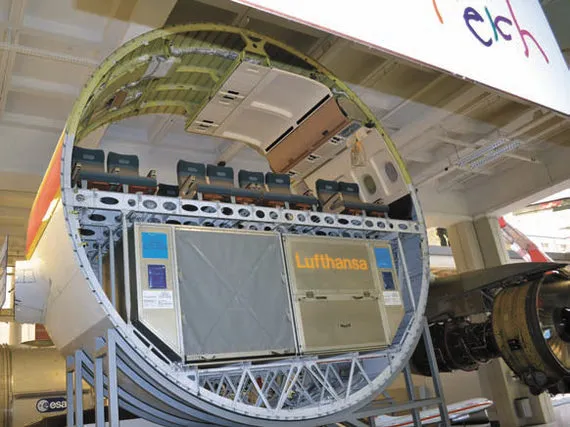
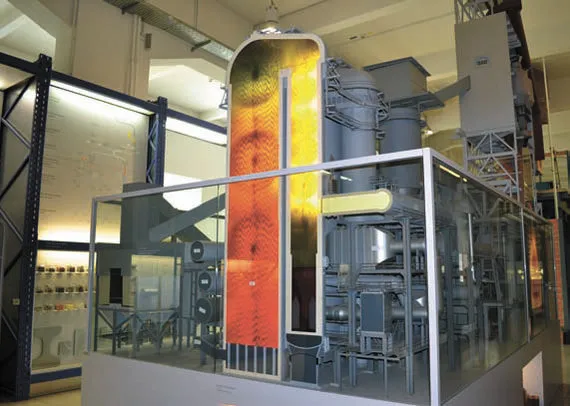
So, on the one hand, there is a huge resemblance to the polytechnic: the same principle of location of exhibits in industries and themes, the same attention to heavy industry, minerals and energy - “bones” of modern European civilization, the same rather old models, some of which no longer work. On the other hand, the difference in details. Almost every exhibit has a sign where with German thoroughness it is told that, in fact, you need to know when looking at this item or layout (in the polytechnic, usually those who wrote were limited to the name of the subject). True, it is written for the most part in German, and therefore these signs almost do not carry value for the language that do not speak language. Many exhibits are shown “in the context”, and “on the cut” of the subject can be schematically shown the processes that occur inside: as, say, inside the domain furnace.
In addition to the “demonstrative” museum there are “touching” sections - for example, general physics. Now it is fashionable to call such devices “interactive exhibits”, but in non-voting centers of gravity and similar objects that illustrate certain physical phenomena or laws, great interactivity, is perhaps not, although the opportunity to feel something in the museum is certainly attractive. There are also such sections in the polytechnic, but so far they are much less.
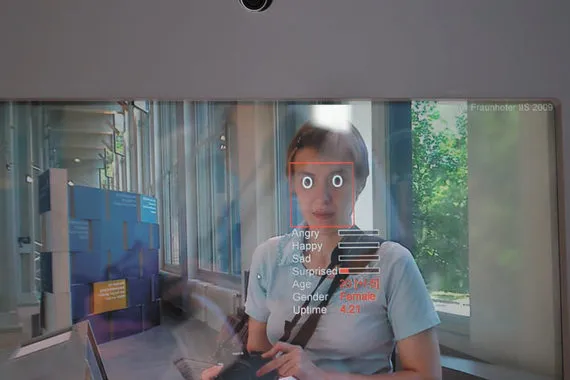
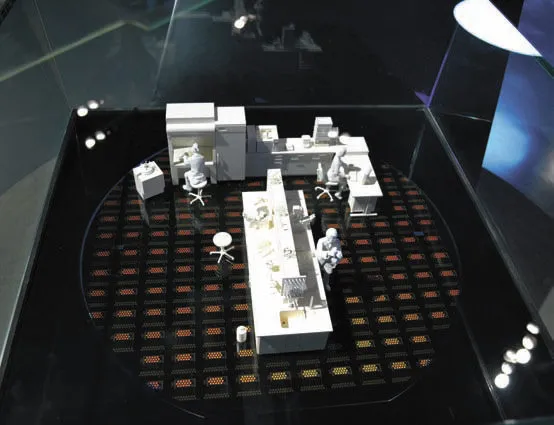
There are real interactivity in the German museum. As already described in our newspaper [2], now the museum is partially on reconstruction, after which visitors should open up new opportunities to get acquainted with modern science. The beginning of this has already been supposed. I happened to see a special exhibition dedicated to the “Prize of the Future” laureates (a federal president’s prize in the field of technology and innovation [3]), “Glass Laboratory” (space, fenced off tables with glass walls, where a small biological laboratory with an electronically scanning microscope is located and anyone can look at how the research is undergoing, and talk with working with working people students), and several exhibits using the features of modern multimedia of funds. Unfortunately, the laboratory for visitors, in which anyone is invited to highlight their DNA, was already closed on this day, but it is this form of work with visitors that is considered one of the most interesting. By the way, it is planned to be used in the Polytechnic Museum after reconstruction.
But paradoxically, the “new” part of the exposition interested me less than the “old”. Despite the old -fashioned, the classic part of the museum leaves a feeling of good fundamental. New forms are perceived as toys - very cunning, but still glossy. Yes, in order to read the signs, you need some work, but if you force yourself to do this, then you leave the museum with a sense of some discovery. The new part of the exposition is still more like a demonstration of tricks and beautiful pictures.
Maybe the point is not in the exposition, but what is more familiar and understandable to me. Or, perhaps, the museum itself has not yet found the form that will truly successfully combine true education and entertainment. It’s more interesting to find out how today's children look at the museum, which Natalia Demina will talk about.
* * *
When my son and I planned a trip to Munich, the DEUTSCHES Museum visited one of the most important points of our educational and entertainment program. And here is a short journey from the hotel on the tram in early sunny morning, and we are at the museum building. It is nice that we, as tourists and as a family, made a discount for entrance tickets.
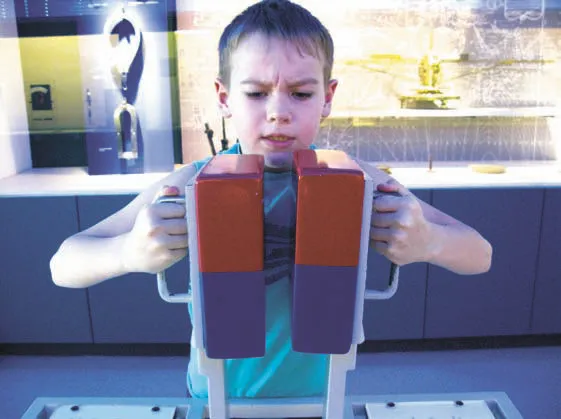
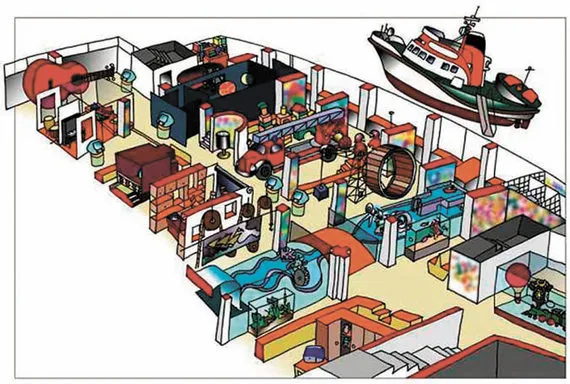
The main feeling after many hours of traveling along the floors is howhamed that there is no such museum in Russia! If you believe our guide on Munich, then in this city any rich person considers it his duty to sacrifice a significant amount of money for cultural and educational projects. And what do we have? I do not agree with Olya Kudynaya, can our boring polytechnic be compared (which, however, is about to close the reconstruction and, perhaps, will become one of the best in the world) with this fascinating museum, where almost all exhibits can and even need to touch, turn it on, turn it off, see them in action. Once my son was so carried away, rejoicing at the next physical fitle, which almost broke the glass of the exposition. It’s good that glass and nose remained intact. We started traveling along the museum with Kinderreich (“Children's Kingdom”)-a special floor for children 3-8 years old [4]. We came there first and alone were able to test all the exhibits dedicated to water, mechanical energy, transport and music. Most of all we liked the site with continuously pouring water, along the "rivers" of which you can drive ships, and in the "docks" to unload them with special cranes. My son tried himself as the driver of the fire engine, hiding at all the special signals, then climbed into a huge guitar, and then hit the drums in a special, soundproof room for a long time. While the children play, parents can sit on a bench and wait for them, comfortable toilets, as well as two automatic massage chairs, where for 2 euros you will be delivered 10 minutes of joy. These chairs are placed throughout the museum and tired visitors have a where to relax. At the entrance, convenient storage chambers for things are also installed.
The least we liked, if not to say indignation, computers - the old Macintoshi with uncomfortable mice who did not want to obey not only me, but also an employee of this "children's kingdom." The computers overflowed with memory from introduced children's names, and we could not remove the old names in order to introduce our own. I had to click on the first name that came across, and the computer spoke to us in German. There were no options for choosing a language, and the content was not very exciting. Perhaps our expectations from this floor were large than it actually turned out to be. In this regard, the Moscow “Experimentaum” is already a cut above (though the prices in it compared to the German museum are sky-high; two of our tickets cost 10 euros, that is, about 400 rubles, and in the “experimentation” the ticket will cost 600-800 rubles for two, depending on whether the day or not). However, it turned out that various seminars and events such as “thirst for knowledge” for children, which we could not see because of a lack of time and effort, were held in the same hall. It was not possible to visit a rescue boat, which has already become part of the "children's kingdom": either he was closed that day, or we simply did not guess to open the door.
But the main territory of the museum made an indelible impression. “I could come here in childhood for physics lessons!” I thought, and my son turned on and turned off numerous exhibits tirelessly. We exhaled on the 3rd floor, never seeing the floors higher and the planetarium. But there are still two separate expositions of the German museum dedicated to transport and aircraft and located in other parts of Munich.
Olga Blacksaya, Natalia Demina
Photos of the authors
2. Museum evolution. No. 104, 05/22/2012 http://trv-scieence.ru/2012/05/22/muzejjnaya-ehvolyuciya/