
Translated material
The charred ancient scroll was “virtually deployed” and read
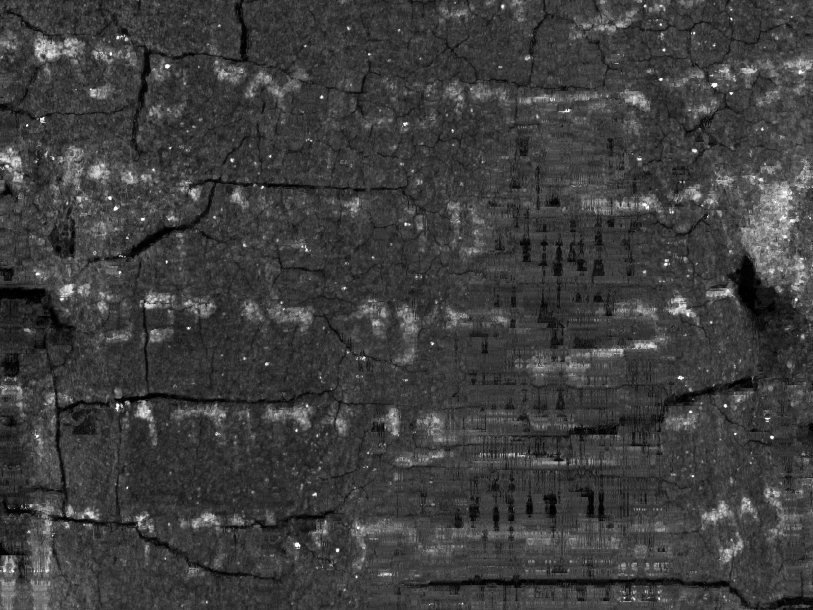
The burnt scroll from parchment, found back in 1970 during the excavations of the synagogue in Ein-Gedi, managed to read with modern technologies.
Archaeologists have discovered a scroll inside a special storage for the Torah scrolls, which is called Aron A-Codesh, and in Russian literature it often appears under the name “synagogal ark”. The document was so much damaged by fire that it seemed impossible to expand and read it.
Recently, the Brent Seales team from the University of Kentukka took up the study of this find. Thanks to computed microtomography, they “virtually deployed” the scroll, leaving it untouched. Scanning was carried out in Israel with the assistance of a project to study the sweets of the Dead Sea of Office of Antiquities.
Scientists then used the Image Analysis Program developed by Sila. The program completed the “virtual unfolding”, turning the curled surface of the scroll into a flat image. Then the special algorithm separated the areas covered with ink, from empty ones. So gradually it was possible to identify the text written on the scroll. The results of the study by Brent Sils and his colleagues spoke at a press conference held on Monday in Jerusalem, which was attended by the Minister of Culture and Sport of Israel Miri Reghev and the director of the Antiquities Department of Israel Hasson.
Scientists were able to read the text that turned out to be an excerpt from the beginning of the Old Testament Book of Levit: “And the Lord called to Moses and said to him from the tabernacle of the meeting, saying: declare to the sons of Israel and tell them: when one of you wants to sacrifice the Lord, if from cattle, make your victim from cattle of large and small. If his sacrifice is a burning of cattle, let him bring her masculine, without vice; Let her lead her to the door of the assembly of the meeting in order to acquire goodwill to him before the Lord; and puts his hand on the head of the victims of the all -imminent - and he will acquire goodwill, in the cleansing of his sins; And hesitate the body before the Lord; The sons of the Aaronovs, priests, will bring blood and cover with blood from all sides to the altar, which at the entrance of the tabernacle of the meeting; and remove the skin from the victim of the all -imminent and dissipate it into parts; The sons of the Aaronovs, priests, will put fire on the altar and put firewood on the fire; And the sons of the Aaron, priests, parts, head, head and tuk on firewood, which are on fire, on the altar ... ”(Levita 1: 1-8) will be laid out.
According to radiocarbon dating, the scroll belongs to the VI century of our era. Thus, he became the most found by the old written monument containing the Old Testament text after the sweets of the Dead Sea.
Brent Sils previously took part in the study of the charred scrolls from the villas of papyrus in Herculanum, which can be read about in a special essay “Bucked Scrolls” . In recent years, scientists created in recent years, contactless study of ancient documents using tomography have great prospects. A lot of texts remain non-obstacle only because of the impossibility of expanding them without damage. For example, in 1981, a grave of the 5th century BC was found in the vicinity of Athens, where a tortoise shell lay next to the skeleton of the buried, which served as a resonator for the lyre, a bronze stylus and a stuck -up papyrus scroll. They could not do anything with him and placed in the storage of the Athenian Archaeological Museum. If you ever manage to read it, it will become the oldest Greek papyrus read by scientists.