
Translated material
Fascinating provocation
In society
 Fascinating provocation
December 16, 2013 Alexey Kuznetsov
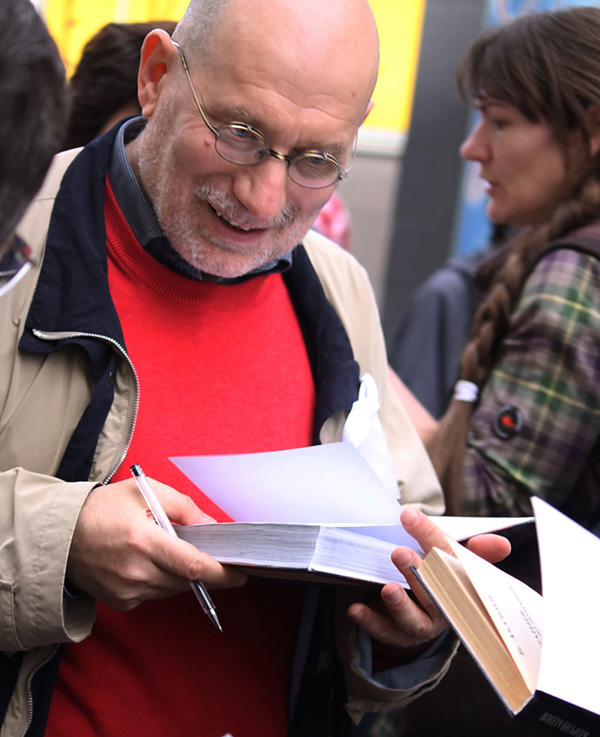
The publication of the first volume of the Akunin “History ...” (B. Akunin. “The history of the Russian state. From the origins to the Mongol invasion. Part of Europe”) did not go unnoticed. Of course, Grigory Shalvovich is not used to, his labors for ten years have invariably encountered by the reading public anticipation and impatience. However, in this case, we are faced with the reaction of a conceptually different plan. Well, it is not surprising: after all, the author also took over much more heavier than the previous ones. And the point is not only in the volume and complexity of the alleged (in the end, not the first), but in the fact that there is just the case when the reader reacts to the name of the author - the famous “detective”, “Westerner”, “whiteword” - long before he gets acquainted with the text. The circulations have undoubtedly beneficial. The perception of the book was just as undoubtedly damaged, which is lower.
Director of the Institute of Russian History of the Russian Academy of Sciences Yuri Petrov rightly noted that at the current level of development of historical science, one person could not do what Karamzin and Soloviev did at one time. However, Akunin is not going to do this, which not only follows from his direct statements, but is also evidently confirmed by the text of the first part. The author is trying to figure out the history of his country and makes this attempt right in front of the reader; From here many imperfections in labor stem, but here many of its virtues begin.
These advantages, in our opinion, are such. Firstly, this is a wonderful style of presentation. He may be close or not close to the reader, but he is literary (which fundamentally violates the Russian academic tradition of writing historical works in the language of unreasonable). It seems that constant references to Karamzin are due to the fact that Boris Akunin considers himself the successor to the “last Russian chronicler” and the first historian not in the “championship”, but in a writer's attitude to the text.
Secondly, the Akunin sense of humor everywhere adorns his work: “It is known that in one of the fights the son of Askold fell (I would like to add“ and Dira ”out of habit); “If this version (translation of the name is A.K.) is true, then Russia is the country of rowers”; “Then the fishermen pulled out of the river ... a dead baby, an unprecedented freak, who instead of a face“ shame, but otherwise could not be a Cossack shame for the sake ”(although, it would seem, which is already worse”). At the same time, the author does not allow any likening to Shchedrin with his parody of Karamzin or “satirikon” of a hundred years ago, invariably remaining within the framework of the declared approach - impartiality and extra -demologism.
This is what is the third dignity of labor. Critics are “patriots”, who have yet familiarized themselves with the book, but with excerpts posted on the Internet (in one difficult case, it was clearly and proudly announced), immediately christened it “Russophobic” and presented their “evidence” without disgracing, while directing the direct drawn . Meanwhile, in the first volume, the author is not in solidarity from any of the extreme points of view on numerous controversial issues, stepping on his throat to his many years of Westernism. For example, on the famous “Norman question” - calmly, soberly, without pathos.
The level of criticism of the author from the "patriotic" camp, to put it mildly, is low. The fact that Boris Akunin called Dazhbog “the god of the sun and rain” for some reason causes accusations that he literally understood the name, although there is not the slightest indication in the book. Indeed, one of the common interpretations (and there is no uniform understanding of the distribution of roles in the Old Slavic pantheon in science) the sphere of responsibility of this deity - the sun and fertility. What is no rain fertility? The accusations of incompetence are equally “justified” in connection with the allegedly existing polygamy only among the Gunn leaders (Akunin considers it the custom of the whole people). Well, the authors of the quite academic collection "History of the Ancient World" (Publishing House "Science", 1983) in the third volume definitely write about the polygamy widespread among the Huns. By the way, this is quite usually for nomads ...
Yes, the author has separate actual “bloopers”, and there are many of them, far from all his conclusions can be agreed (one of the most qualified analysis at the moment, the historian Nikita Sokolov made), but to represent him with a half -knew means to sin ahead of the truth. Yes, and not in the "blunders" the main claim of nationalists. Here in each line there are accusations of “Russophobia”, “belittling”, “denigration”, accompanied by the vitation of the inadmissibility of the pseudonym for the historian, which is operating on the glorious tradition of the “disclosure of pseudonyms”, laid down in the output times of the “struggle against cosmopolitanism”.
Meanwhile, in our opinion, the pseudonym is eloquent not at all in the sense of concealing the “Russophobic” surname. Grigory Chkhartishvili, a Japanist historian by education, is connected by the framework of a strictly scientific approach, from under his pen, theoretically reasoning, could work on Russian history, but a completely different format. Boris Akunin can afford to write not an academic course, but a book for reading (adding a “family”, but the genre has died). She is exciting, she encourages to think and - most importantly! - provokes further digging in the material. Moreover, it provokes not only the reader, but - we suspect - and Grigory Shalvovich himself. What he honestly wrote about in the preface.
Photo by hedgehog/Olendskaya Maria