
Translated material
Checking on the roads
In society
 Checking on the roads
December 12, 2012 Boris Kolymagin
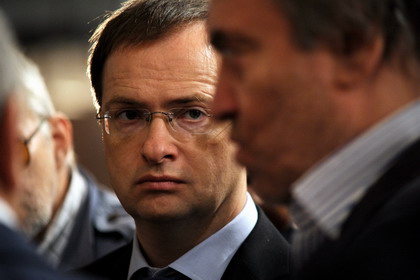
The Russian Institute of Cultural Studies subordinate to the Ministry of Culture and the State Institute of Art of Arts were subjected to "strict verification" of anonymous experts. And, despite the unfoundation of the charges, it is they who can form the basis of decisions regarding the future of these structures.
In total, five research budgetary institutions are subordinate to the department of Vladimir Medinsky. In addition to the mentioned, these are Gosnia of Restoration, the Russian Research Institute of Cultural and Natural Heritage and the Russian Institute of Art History in St. Petersburg. In the cultural community, rumors are multiplied that all research institutes will be liquidated, and instead a certain center with a staff of 100 people is created, that is, 7-8 times less than now.
The director, by the way, mentions this opportunity in one of the recent interviews, Rick Director Kirill Razlogov. Without denying the idea of creating a “humanitarian” Skolkovo, which “would unite the totality of all Russian sociocultural research,” the film account insists on preserving independent scientific centers under his names. Although, it is possible that protecting his brainchild, Cyril of Droglov leads a double game. While the leaders of the four institutions opposed the invarion ideas, the head of Rick, as they say in the academic environment, became a strategrachera. And, indeed, the director of the Institute of Art of Arts Dmitry Trubochkin was in a tight junction with the Ministry of Culture, and Kirill Droglov went into the shadows. Time will clarify his genuine position. In the meantime, it is obvious that the life of honey did not seem, the ministry deprived Rick of the opportunity to conduct the traditional Congress “Time of Culturalology”. Its organization was entrusted to a certain Ostmedia CJSC, which specializes in striptease and other tempting actions.
Allegedly based on these checks, the Ministry of Culture reproaches the humanities of inefficiency of research and requires scientific plans “in the light of state policy in the field of culture”. In fact, this means narrowing the circle of topics and issuing the necessary examinations, for example, for all kinds of opposition actions. Although this practice, if we speak honestly, exists now. Yes, the Russian Institute of Culturology protested against the adoption of the scandalous law “On the transfer of religious property to religious organizations”, but in its walls the desired investigation was born an expert opinion on punk grab. So representing Rick white and fluffy is probably also wrong.
Nevertheless, many scientists honestly work in its walls, and prevent the culture from turning into one continuous simulacrum. And what can they listen to the reproaches that budget funds are going the wrong way. Otherwise, how to understand the statement of the experts of the Ministry of Culture: “Every year, 45.3 million rubles are allocated for salaries, and for the study of each topic 200-300 thousand rubles a year.” “The calculation mechanism is interesting,” the scientific secretary of Rick Nina Kocheleeva is surprised, “the entire set of research is carried out for the salary, and the indicated amount on the topic is the annual wage of 2-3 employees of the institute.” By the way, the average salary of a scientific employee of a candidate of science is a little more than 10,000 rubles. per month. And it is for this money that researchers work.
I would like to give one more amazing phrase of experts: “Often, if you roughly divide the number of signs in the final reports by the number of working days a year, it turns out that during the working day the researcher should write from 100 to 300 letters.” That is, we are offered to measure mental work by the number of letters written in the day, as if it were piecework work on the manufacture of paper packages. These are the ideas of the ministry officials about scientific work. Their intentions are clear: to strengthen their influence on the formation of scientific plans, reduce the costs of research institutes and take up the benefit of the distribution of financial flows with the greater benefit.
On December 11, an expanded meeting of the Academic Council was held within the walls of the Institute of Art History, striving to convey his position to the public. A specialist in ancient Russian art, Levs Levz laid a dozen weighty volumes on the table - institute publications. And he recalled that the first two volumes of the “History of Russian Art” Grabar were preparing ten years, and then, when the necessary materials were collected, the books began to be published regularly. This was our answer to Chamberlain to reproaches in a scientific long -term construction. Doctor of Philosophy Alexander Rubinstein sadly noted that the new party apparatus does not understand the mission of the Ministry of Culture: “Science lives its laws, it serves society, not the ministry. Any merger is fraught with big losses. ”
The director of the Russian Institute of Cultural and Natural Heritage, Yuri Vedenin, agreed to support his colleagues: “Each institute is a center of certain scientific schools.” And the head of the theory of art theory of Rick Vyacheslav Shestakov expressed a firm conviction that it would definitely not be able to place all colleagues within the walls of the Institute of Culturology.
In this exciting place, director Dmitry Trubochkin said that the presidential adviser Vladimir Tolstoy and Minister of Culture Vladimir Medinsky arrived at the meeting.
I must say, it was a strong minister's course. After all, he not only listened to many reproaches in relation to the department he headed, which did not deign to establish proper interaction with the institutions, but also answered many specific questions: from "Why is it impossible for you to get to the appointment?" Before "Do you understand the difference between fundamental and applied science?" And yet, to the main question-whether the research institutes will exist in the foreseeable prospect, he did not answer anything definite. It is important, they say, to preserve scientific potential, and in what format the institutions will live is not yet clear. Let's stay in the dialogue mode, not the information war and together to look for acceptable solutions.
After the departure of the minister, Vladimir Tolstoy talked with scientists for a long time. According to him, it will still not be possible to avoid Usushka and Utruska and something will have to be sacrificed.