
Translated material
Moss breeders
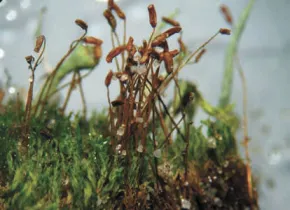
Four hundred million years ago, the planets were not still full of flowers and butterflies did not curl over them. Ferners, horsetails and plans covered the ground, and mosses stuck between them. All these plants, although they got out on land, water was needed for sexual propagation. They are still growing in moist places.
Mosses and ferns do not form pollen, reliably protected from drying. Their male germ cells, sperm, get to the eggs, and in the air are motionless and defenseless. A lot of water for fertilization is not required. Mosses, for example, a sufficiently thin film formed by drops of dew or rain, but in dry weather they may have problems with reproduction, especially if male and female plants are removed from each other. Under these conditions, only animals can provide sperm to the transfer of sperm.
Small arthropods are constantly scurrying in moss pillows. Can they contribute to the transfer of sperm, like insect-pollinators of flowering plants? In 2006, the Swedish biologist Nils Cronberg and his colleagues from the University of Lund and the Bulgarian Academy of Sciences have experimentally proved that ticks and colleboxes (Nogoch -highs) really increase the effectiveness of fertilization of mosses.
Scientists worked with the widespread moss - Bryum Argenteum. Kur-Tinks of male and female plants placed in plastic cups close to each other or at a distance of 2 and 4 cm. It was wet in the cups, but their bottom was lined with paper, which absorbed moisture and created a reliable barrier for sperm. In mosses, ISOTOMA CAERULEA or Oribatid ticks ScutoVERTEX Minutus and S. Sculptus launched. In the control version, mosses were left without arthropods. The effectiveness of fertilization is very easy to determine. If the process is successful, sporophyte develops from the egg. Fully formed, it is clearly visible to the naked eye: a box with spores sticks over the female plant on a thin leg.
After 3 months, the sporophytes in many formed in those cups where the shreds of male and female moss lay close to each other and sperm unimpeded swimming between plants along a continuous water film. If heterosexual plants were separated, sperm could not independently overcome a few centimeters of the blotter and fertilization did not take place.
However, in those cups where collebox or ticks were hooked, there were a lot of sporophytes. The arthropods successfully endured sperm through a paper abyss. Researchers suggested that the germ cells somehow hold on their cuticle. The success of fertilization in this case depends on the mobility of animals: nimble colleboles act more effectively than low -speed ticks. The farther from each other male and female plants, the more noticeable the difference. The distance of 4 cm of sperm with the help of the footwear is overcome 3 times more often than on ticks.
But the question arises whether fertilization happens passively, as a side result of the movement of arthropods through a moss thicket, or whether the plants attract them with something, just as the flowers are lured with pollinating insects. To find out, the researchers conducted a series of experiments. Animals were given the opportunity to choose between male shoots, fertile (i.e. with propagation organs) and sterile, between sterile and fertile female, as well as between fertile plants of both sexes. Both collemons and ticks confidently preferred fertile plants, and among the fertile - female (3 times more often than male). So mosses with ripened gametes attract small arthropods with something, and what exactly is incomprehensible. Researchers suggested that the fertile stems of moss are more nutritious, since they contain not only sucrose, but also starch, fatty acids and mucus.
After 6 years, the baton was picked up by American ecologists Todd Rosenstil and Sarah Epli (Todd Rosenstiel & Sarah Eppley) and their colleagues from the University of Portland. Scientists worked with other species, they chose a common type of moss - purple cratodon purpureus and Folsomia Candida collebox. Ceratodon is an unpretentious moss, its dense pads grow everywhere, even on the roofs of buildings in Portland, and this is an aggressive environment for plants. Researchers did not divide plants into male and female, but simply placed the moss “shreds” in terrariums, creating different conditions for them. In some, there was neither water nor collebox, in others it was moist, though it was dry, but the animals ran, and finally there were terrariums wet and populated by colleps.
As expected, sporophytes are almost not formed in dry terrariums. If mosses spray, fertilization efficiency, i.e. The share of female plants that formed a box with disputes increases to 25-30 %. Colleps completely compensate for the lack of water, with their help, sperm delivery is as successful as in moist conditions.
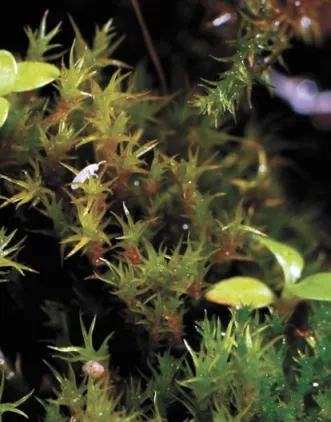
Do you need mosses assistants, if they have enough water? It turns out yes. In humid conditions, colleboles increase the fertilization of mosses to 50 % or more. According to the researchers, water helps spermias to get into the external environment, where they are in contact with animal carriers.
After making sure that colleps really contribute to the fertilization of mosses, the researchers returned to the question of the bait. Flowering plants attract pollinators by smell; Perhaps mosses smell like something. Chemists have connected to work, who, using gas chromatography and mass spectroscopy, determined the volatile substances secreted by C.Purpureus. There were more than 400 of them, and the profiles of volatile compounds secreted by male and female plants differ. Therefore, they smell, and in different ways, and colleboles feel this difference perfectly.
The arthropods were placed in a special camera where they did not have access to plants, but they could smell them. Collebox undoubtedly preferred the aroma of female plants. However, what exactly the mosses smell of is still incomprehensible. Among the huge number of volatile compounds, researchers have not revealed those that attract the footage. F.Candida live in a forest litter, among rotting organics, so that their favorite smell may not be pleasant for us at all. Scientists in the tissues of the moss have not yet found any special cells syntizing plowing substances. Portland researchers really want to check whether other types of mosses are emitting smells that attract arthropods. If so, then, according to Sarah Eppli, the existing concepts about the ecology of mosses will have to be reviewed.
It is generally accepted that animals began to take part in the fertilization of plants at the beginning of the Cretaceous period, about 140 million years ago, when coated-seeded and insect-pollinators occurred. Perhaps at first, insects simply ate pollen, and then their relationship with plants grew into mutualism - mutual maturation.
Mosses and soil arthropods appeared almost simultaneously, 440-470 million years ago. What relations have developed between them, we do not yet know, but most likely, colleboles are not accidentally stumble upon plants that are ready for fertilization, mosses are lured. Researchers do not exclude that the participation of arthropods in sperm transfer could play a key role in the spread of plants on land.
Natalia Reznik
1. N. cronberg, R. NATCHEVA and K. HeDLUND. "Microarchropods Mediate Sperm Transfer in Mosses", Science 2006: V. 313 No. 5791 p. 1255 Doi: 10.1126/Science.1128707.
2. TN ROSENSTILE, EE Shortlidge, An MelnyChenko,
JF Pankow & SM EPPLYY. “Sex-Specific Volatile Compounds Influence Microbrophropod-Mediated Fertilization of Moss”, Nature 2012, Doi: 10.1038/Nature11330, Published Online 2012.