
Translated material
The texts of the north
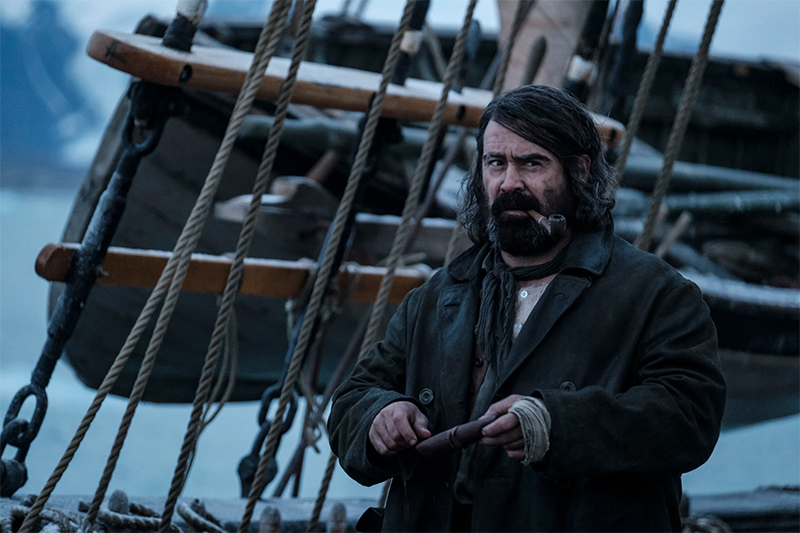
The retired military doctor Patrick Sumner (Jack O'Connell), returning from the fronts of British India, is hired by a doctor on the whaling vessel "Volunteer". With him in the fellow travelers-Henry Drakes Gangpuner (Colin Farrell), a plow captain Brownley (Stephen Graham) and his slippery assistant Cavendish (Sam Spreull). They now and then ask the young doctor why he went into swimming with them-and for miserable pennies, to the distant north, with his track record. Sumner each time answers something evasively, unusual. It is only clear that he runs not so much from need as from himself: the bloody scenes of war with the rebellious sipas now and then pop up in his covered with opium tincture. But soon not only the past, but also the present begins to bother him: the doctor quickly realizes that he was waiting for the horror and moral terror of the Indian terror in the sea. On board, lawlessness and violence reign on board, and the “volunteer” himself is just right to rename from the “suicide bomber” - they will rather be able to understand that the ship is doomed to death in the ice of the Gudzon Strait.
Even the runaway retelling of the Northern Waters hints: before us is something like the “heart of darkness” of Joseph Conrad, the famous English story, where the alloy on the river into Africa into Africa turns into an immersion in the frightening abysses of the human soul. With only a correction: from sultry tropics, the action is transferred to the Arctic open spaces. But the rest of the signs of a non -romantic plot are preserved: the motive of travel, an exotic location, a dark past, the struggle with the forces of nature. And also - the mutuality of good and evil: the central antagonists - Sumner and Drax - embody culture and nature, civilization and barbarism, consciousness and will. And according to the laws of the genre, the line between these poles with each new series is thinner. In parallel, the quote field of the series is growing. Kitoboev’s life and religious disputes clearly refer to the “mobile wild” German Melville. In mysterious crimes on board the ship, echoes of the hermetic detective Agatha Christie are heard. The second half of the season is completely turning into a robinsonade with an indispensable Jectonian theme of the thirst for life. And it is unlikely that all these references are accidental: the author of the primary source Ian McGavir is a literary critic, an expert and a large admirer of adventurous prose. Among his scientific publications there are articles about Melville.
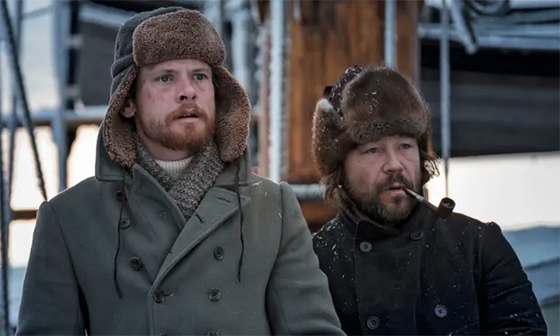 © BBC / See-Saw Films
Due to the exact follow-up, the book canons of the feeling that we are in front of us are a very traditional story with recognizable types and predictable conclusions. The fragility of morality and civilization, the “man of man’s wolf” - all these topics were relevant for the authors of the era of early modernism, which anticipated the nightmares of world wars, but for the current viewer they are unlikely to become a great revelation. Although, it would seem, the “northern waters” examine a rather non -standard material: hunting for whales in the 19th century, distant sea expeditions, survival in the conditions of severe Arctic (something similar can be found only in the first season of the series “Terror”, as well as at the level of individual episodes - in the film “Survivor”).
Nevertheless, recognizable adventure literature templates slightly smooth out the naturalistic effect of setting and decorations. But the “northern waters” are still strong in their textured historicism: it is interesting to consider the port cities of Victorian England, to study the rough fishing of the whales, to listen to their various accents. And, of course, to watch Colin Farrell: the actor ate eight times a day for several months and turned into a shaggy strongman to look exactly like British dockers and boxers of the 19th century (it was on their photographs that Farrell was oriented during preparation). Strictly speaking, the first-hand book was precisely praised for reliable details, the knowledge of the era, for "making the past tangible."
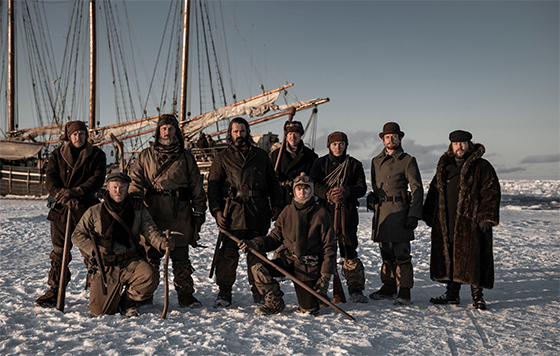 © BBC / See-Saw Films
So the series strives for realism by all means. According to the producers, shooting the series started in September 2019 on the 81st parallels of northern latitude-supposedly, artistic television projects have never swam so far. Director Andrew Hay explained why this test was needed: “You feel the cold in the bones, you feel its taste and smell. I wanted the camera to reflect it. ” Then the film crew lived for six weeks in boats in the open waters of the Arctic Ocean-without the Internet and mobile communications, without the ability to rehearse due to strong colds. The team kept preventing walruses, white bears, who were frightened by warning shots, early advancing darkness, as well as pieces of sea ice, which suddenly broke away from the coastal massif and carried away actors and operators. In such cases, the director, of course, stopped production and was in a hurry to help his colleagues. After the filming ends, Colin Farrell admitted: "I will never forget that relief from the thought that none of us died."
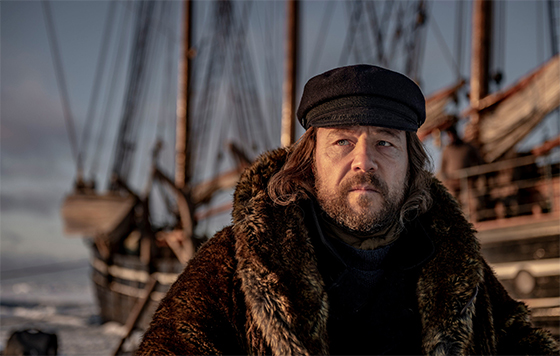 © BBC / See-Saw Films
The proximity of death, a sense of threat and constant danger penetrated from the set into the series itself. The misanthropic mood, inspired by the plot, is also aggravated by meticulous naturalism: the horrors of the colonial war, cutting whale carcasses, crushed skulls and opened ulcers. Thus, a recognizable adventurous plot is served in the format of hard realism. Nevertheless, five chapters , of course, are not enough to create a large-scale adventure canvas. “Northern waters”, rather, is a short journey to the country of familiar literary heroes, a crossover whose real place of action is a cultural field, and not lead waters and white deserts of the north.