
Translated material
Elections in Latvia - the winner will remain in the opposition
In Latvia, the counting of votes in the elections to the Sejm (parliament) of the country is completed. As a result, the “Russian” Social-Democratic Party “Consent” formally won, but its separation from competitors is not too large. According to the Central Election Commission, 23.3% of voters voted for it, and the Unity party entered into the ruling coalition took 2nd place (21.6%). The President of Latvia usually provides the right to form the winning party, but the “consent”, which received 24 out of 100 seats in the Sejm, again, as in 2011, will most likely remain in the opposition.
The results of the parliamentary elections in Latvia for the "Daily Journal" are commented by the poet and publicist Boris Kolymagin .
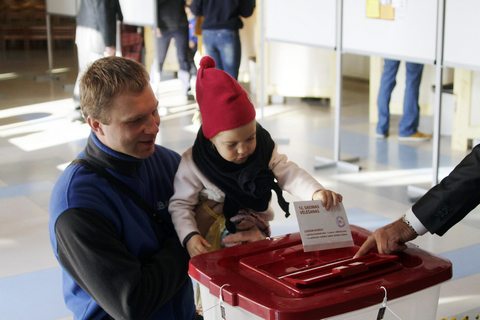
Elections to the Latvian parliament showed that fear of Russia outweighs all logical arguments about the benefits of integration and mutually beneficial ties. And although formally the “Russian” party “Consent” won, the political configuration remained the same and there will be not many new persons in the new Sejm.
On the day of the elections in the resort Ventspils, it was lively. The orchestra hung in full, people from polling stations were in a hurry to the market. True, not all citizens wanted to use their right. According to the Central Election Commission, of 2 million people, 58.78% of voters participated in the elections. This is the lowest indicator in the parliamentary elections for 23 years of independence of the republic.
President of the country Andris Berzins associated this with the outflow of the population to other EU countries. But the matter, obviously, is not only in migration, but also in the predictability of the political process. The famous Latvian writer Guntis Berelis did not participate in the elections. He sat quietly on the bench next to Kirsh and watched the movement of people along the cobblestone bridge. To the question of the author of these lines, why he does not go to the polling station, Berelis replied that he did not see any sense in this and he did not want to associate himself with some political force.
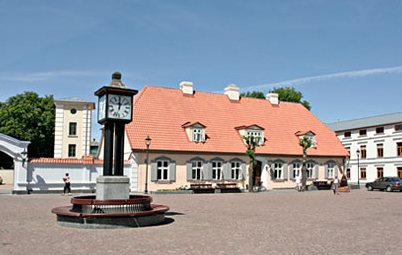 Berelis is now working in the house of a translator in Ventspils, he arrived for a month. Here, under one roof, writers from Germany, France, Latvia gathered. And from Russia too. Latvians, in spite of everything, seek to maintain a cultural exchange, build literary ties.
But communication, and too close economic dependence, especially in connection with the events in Ukraine, they are afraid. So they do little from the point of view of common sense and the economy of action. For example, the other day, the Parliament of the Republic supported the proposal of the ultra -right nationality to temporarily stop the issuance of a residence permit in exchange for investments to citizens and transferred it to relevant commissions. Now, according to the immigration law, a residence permit in the republic can be obtained by buying real estate worth more than 250 thousand euros. Will it really not be ... even at the cost of the collapse of this very real estate market?
Ukrainian events, of course, influenced not only foreign policy, but also to solve the problem of integrating the Russian -speaking community into the Latvian society. According to the translator from Latvia, Sergey Seleno, the Russians in Latvia do not want any association with Russia. It is no coincidence that the leader of the “consent”, the mayor of Riga Nil Ushakov constantly calls for the strengthening of ties with the EU and NATO, but, like all the Social Democrats, political opponents continue to hang the old label of the “secret agents of the Kremlin”. “Many Latvians vote for 'Consent' ',” continues his thought Seano, “they want to overcome the break between Latvians and Russians.”
The assertion of the Seaso is partly shared by the leader of the Visu Latvijai party! -Tb/DNNL Ainar Schlesers: “People since the summer are scared of threats from Russia. It seems that before the elections to the Sejm calls are going! '' It was much more significant than in the previous parliamentary elections. "
The appearance on the streets of Riga NATO tanks, which proceeded to the place of their deployment 200 km from the Russian border, turned out to be very useful in the context of working with a nuclear electorate.
In this channel, it is probably necessary to perceive the government’s decision to transfer the planned shepherd visit to the Latvia of the Patriarch of Moscow and All Rus' Kirill for an indefinite period. And the decision to close Russian -speaking radio stations has the same roots.
In the 12th Sejm of Latvia, the previous configuration will remain. According to preliminary data, after the “consent” (23.13%), the second and third places were taken by the ruling parties “unity” (21.76%) and the union of green and peasants (19.62%). The National Association Visu Latvijai! -Tb/DNNL received 16, 5%. Recently formed parties “Association of the Regions of Latvia” and “Latvia - from the heart” (6.91 and 6.47 percent of the vote, respectively) were also held to the Sejm. It is these parties that will compose a new coalition, pushing the “consent” to the opposition.
True, real winners do not experience the feelings of superiority. Suffice it to say that the leader of the “unity” and the speaker of the parliament Solvita Aboltin did not go to the new parliament.
Be that as it may, we have to admit that the process of Russian integration into Latvian society is delayed again. And the reason for this was partly Ukrainian events.