
Translated material
Reform without a beneficiary
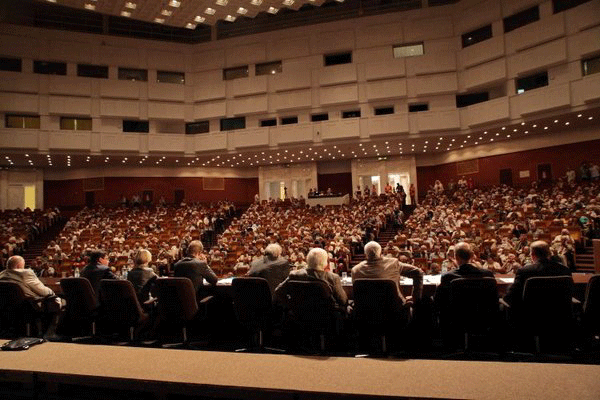
The reform of science, announced in the summer of 2013, only now began truly. The Ministry of Education and Science and the Federal Agency of Scientific Organizations prepared a package of documents that fundamentally change the scientific landscape of Russia. The number of scientists will be reduced three times, and the last “Kamikaze” will be given the task of officials. This was discussed by participants in the third conference of scientists held in Moscow.
It all started in June 2013, when the government submitted a draft law on the Russian Academy of Sciences, which shocked even the most active supporters of the reform. In the first version of the law, it was assumed that the three large academies - the Russian Academy of Sciences, the Russian Academy of Medical Sciences and the Russian Academy of Agriculture - are being bloomed and instead of them a new club of scientists is formed that does not have the right to manage research, finances and property. For management, 750 academic institutions were supposed to create a special agency.
From the complete destruction of the Academy, then the anonymity of the authors of the draft law saved. The law was prepared in such a strict secret that even officials of relevant departments did not see it in the version in which it was publicly declared. For the same reason, the law was not agreed with all participants in political processes. This caused a scandal that united the protest moods of junior researchers, the academic establishment and part of political groups, including some deputies of the State Duma and government members. As a result, Vladimir Putin recommended that the adoption of the law for the fall and make amendments that are important for the Academy.
In October 2013, the RAS Law was adopted in the final version, according to which it was assumed that expert functions and the leadership of scientific research would remain behind the United Academy. But all institutions will be managed by Fano, the head of which was appointed former Deputy Minister of Finance Mikhail Kotyukov. Few, few understood how to manage research, without access to the budget and administrative management in institutes. And few believed that Fano would allocate money for research, bear responsibility for the result, but would not interfere in the process. It was especially surprised that the issues of stateliness in the field of science will still be under the jurisdiction of the old and chief opponent of the Academy-the Ministry of Science, it will be composed of regulatory acts for Fano. Along with this, the ministry simultaneously took away the lion's share of funds for fundamental research and transferred them to another new organization - the Russian Scientific Fund with a budget of 47 billion rubles for three years.
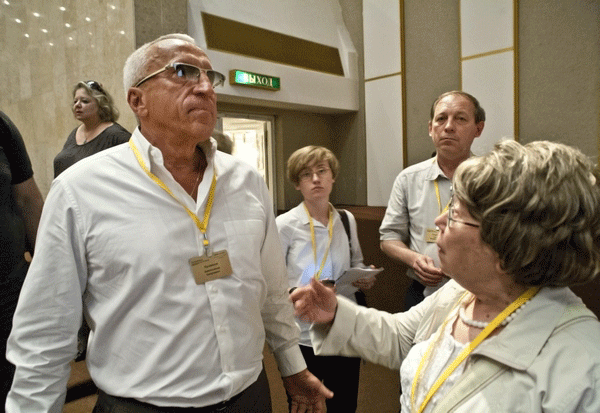
A.P. Kuleshov (Academician, Institute of Problems of Transfer of Information named after A. A. Kharkevich RAS, Moscow)
Nobody saw the success of such managerial structures. But how the hardware logic of displacement of each other works, everyone knew perfectly. And therefore, the new science management structure was met by scientists with severe pessimism. Only the lazy did not joke about the administrative Bermuda triangle in which Russian science should drown.
And most importantly: no one understood what should happen at the exit? What kind of science does the state want to get using such a bizarre management scheme? And there was no one to ask, since the authors and ideologists did not appear.
And again, President Putin reduced the degree of dissatisfaction, announcing a one -year moratorium on property and personnel transformations in institutes. That is, the Fano year did not have the right to dismiss directors and transfer the property of the Russian Academy of Sciences to the treasury for further unknown use. Mikhail Kotyukov himself repeatedly emphasized that he was also a supporter of the moratorium, since he needed time to inventory and understanding what exactly fell under his control.
By the beginning of 2015, much has changed. The fano not only swept and described everything that possessed, but also began full management. The dismissal of directors began without coordination with the leadership of the Russian Academy of Sciences, the merger of academic institutes from different regions into single legal entities began.
For example, in Kabardino-Balkaria they forcibly tried to drive into one regional center of historians, philologists, mathematicians and biologists, adding a Baksan neutrian observatory to them. When scientists in Nalchik learned that Fano appointed the 73-year-old Peter Ivanov, director of the Institute of Informatics and the problems of regional management for five years, it became clear that there was no question of any meaningful reform. Indeed, not only in the local scientific environment, but also in the leadership of the Russian Academy of Sciences and Mon, they knew that the dissertation council, headed by Peter Ivanov, was an academic leader in the number of false dissertations. For which, in fact, was closed.
But in Fano they decided that it was this person who should be given full administrative and financial power over institutions, the profile of which is absolutely far from his competence. So far, the neutrinum observatory and the Institute of Ecology have fought off for violent absorption. The rest, under tough pressure, agreed to a merger.
And the example with Kabardino-Balkaria is not the only one. After all, a whole plan for the restructuring of Fano institutions has appeared, and again no one can understand how to combine or close institutions if an expert assessment of the activities of scientific institutions has not been conducted. Therefore , no one can say today what is a real science in Russia, where there are now alive and where there are already dead laboratories. And you need to understand this before building a science reform plan, scientists have been repeated for ten years. But this was never done.
However, the real scale of the distress became clear only when the documents of the mon appeared:
- draft order of the Government of the Russian Federation “On approval of the program of fundamental research in the Russian Federation for the long term”;
-The draft departmental order “On the approval of methodological recommendations for the distribution of subsidies provided by federal state institutions performing state work in the field of research and scientific and technical activities”.
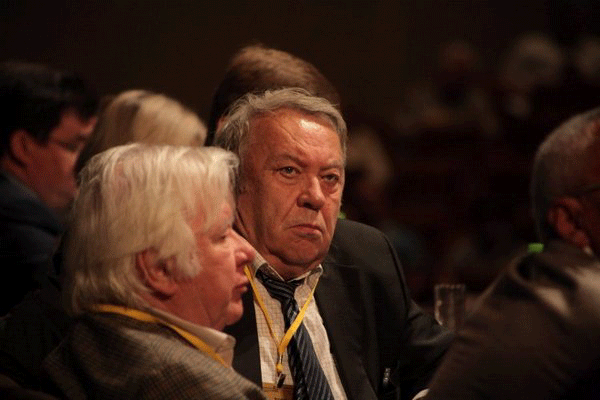
President of the Russian Academy of Sciences V.E. Fortov and V.E. Zakharov (Academician, Physical Institute named after P.N. Lebedev, Moscow) - Chairman of the Organizing Committee of the Conference
The first is striking in the fact that we unrealize and does not give an idea of what Russian scientists should do. Thus, according to experts from the Society of Scientists, plans for which are completely mutually exclusive are to increase the number of publications in Web of Science in five years by 31%, and financing of research, following which these very publications will appear, suggests an increase by 16% over the same five years. Given inflation, this means that there will be less money, and good results should be one third more. The experience of the reform of the science of neighboring China shows that it is possible to achieve a sharp and large -scale increase in high -quality publications only by increasing financing for research at times. So, since 1999, China spent every year on research and development 20% more. For example, 2007 to 2011, the amount increased from $ 102 billion to 180 billion. As a result, Chinese scientists now occupy the second place in the world in publications, increasing them by 7 times in ten years. In Russia, over the same 5 years from 2007 to 2011, science expenses increased from $ 26 billion to 33 billion, which simply allows you to maintain approximately the same level of publications in the region of 32-33 thousand publications per year.
In addition, the fundamental research program used to be formed “from below”, that is, the proposals came from the scientists themselves and then they were clothed in the form of state buildings, since it is difficult to imagine that the official’s official knows what kind of research should be conducted. Now this principle is violated.
The second document, called delicately “methodological recommendations”, on the contrary, clearly made it clear that for its implementation it was necessary to reduce the number of researchers at least three times. The Central Council of Trade Unions of the Russian Academy of Sciences gave an expert assessment of this order and came to the conclusion that, on this project, even temporary financing within the framework of state assignment would be provided with no more than 30% of scientific employees.
In addition, according to the latest version of “Methodological amendments”, 50 % of the same small means should now receive the competition. This means that those who, for various reasons, will not be able to win the competition will simply disappear from the scientific card. After all, now basic financing is already small, it provides the survival of teams. All full -fledged work is carried out where there are additional funds from other programs and grants. For additional, not basic money, they bought equipment, fed youth, paid for publications in prestigious magazines, etc. But everyone understood that if today it was not lucky and the grant won, then you can sparely survive until the next competition. And when reducing guaranteed money, half is not that it will become impossible to plan research work, it will not be possible to simply reach the next competition. And if we take into account that Russia is already in 26th place in the world in terms of the number of researchers per capita, then even the most powerful and promising scientists are not happy with such a forecast. For everyone understands: the scientific environment will shallow, there will be nowhere to take already small graduate students. 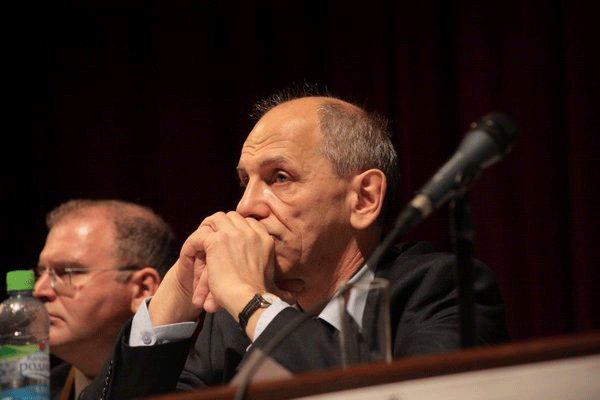
V.A. Rubakov (Academician, Institute of Nuclear Research of the Russian Academy of Sciences, Moscow)
“I do not want to compete with colleagues from Ufa and Makhachkala on such conditions,” said the famous theoretical physicist, a member of the conference organist, Academician of the Russian Academy of Sciences Valery Rubakov. And the hall exploded with applause.
In addition, documents are poorly consistent with each other. From the first document, a planned increase in the publication in WOS by a third follows. And from the second - the reduction of scientists is three times. How will the remaining researchers increase the number of publications by a third, if it is not possible to do this with the current number of scientists?
And this despite the fact that work on them takes place against the backdrop of constant meetings and interactions of the mon and Fano with public scientific organizations, such as the Council on Science under the Mon, the Society of Scientists, the Commission on Public Control in the Field of Science. Mon and Fano are one of the most open to the dialogue of departments. That is, scientists have the opportunity to convey their thought to officials. And there is no possibility to influence the outcome of the decision.
Why? Because decisions are made not there and not those with whom the dialogue comes. The first deputy head of Fano Alexei Medvedev almost directly said this at the conference. He ended his speech with a hint that the main confrontation today is not between Fano and RAS, but there are many other players whose values system are noticeably different from the system of values of those who are sitting today in the hall.
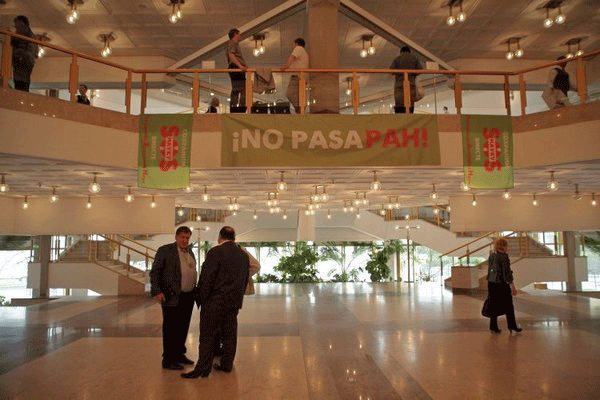
As a result, the reform in the form in which it is carried out is not beneficial and not pleasant to anyone. She does not have a beneficiary, some injured. Mon has to fight the wounds and Fano, Fano has to sink in coordinations with Mon and RAS. The wounds have to argue with Fano. And scientists are forced to write three times more reports in three departments. And track where a new terrible document will come from.
Putin, of course, may again unexpectedly intervene at a critical moment, but he cannot draw a plan for the general reconstruction of Russian science. This plan can be born only in the dialogue of ideologists and participants in the reconstruction process. And for this, the authors of the reform should appear in public. And while they are not there, scientists will mobilize all their strength to resist the new project, write Alarmist letters to the head of government Dmitry Medvedev, wait for a new redistribution, lament about the money spent on the creation of a new department of money and about the tiring struggle of time.
Author - Cand. Phil. Sciences, scientific journalist, member of the public control commission in the field of science.
Photos in the text of Alexander Marov.
Photo report from the third session of the conference of scientists
Maria Olendskaya / Hedgehog