
Translated material
It is difficult to be a robot
Robocup-2017 began in Japan-the World Cup among players with artificial intelligence
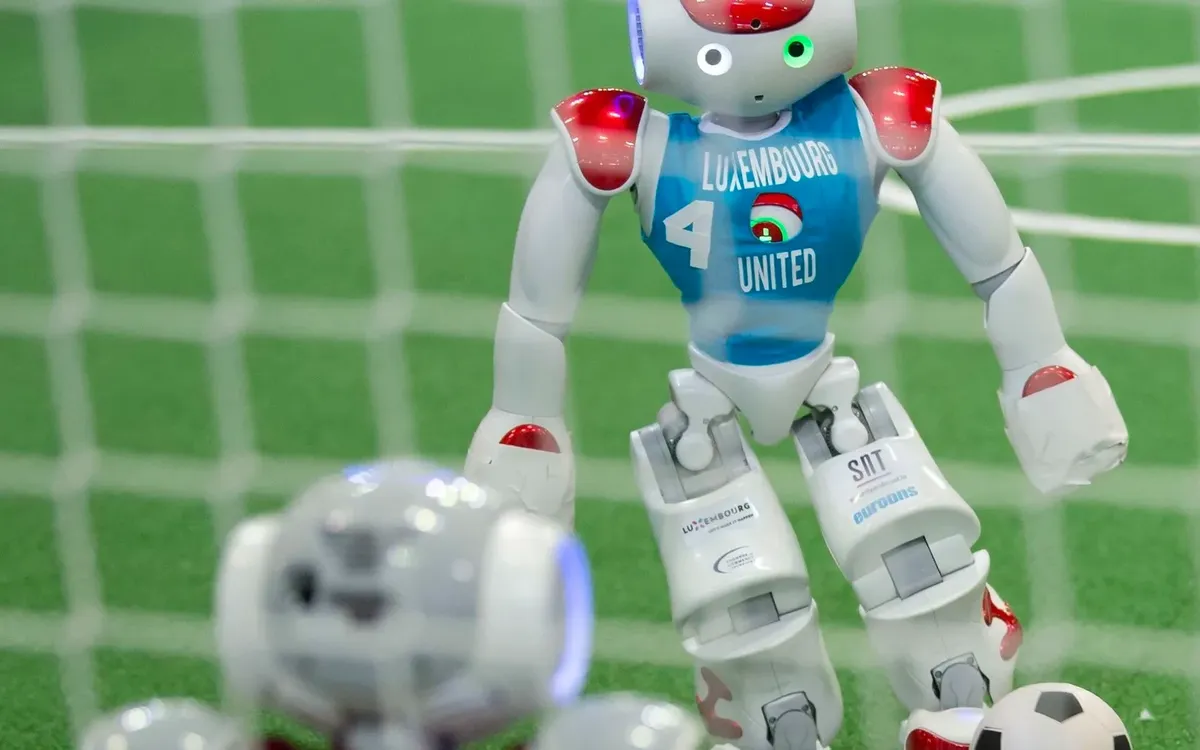
I prefer gumanoid robots, although pyramid robots play better. The pyramids have a semicircular neckline below, where the ball exactly lies, and now, catching the ball, the pyramid smoothly slides across the field of artificial grass, without experiencing problems with equilibrium. And for the humanoid, every step is a problem, and therefore he all the time crosses his feet in place, trying on and pondering, pondering and trying on. It seems, what is there to think, you're a meter from the gate, shawl and trials, but no, the humanoid stands on half -bent iron legs, stomps finely with large feet, blinks with lamps in his head and thinks, thinks, thinks.
When the Robot Humanoid is a petrifle stands in front of an empty gate with a ball in the legs and in terrible mental effort strains all four nuclei and 3.2 gigaigerian of his processor, you realize how difficult and amazing the creation of a person. A child of three years old would score without problems. To explain to him how to act, it would take five words and three seconds. "Make a leg like this, baby!" But the humanoid does not think in words, but with algorithms, he must choose the right algorithms from those thousands that are laid in it. He must calculate the distance to the ball, determine the position of his body relative to the gate, the front and the penalty area, he must choose those that lead to the result from millions of possible movements for him and 32 degrees of mobility, and he must also bring his angular leg and hit the ball so that it rolls along the correct trajectory in the right direction. All this is so complicated that sometimes the robot suddenly falls face down, like a knitted one. I could not do it.
But, falling, they get up, and get up very deftly. They know how to get up themselves. They put their elbows, bend their knees, rise. In their bodies two hundred sensors, thirty microcontrollers, and instead of the nervous system, data transfer tires and TCI/IP protocol. The athletes have their own teams, which include coaches, massage therapists, nutritionists, psychologists, and the predatory robots too. The team of the Great Humanoid Sweaty (height of 1 m 72 cm) from the University of Offenburg includes fifteen programmers, mathematicians, engineers, among them are four professors. They arrived with him in Nagoy. But sometimes - this happens in the games of small humanoids, their height is less than a meter - the robot suddenly freezes on the edge of the field in a pose of surprise, as if it was paralyzed by the unthinkable complexity of the game and being. Then a professor in a T -shirt with a number on his back runs out on the field, an unceremoniously grabs the robot by the scruff and takes his brains for the edge.
Pyramid robots play football better than humanoid robots, if only because they are more stable. Looking at the clever sliding of the pyramids - and they are capable of the team game, open in free zones and even sometimes give passes to exit to each other - you understand that the thesis about a person as a crown of creation is doubtful. If we were pyramids, we would be stable and did not break the arms and legs. The pyramid does not have the concept of “fell”, but the humanoid has. When playing football, the humanoid must constantly twist the camera on the shoulders, select the leg under the blow and all the time to analyze the information of the sensors about which direction the blades of the grass under the feet are inclined. A robot gumanoid playing football as if proves the absurdity of our human structure, the absurdity of the structure with two legs, two hands and one head. It is strange, by the way, to have one and not have a backup.
Football of people has become so fast that we often do not see the movement of the foot, which Messi shakes the ball, or instant movement of the corps with which Suarez wins the position. In the slow matches of robots, we see everything, even see a thought. What strained in the entire figure of the humanoid, what tension in all its servomotors, when he suddenly lifts his leg to give a “cheek” to another robot. Pas is a thought. In this PACE, two meters forward are more than thought and overcoming than in the worked out movements of many human teams.
He thought, this strange, clumsy humanoid, he tried, he loaded the processor 100%, he carefully turned his leg, which is why his motors were dangerously heated, and then he cooled them with water from his cooling system and therefore “sweated”-how difficult it was for him, and yet he understood, presented, calculated, made it.
Forty years ago, no one could have imagined that in our pockets we would lie with flat pills weighing 100 grams, with which we will connect with people on other continents. From 1960, my laptop with Ubuntu and Bitmessage is not present. Could Blerio, who was flying on a “thery ”with a motor, imagine Boing-777? The officially proclaimed goal of the community of the creators of football players-by 2050 to prepare a team that will beat world champions among people. Like a plastic firing with a processor filling, slowly raising his leg, it can beat Messi, I do not understand. But everything that happened and happens with high technologies suggests: he can!
Looking at the football matches of robots, you understand how much football is more difficult to chess. In the chess Fritz and Deep Blue, grandmasters have long been beaten, and in football, robots today could not play against the team of kindergarten. I (and you too) will beat all this world championship. A pure thought, a clean calculation work in chess, and in football a humanoid needs to turn into action as soon as possible. The processors perform hundreds of thousands of operations per second, but for the immeasurable complexity of the great game this is not enough. In the final of last year’s Robocup there was an amazing scene when, after a robot hit in a black shirt, the ball rolled onto the ribbon of the gates of the robots in white shirts. It remained only to poke him lightly so that he would enter the gate, but the humanoid is about horror! -For some reason, he turned away from the ball and went the other way. If a person had done so, they would say about him that he had gone crazy. And the robot? What happens to him when he makes an absurd decision?
This guy in a shirt with a number and flashing lamps, instead of eyes, went to wander around the field, and other robots from his team seemed to become infected with his condition and also wandered with him. The humanoids from the team of rivals, bewildering 360 degrees their oblong heads of aliens, joined this scene of universal prostration. Eight football robots, as if forgetting about the rules of the game and the tasks embedded in them, was randomly staggered around the field, it was not clear why and where, stood before each other, as if in order to conduct silent conversations on extraneous topics, and the ball was all on the ribbon. And he did not interest them at all. But then, after about five minutes, one, with nothing but the number on the shirt, not distinguishable from others, suddenly understood something.
He dawned on him! He remembered. Topping his feet, he went to the ball, solemnly stood in front of him and made a careful movement with his foot, which made the ball crossed the line.
All robots from one team are made the same, everyone has the same processors, the same sensors, the same bodies and the same software, but understood and made only one of them. The most capable? Such in which the immeasurable complexity of conductors in silicon, controllers and microcircuits, communication and control channels, information systems and processing systems for some accidental regularity or regular accident suddenly created a new quality of thought?
When the humanoid awkwardly fired the ball on his funny clumsy legs, several hundred people who stood closely around the field exploded with cries of joy and even delight. Mostly the creators of the robots stood around the field, and they sympathized with him and realized how much he had to calculate, analyze and understand, to make this small but infinitely important decision.