
Translated material
The minister is in the siege
In the Kremlin
 The minister is in the siege
April 24, 2013 Alexey Makarkin
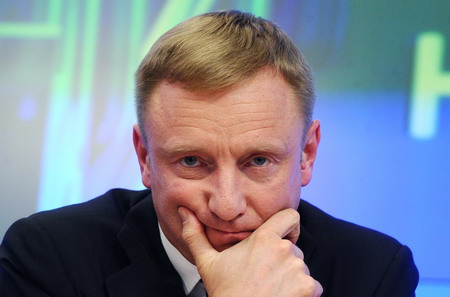
The resignation of Dmitry Livanov will soon be demanded by the whole country. Three factions of the Duma opposition (including the LDPR Kremlin completely loyal to the Kremlin) turned to the president on this occasion. United Russia did not formally join them, but the State Duma speaker Sergei Naryshkin made it clear that he had nothing against such an initiative. Representatives of the ONF announced the beginning of the collection of signatures for the resignation of the minister. Prochrevskaya youth turned Livanov into an object for permanent attacks, not even excluding copying the Femen group tactics (our guardianship guardians, of course, are strongly condemned, but in this case they made a remarkable exception).
This has never happened in modern Russian politics. The Duma opposition, however, demanded the resignation of individual ministers, but the "party of power" never joined it. The tough principle acted - not to touch their own. And when the stimuli from the government finally left their offices, this happened with maximum honor. Andrei Fursenko and Tatyana Golikova moved to the Kremlin as presidential assistants (in the informal “Table of Ranks” this is not a decrease - rather the opposite). Even the author of monetization of benefits, Mikhail Zurabov resigned, more than 2.5 years after his unpopular reform. And at the same time he became an adviser to the president, and then went to the ambassador to Kyiv.
What is the matter? It is impossible to explain the attack on Livanov only with his rigid statements regarding the Academy of Sciences and attempts to eliminate part of the universities that have turned into vestibule issues about higher education. The Kremlin is not interested in the suffering of their rectors - even Sergey Baburin, who tried to rebel, was not supported by power, which predetermined the failure of his rebellion. As for the academicians, the Kremlin several years ago tried to put the wounds under its control and achieved some success in this direction. Now the rhetoric of Livanov regarding the venerable veterans of science (many of which have recently been busy not so much by specialized research as a successful study of the wisdom of the practical economy - rent, subleases, etc.) could cause some irritation of power - due to untimely, but no more. Nobody would have become a campaign against the minister with the participation of United Russia and ONF because of this.
There remains a loud story with plagiarism, in which Livanov just suddenly hit his own - that is, by a large pro -government elite, which is used to placing on business cards and indicating scientific regalia in profiles. This is important not only for the pride of individual citizens, but also for a very specific task - when assigning to higher posts, not only hardware, but also questionnaires are taken into account. And the candidate degree in economics or history is an additional competitive advantage. The elite could expect that the unspoken rules of the game would not be violated, and therefore, the ministry would defend its own. And suddenly Livanov hits his own in the back, authorizing an investigation, which led not only to the deprivation of the degree of Oenaf’s figure Andriyanov, but also to the effect of the Snow Coma, when the exposures began to pull into the light of God more and more scandalous facts. The joke that now the authorities will pay money for the "elimination of dissertations" (so that there is not even a trace of them in the profiles), threatened to acquire real outlines. But another, more familiar protective reaction was chosen: the PR counter -offset to the Minister in order to discredit and resign.
It seems that, starting with an anti -plagiate operation, Livanov did not receive the Kremlin’s sanction - he himself is considered the “man of Medvedev” and could count on the support of the prime minister. It is unlikely that the minister wanted to play along with the opposition, rather it was a question of the desire to display the next “Avigiev stables”, which fits into the overall logic of Livanov’s activity. But such actions were regarded as disloyalty. The Kremlin is not averse to “hanging” the elite, increasing its loyalty by increasing control over foreign real estate. However, it is one thing to “suspend” (when the authorities themselves can decide who to expose and whom to sweeten), and quite another - a shameful scandal, which are involved in both insignificant figures and completely popular types of Burmatov or Lebedev (just at the time when his father Zhirinovsky actively protects the interests of the Kremlin in parliament).
So Livanov from his own became a stranger (especially since he was also the first of the ministers criticized the odious “anti -Magnitic law”) - and was in the siege. The situation is aggravated by the fact that, as noted above, the minister is considered the protege of Medvedev. Usually the premiere’s patronage is a plus, but now it is a large hardware minus. Now from Medvedev they make responsible for all failures in the economic and social sphere - the Kremlin does not want to change the government (at least before it will carry out an unpopular pension reform), but far from averse to weaken the already not very strong premiere. Now Medvedev is driven into Tsugzvang: it is impossible to dismiss Livanov without him, but any action of the prime minister can lead to the most consequences unprofitable for him. If he “gives” the minister, he will show his team that he cannot be an effective patron (for any big boss this is a disaster). If he doesn’t give it up, then the prime minister will be accused of defending an unpopular minister and he will be responsible for all the real and imaginary sins of the ministry.
And Livanov, by definition, are unpopular - like any minister who seriously engaged in reforms. He is trying to rely on the living that remains in the scientific and educational environment, and to support it as much as possible, even “stepping on the tails” to numerous influential players (otherwise it is simply impossible). Hence the creation of the Council for Science under the Minister (which includes existing scientists with international fame), and the project for supporting promising laboratories, and not old Soviet institutions. Livanov’s hurry and sweeping, who do not add friends, are quite understandable: apparently, he feels a shortage of time, wanting to be as much as possible in conditions of a deficit of power support. In addition, we are talking about a self -sufficient person (until recently a rector of one of the successful Moscow universities), who himself is not going to leave the post, but does not hold on to his career in the civil service.
But in modern Russia, a completely different minister is in demand - who will talk about the death of Russian science and about wonderful national traditions in education. Livanova is rejected by the Kremlin, the pro -government elite, and the society, the fearful of any reforms in the social sphere, and the parliamentary opposition, using the attack on the Minister as evidence of its principledness (in conditions when it should be agreed upon with the authorities on politically significant issues), and the opposition is extra -parliamentary, for most of which he is only one of the representatives of the authorities - nothing more.
Author-First Vice President of the Center for Political Technology