
Translated material
What king does the Russians need?
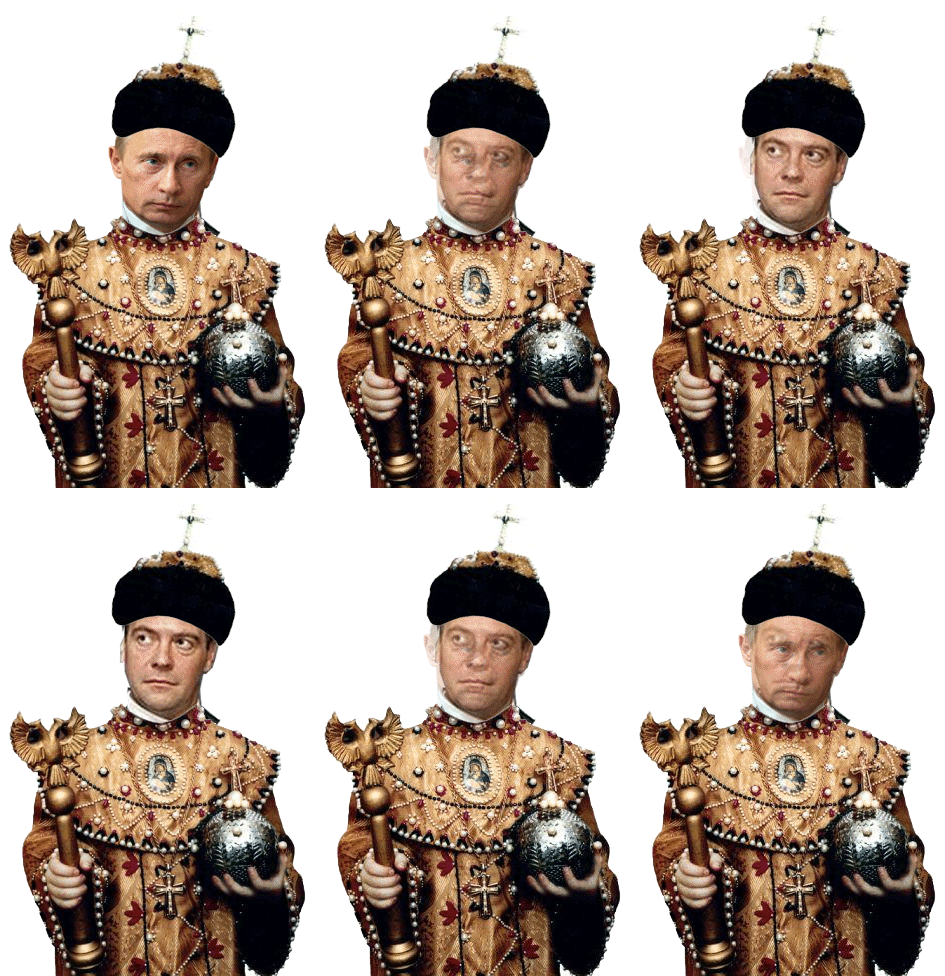 So, Medvedev unequivocally states that he is ready for the second presidential term. And even brings the base to this: Putin's time has passed, what was good ten years ago, outdated, and changes were rushed.
Six months at least there is a dispute - Putin or Medvedev. And for the most part, political scientists, people who consider themselves adults, are confident that Putin will be president: in his hands is genuine power, the main forces and finances. The environment of Medvedev is not serious, and he himself - no matter how hard he tried - nothing more than a puppet. And therefore it looks ridiculous in its “independent” statements.
But in fact, the main argument against Medvedev is that he is “the king is not real”, that is, he does not look like the Russian king, does not rule, he does not actually behave.
In Rus', the king from the very beginning was perceived as a sacred figure. His power was not based on earthly grounds, but on divine law. And the speech, as Boris Uspensky rightly emphasizes, could not go about the “bad” or “good” kings, but only about “correct” and “wrong”.
A real, correct king in the ideas of a medieval Russian person is primarily not the one who cares about subjects or even strengthens the power. And the one who behaves as befits a true sovereign: that is, he observes a complex ceremonial and lives in strict accordance with the “procedure”.
Why didn't the young and talented False Dmitry I last in power? And in many ways because he did not behave in a kinga: after lunch he did not sleep, ate a fork, did not go to the bathhouse, went around Moscow almost without guard, talked with an ordinary people. And on the other hand, he started all sorts of incomprehensible reforms, invented new names. So the people went to the people-"the king is not real."
A lot of water has flowed since then, however, the process of deskalizing power during this time has gone extremely slowly and not fully. And traces of ancient Russian ideas about it can be found in the Russian mentality today.
The definition of the “highest” in relation to the authorities still reflects not so much its position in the management hierarchy as a special, almost “unearthly” status. From the ruler, they expect not so much concern for the prosperity of citizens of the country, but the performance of a special mission and compliance with the image of an ideal ruler.
Although religion in society has long lost its system -forming role, atavisms of old religious consciousness turned out to be a wonderful help for political PR. The enhanced planting of a certain mythology around the first persons of the country allows you to often replace an essential conversation about their policy by discussing exclusively external manifestations of their activities.
This is not to say that this is a Russian phenomenon. The mythologized consciousness is characteristic of any society at any time, and Western political technologists with the same careful as their Russian colleagues, construct the image of their high -ranking “wards”. However, in addition to the myth in the West, a lot and interestedly talk about reality.
But here people still pay much more attention not to what a person does in power, but how he gives himself. And since Putin is a PR man from God, it looks more organic ruler than Medvedev.
Yeltsin ruled as a king, Putin-as a nationalist, and Medvedev tries to become president-reformer. The fate of the reformers in Rus' is known. Nevertheless, is our population ready to finally choose the president, and not the leader or king? It seems that the fate of the 2012 elections depends on this almost rhetorical question.
Collage hedgehog