
Translated material
Deformation of institutions
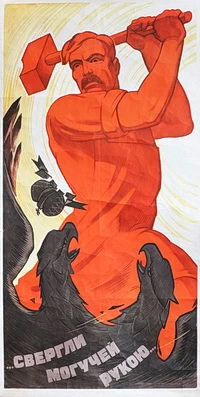 There is an idea that rooted institutions are easy to break. In fact, everything is more complicated and depends on the nature of the institute.
The Bolsheviks, having come to power, decided to destroy the "whole world of violence" to the ground. And in a short time, this world, as they would say now, was canceled - all the power institutions that have survived from imperial times were eliminated, the bank deposits confiscated, and then canceled private property. But they could not immediately break the old system: even the money had to be printed before 1919, with the eagles, until they switched to sabotas, the trust of which was significantly less than the Nikolaev bills. Moreover, the system in a number of spheres has been preserved for quite some time in a very deformed form - the institutes resisted, compromising and trying to defend at least part of their self.
Universities passed under the full control of the Bolsheviks only in the early 1920s. Back in 1918, Ilyin could defend a dissertation about Hegel at Moscow University, and one of the official opponents, Professor of Novgorod, was by the time as a cadet politician already in an illegal situation, but still could come, and participating in a full-fledged multi-hour debate (soon he fled to the south). Lawyers fundamentally boycotted the official “right -wingers' colleges” with the Revil Tombunals, but used the populist position of the new legislation, according to which any present from the public could be defended by the defendant. They came and performed. Even the liquidated Moscow Theological Academy continued to informly conduct classes and award the degree.
Until 1920, representatives of the Party of the Mensheviks, whom the Bolsheviks suffered and unsuccessfully tried to tam the cooperative movement, continued to dominate (when they realized that they would not work out, organized a demonstration process on them, condemned and soon released: it was necessary to work for someone, and not just make speeches, command and plant). The Cooperative Publishing House of the Zuruga, led by the People’s Socialist Melgunov, continued to exist several more years after the revolution, even when his leader was imprisoned (and even - although a very short time - after the expulsion of Melgunov from the country in 1922).
The Academy of Sciences existed in the old form until 1925 (the Academician of Oldenburg, who was engaged in communications with the power of Academician Oldenburg, was criticized both on the right and left), and the charter adopted under Emperor Nicholas I was finally canceled in 1927. The Soviet authorities began to influence the elections of academics only in 1929, and for the first time it did not work out too well: three candidates who did not meet academic criteria at all, and were dragged to the academy only on the second attempt (which led to the “academic affairs”, when scientists were accused of counter-revolution).
Full control over the Russian Orthodox Church was established in 1927 - its expression was the declaration of Metropolitan Sergius, symbolizing the transition from loyalty (the transition to it began as a forced phenomenon even under Patriarch Tikhone in 1919) to service.
The old world went slowly even in the conditions of the revolution and the Civil War. The most powerful inertia made it possible to exist deformed institutions, although their fate was a foregone conclusion with the strengthening of Soviet power. And the mass production of new loyal Soviet experts led to the fact that by the end of the 1920s, need for those who were part of these institutions began to disappear-and mass repressions began against the old “bourgeois specialists”.