
Translated material
There was no childhood, and there is no old age ...


There was no childhood, and there is no old age ... 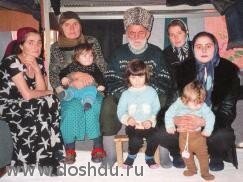 Today we can only guess how they happened - the arrests of entire peoples. Women's howl, crying of children who do not understand where and why they are taken from their home, the loss and despair of men, powerless to protect their loved ones, execution in the place of resisting ... It has already been written about this, and a lot: about commodity wagons, cursed by old people, children, nursing women, about the torment of the path and the convoy, throwing out of the wagons of the dead under the slopes at stops, about mass mortality from hunger and diseases where these countless echelons were unloaded ... Yes, Stalin did experiments that history did not know before him. The peoples survived in the inconceivable conditions of exile, and when the light passed, they returned to their homeland, who could. Not everyone in the post -Stalin era was allowed to return, not everyone was restored national autonomy. The Chechens were among the "lucky ones". Their return at the end of the 50s was not cloudless, they were then much more lucky than, for example, the Crimean Tatars or the Germans of the Volga region, not to mention the Messhetinsky Turks or Kurds. But half a century has passed - and such disasters fell on the Chechen people, before which even memories of the Stalinist deportation faded. Many elderly Chechens underwent much more severe flour than those experienced in childhood. Woe, homelessness and disorder are transferred in old age much harder. Especially when you consider that disenfranchised hungry childhood affected health and led to many ailments with age. The war does not understand whether an elderly man is sick, blind or paralyzed. She beats without pity for all, without leaning to neither veterans of war, nor repressed, or disabled, nor old people, nor children. Mahmoud In the cold January 2003, I visited the tent camp of refugees near Sleptsovsk and lived in it for several days. I met Mahmud Tapsultanov - a blind, seriously ill person. Together with him, a wife, three daughters and four little grandchildren lived in a tent - only nine people for 12 meters of space under a tarpaulin roof. A little less than one square meter per each. Mahmoud was completely blind. But when he recalled the series of those terrible days of his childhood, he could hardly restrain himself so that tears would not flow from the blind, half -closed eyes. A cold winter morning their house in a small village near Achha-Martan was surrounded by the military. They gave 15 minutes to fees. Father, mother and seven children took with them only what they managed to dress in. Then there was a long way on foot or on cars to commodity wagons for the transportation of livestock. And they loaded them like cattle - with a bit, in a part. Children, women, old people ... Many died on the road. Every morning, the convoy came in and asked if there were dead. The corpses were thrown directly into the snow ... They were brought to the Karaganda region. And there is no housing, there is no food, no one takes on the wait. We slept in the club. Work on the collective farm - as much as you want, but did not pay a dime for it. There are a lot of workdays, but the collective farm has nothing. People died again - from hunger. In the spring, Mahmud already worked on arable land with bulls. From morning to night. 700 grams of bread per day of overwhelming work - that’s the whole payment to the boy. There was no question of school. All children worked. It was lucky that there were no small ones in the family, only one was younger than the 12-year-old Mahmud. The children survived. Father and uncle were buried in Kazakhstan. And the older brother, who went to the front a year before the eviction, disappeared - went missing. In 1957, the Chechens received permission to return to their homeland. Returned. And there - one hillock instead of a house. Mahmud went to work in the Bamutic forestry. I earned money, somehow built a house in Achkhoy-Martan. The walls of this house are still standing, gaping with empty window openings, Mahmoud told me. And the roof, ceilings, rooms - everything is broken by shells of today's war, everything is scorched. From these shells and bombs, the Mahmud family fled in October 99th. First, the Ingush was rented a room, and how the money was over - they moved to the tent. It is cold in it in winter, unbearably stuffy in the summer. And it is very crowded, because the family has a big Mahmud ... Hanifa 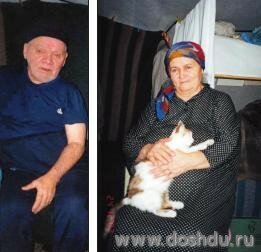 The wife of Mahmud, Hanifa Badayev, to the generation younger than her husband. She was born in Kazakhstan, she knew about eviction only from the mean stories of her parents. The military came to their mountain village, asked men to gather, surrounded them, and they said to the women: "Come on, get together on the road." And what to collect? The mother has a chest daughter in her arms, and a baby is an older one nearby. You can’t take anything else in your hands. They got into some military unit. The younger girl died of hunger, because her mother disappeared. They did not let them bury, put in the mosque. With the second girl, they somehow got to the wagons, transferred the whole hell to Kazakhstan, arrived to the Kokchetav region, barely survived in need, hunger, cold, and diseases. But in the end they adapted. Children began to be born in Kazakhstan. Gunif and Hanifa were born. And so many years later, a tent became her crust, where one has to huddle with a large family, her heavy destiny - care for her grandchildren, who are sick endlessly in these conditions, and about a blind husband. - They say to us: "Go home!" We would go if the house was. And if the war left. We have a disabled person, there are bouts, does not see ... How to live there, how to go there? All children are sick, Hanifa explained to me. I looked at her grandchildren, at their painful, pale faces, at how one is very tiny, everything was pressed at the feet of my grandmother ... “A little more than a year,” said Hanifa. - His name is imam. He is no longer considered a refugee. What refugee, if he didn’t run anywhere, was born here? Therefore, help from the Ministry of Emergencies is no longer laid ... Alamat Not far from the tent of Mahmud and Hanifa, Alamat Duriev lived, a disabled person of the 1st group. He is from the notorious village of Haibach. He was 9 years old when the military surrounded the village at night and said: "Collect things!" But what can you collect if they don’t give a delay, they rush. Seven people of children, father and mother moved from the village in what they managed to put on, and some, as Alamatu remembered, walked barefoot in the snow. In a blade, with all the village they drove them into the huts. Who fell, could not go - they shot on the road. In the huts, everyone was loaded into the studioker and brought to the railway. Merchant wagons, cattle breeds ... There is nowhere to sit or lie in them. Alamat remembered how they shot those who, having settled down at the station for water, did not have time to go back to the departure of the train. But the most difficult scar in the memory of the inhabitants of Haibakh was a villainous reprisal committed over their fellow villagers. Everyone who did not have time or could leave the village with the convoy - and these were mostly weak old people, women with infants, shepherds who returned from grazing - they drove everyone into the stable and burned alive, and killed those who tried to escape. The Haibakh became famous. The Alamat family was brought to the Pavlodar district of Kazakhstan. On bulls, on a sleigh, they took to the collective farm. They drove into the club, and whom and to the barns, in the stables. Naked cold floor, no blankets, no mattresses. Frosts under 40 degrees. So they lived ... They died of hunger, from typhoid, they froze .... Alamat had a younger brother and sister, brothers and sisters of their parents, their children and grandchildren. “We were still lucky,” said Alamat, “we got into a good place, we got into the collective farm.” Mother was Shustro, she kept us. God helped, so she kept. That is, she did not let go of hunger. And hunger was not in childhood forces. It is impossible to leave the village without permission - they could give a term of up to ten years. But Alamat, the child, left in the spring for 18 kilometers per arable land - to where they fed for work. There were other teenagers with him. - We came there just for dinner. They gave us a soup on a plate, a piece of bread, fed, and then six bulls were harnessed to one plow - that’s the job. Sowed manually. Dotemna plowed. And in the morning we were raised early. The foreman comes, shouts: "Rise!" Whoever does not get up - he could hit the scourge. And come on, harness, screw up ... So Alamat earned his bread: first he plowed, then a graze of calves, cows, rams, water carriers, wielded a rake, worked on a mower ... There was not even a question about the school. Two years later, the family was transferred to South Kazakhstan, to Taldy-Kurgan region. It was already easier there because there was a sugar factory nearby. Both parents and Alamat worked at the factory. In exchange for sugar, both bread and cereal could be purchased. Somehow the family stood on its feet. In 1957, permission came to return to Chechnya. But they were not allowed into their native village. Settled in Samashki. First - as in Kazakhstan: they lived in the club, in the stables. Then they built a house for themselves. Alamat worked as a gas welder, then - the accountant, the forwarder of the state farm. He worked when he became disabled, but could still move. Alamat has grown six children: five daughters and a son. The son was drafted into the army and was in Afghanistan. Then Alamat and his wife suffered unrest. And now, looking at the sentence children in Chechnya, he thought that their parents suffered somewhere in the same way. “There is a murder on our part,” Alamat sighed bitterly. - Not officers, not generals, but these boys. They drive them forward, but they themselves remain alive ... " And Alamat also talked about that heavy assault on Samashk, in which many civilians of the village were killed and burned. Then his cousin died with his family. In the first war at the house of Alamat, only the roof was defeated. When there was a second assault, the house was burned, only the walls remained. For the third time, the rockets were destroyed by the remnants of the house. - And how are you with the children now? .. - One daughter with a family in the center of temporary placement of refugees near Tver, the other in Sleptsovsky. Another daughter and son are also in tents with families, with young children. Two unmarried daughters here in the tent with us ... Alamat is completely paralyzed. A long -standing disease of the spine, even from Kazakhstan, made itself felt: the body could not withstand the shocks of this war. “There is no wheelchair,” Alamat's wife complained to me. - When the heat begins - just a trouble, how can he get out of the stuffy tent, breathe? ... - And if the war ends, where will you live? - In his village, of course. -But, after all, is not at home. - If only the war is over. We will expand the hole, we will live ... “There was no childhood, and there was no old age,” I only heard from these people who survived all the hardships of deportation in childhood and the nightmare of two Chechen wars at old age. I know: that tent camp has long been disbanded. And the old people, along with their families, with children, with little grandchildren born in tents, were forced to return to their broken villages, to the destroyed houses, to the ashes ... A sign of a state that overcome its totalitarian past is special respect for old people who suffered from repressions. But we seem to have not yet begun to overcome it ... |