
Translated material
The end of the "crazy coalition"
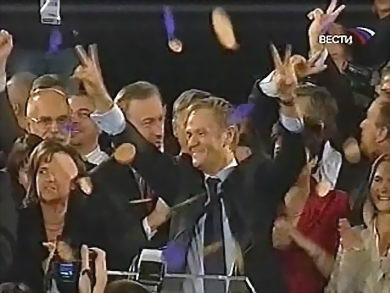
Recently, events rarely occur that cause a positive reaction in Russia and Europe - the priorities of both parties are too different. However, the results of Sunday parliamentary elections in Poland were positively perceived by both the Russian establishment and European politicians. Both of them were happy with the inevitable resignation of the government of Yaroslav Kachinsky. The fact that his twin brother remains in the presidential chair is secondary. Poland is more like a parliamentary-presidential than the Presidential-Parliamentary Republic, and the main levers of power are concentrated in the government responsible before the Sejm.
Starting from last year, Poland was controlled by a coalition, which is difficult to name otherwise than “crazy”, if you look at its composition. Moderate nationalists from the Kachinsky Brothers Party “Law and Justice” coexisted in it with the ultra -rationalists from the League of Polish families, who was accused of anti -Semitism and obscurantism for no reason. But if such a neighborhood still had its own logic (although it was in itself the understandable irritation of Europeans), then the third partner - “self -defense” - entered the office exclusively from the conjunctural reasons. The radical levopopulistic party, which actively used social demagogy throughout its history, agreed to create an alliance with various nationalists only for the portfolio of the Minister of Agriculture for its charismatic leader Andriy Lepper.
From the very beginning, it was clear that such a mixture of left and right radicals would explode - moreover, sooner than it was later. For more than a year, the Kachensky brothers made maximum efforts in order to keep their radical partners in the government, while trying to limit their influence on the political course of the office. As expected, these two opposite tasks were not solved. The “frontal” conflict with the Lepper ended with a grandiose scandal, an attempt not only to dismiss, but also to “put him on accusations of corruption, the loud resignation of the head of the Ministry of Internal Affairs, Janusz Kachmarek, who, according to the supporters of the Kacinsky, warned the Lepper about the preparatory special operation. As a result, not a Lepper was sent to the investigative insulator, but the Kachmarek, who, meanwhile, turned into the main exposure of the abuses of the Kacinsky, including illegal “wiretaps” of telephone conversations of both political opponents and non -unearthly allies (later the arrest was recognized as illegal). Under the avalanche of these scandals, the government collapsed-despite quite decent economic indicators (7 percent growth without raw materials).
Russia rejected the “crazy coalition” emotionally - the Kremlin did not like the Polish politicians that not only appeal to national feelings, but also constantly demonstrated their proximity to the United States. The consent of the Polish government to place the American Pro system in its country, Russia responded with the introduction of the embargo to the supply of Polish meat. In turn, Warsaw blocked negotiations between Russia and the European Union on the conclusion of a new agreement. The arrival of the new government gives the Kremlin hope to reduce the level of confrontation in bilateral relations.
Europeans were also unhappy with the Kachinsky cabinet-and not only because of the presence of ultra-right politicians and the pro-American “skew” in foreign policy. Active speeches of the Polish authorities in support of the death penalty violated one of the basic principles of modern European political correctness. The loud claims against Germany reminded that in the Old World there were many skeletons, which, it seemed, was able to cover universal relief in the cabinets - until one of them was extracted from there by Polish nationalists. And the proclamation of one of the priorities of the lustration policy, which has become a form of accounting with political opponents, would organically look in the turbulent 90s, but now it looked wild.
The new alignment of forces in the Sejm of Europeans is quite satisfied. The winner of the elections is a liberal-conservative civilian platform, the heiress of the moderate traditions of “solidarity” (unlike radical, which privatized the Kacinsky). Residents of large cities, an educated middle class, who thinks not only about economic growth and national self -awareness, but also about the image of the country in the international arena. The leader of this party Donald Tusk will become a new prime minister - he has established himself as a pro -European politician, and there is every reason to believe that one of the priorities of his government will be the restoration of positive relations with Germany. Most likely, the civil platform will conclude a coalition agreement with a calm Center Polish Peasant Party, which will provide the new cabinet with a strong majority in the new composition of parliament. The opposition remains “law and justice” (which retained the support of the Polish province) and the left -giant block of former President Alexander Kvasinevsky. The two radical parties, which were part of the Crazy Coalition, were outside the parliament - the “protest” voters were disappointed in the results of their stay in power.
As for the Polish-Russian relations, there are much less grounds for optimism. Let us recall the Kremlin’s extremely cool feelings for the pragmatic President Kvasinevsky at the end of his stay in power-when bilateral relations deteriorated due to diametrically opposite approaches to the “Orange Revolution” in Ukraine. Now, on the agenda, the acceleration of the Atlantic integration of the same Ukraine may be on the agenda - it is clear that Moscow and Warsaw are again in the role of opponents. In the same way, it is extremely doubtful that the new government will take a fundamentally different position on the issue of American about: not a single Polish office will go for any serious deterioration in relations with the United States. Thus, bilateral relations are likely to be less emotional, but no less complicated.
Author - Deputy General Director of the Center for Political Technology