
Translated material
Fathers and these
Sergei Soloviev made a generalizing film about the fate of the lost generation of today's 25-year-olds. Gloomy, but with hope

The main character (right) with a monkey and one of his many comrades in misfortune to be young. When the hero distiliates the mafia refrigerator, the monkey throws a bribe to traffic cops from the window of the cabin. And those - nothing, take it (photo: Igor Evnevashev )
After a six -year break, Master Sergei Solovyov returned to the cinema, removing the "gentle age". Starting from "One hundred days after childhood" he always shot about the young. Maximum young. "Tender age" is that rare version of the impassable film (Soloviev after all!), In which there is only the forefront, everything is clear, everything is definitely. Unusual interpretations are excluded. Wanting to transmit the author’s intentions as accurately as possible, I simply transmit the content of the film - from the official annotation. I don’t know if Soloviev himself edited it, but with the directorial comments (in the press, on the premieres) it does not disperse.
Phrases from the annotation and the film itself are typed - without correctional correction and designation of bills. His whole young life came during the period of transition from socialism to market relations, which was especially difficult for the young. This generation came to the school under Brezhnev, the young Leninians-Okhnhtyat, then they were made by Lenin pioneers, it turned out to be the fifth grade that all this was not needed, since no one needed and the previous heroic era of the life of their grandfathers became completely lies. And those same market relations, for whose arrival, noble people like Sakharov and Solzhenitsyn advocated with such sincerity, suddenly in practice brought state banditry, the most unbridled corruption and gangstance, hatred to each other and the cult of power. And to all this, every young man should either obey or resist. Still - this is the story of growing up a particular person, his love for a classmate, who becomes the famous Parisian top model, gentle relationships with which pass through the hero’s life.
I will add that a specific person also falls into Chechnya, where horror and their own stupidity urinate their own. He goes to the war volunteered, fleeing the spiritual crisis; In the same way, many Russian boys starting with Pechorin tried to be saved with the help of the war in the Caucasus (the thought is not mine, commonly, Solovyov persistently brings the reviewers the names of the heads to it, which the film is divided into: an idiot, fathers and children, war and peace etc). Until every Chechnya, an extra person and a typical representative throws a school (like everything at this time, the film says) and grows in a teenage gang, led by a cynical, rich again, a Chechen. Helps to steal expensive foreigners, then, having found another, already Russian, owner, it is adjacent to overtake the mafia refrigerator to Moscow. The hero is good. The victim of time.
As always, Solovyov’s time of “ASSU”, “delicate age” is simultaneously pathos and seems to be not serious, filled with fenks, in the late 80s seemed quite funny, and now, during the years of mtv, for some reason reminding the fashionable haircut of the “Youth” in the hairdressers of the 70s. The main joke is that all actors portray their heroes from pioneering age to this day. I agree that Soloviev has greatly simplified the understanding of who is who is at 11 years old, at 13, and at 15, and at 25. Moreover, if the pioneer played a 12-year-old, Soloviev (based on the Criminal Code) could not remove the scene where this 12-year-old, embodying the dream of many pioneers of the USSR, seduces a young teacher on the table. But still: mature dudes in pioneer ties look somehow strange on the screen.
Another joke: each new character is indicated in the film graphically. Stop-frame, a loop with an arrow is drawn on the hero’s neck, and under the arrow it is written by hand: May phaser, Chechen Aslan (Moscow mafioso) etc.
History is based on real fate and facts. In the film, the real people with whom these stories occurred are shot. In particular, in the title role of Ivan, the son of director Dmitry, who already told his father about everything about everything that the film talks about.
Father-director was not only amazed, but also shuddered. The main thing in the picture is cruelty. Everything is sold, everywhere the mafia. Almost everyone, under the influence of cruel times, became valu, selfish, hate each other, beat each other what they would turn up for what. Our girls (from an adequate review of the review) - on the covers of fashion magazines or under the pursuers -Chechens (who also kill them for offenses). The new "one hundred days after childhood" - about a generation, which did not have childhood, the country with its social cataclysms did not give a sink at tender age.
It is believed that in our modern times the oldest catastrophe was survived by the old people. Or, for example, the seventies, who suddenly realized the disappearance of the former - intellectual and moral - values (see, if it succeeds, "Moscow" Zeldovich and Sorokin). The radicalism of the "papa"-Solovyov, whose youth film "Assa" was responded to the "Daddy's Cinema" by a rocker-chiro, is that his "delicate age" declares: the most modern times have rebuilt the generation of young. The same thing, which, according to ordinary ideas, fit into them most painlessly.
Any radicalism (if it does not lead to household injuries) is always good, since it serves as a catalyst for ideas.
Further, however, questions. Since there is generally too much bargain in the film.
The crap is already that not all born in the mid-70s tragically broke in the 80-90s. For some reason, many of these times were inspired, remained people, did not stop believing that there is morality, that we need to study and work, that you can’t steal, contact the country, you can’t distill gang trucks in the country, especially (this is obvious) with weapons or drugs.
Laiga is a kind of false simplicity - in the very structure of the plot: the hero, after being wounded in Chechnya, tells his whole life and the latest history of the country a psychologist from the hospital and with a bandaged head gives aphoristic -fruits of judgments, some of which are read out by Solovyov Sr..
And psychologically, and aesthetically, and conceptually the film is approximate and sloppy. Slorfulness is most manifested in detail. Solovyov’s father and his son seem to summarize the fate of the generation, want to show how it changed from 1985 to 1996, but in their memory it was strangely confused, what happened when it happened. The claims are incorrect, they will tell me, because the film is a game, not a documentary. But the text is in the frame and behind the scenes - almost publicist!
Examples (in this case, I convey the meaning and I can’t vouch for the accuracy of quotes): “In 1986, Gorbachev suddenly announced freedom, but what it is, refused to explain” - as a result, pioneer debauchery, alcoholism and banditry immediately begin at school and around it. I don’t know about the pioneering debauchery of the 80s, but for some reason I remember that neither in the 86th, nor even in the 89th and 90th nothing was too sharply happening. Or: the same about the 86th, and the pioneers talk about the need to use condoms, since AIDS is around. In which year? Another case: Gorbachev’s voice from the TV is interrupted by a ordered message about the mass impoverishment of the elderly. Hello! Pavlovskaya reform of the beginning of the 91st led to this - but only. Even in the summer of the 91st south, they drove in a couple of hundred. 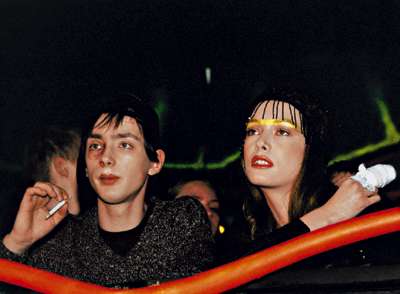
At the top: this is a sweet couple of "tender age": an experiencing trouble with his country Hero (Dmitry Soloviev) and the heroine (Elena Kamaeva) (photo: Igor Elevas ) in Paris)
Also - from the point of view of the actual - casually image. The year is about the 92nd (actual poverty), and Moscow from "tender age" is all in advertisements, and buildings in modern lights. The peak of the Nolovyovsko-Labyshevsky chamber is the peak of the Solovyovsko-Labyshevsky chamber-it panoramles of the 93rd Pushkin Square with large advertisements of the Hollywood film "The escaped bride", released at the end of 1999. Elementary question: why wasn't this frame cut out? Therefore, it is likely that the director was all the same.
The fact that the main character flies to Paris to his beloved on the first impulse is unknown as without an invitation to receive a visa, already trifles. Not trifles: what kind of bucks the mafiosa-cocker paid with boys-robbers in the late 80s. I am sinful, I could be mistaken here, but it clearly seemed to me that new!
The depressive "delicate age" (at some point the hero cuts the veins, but not to the end) ends in a Chekhov, in the Divine, in the tune: the words that we still need to hope and certainly need to live. At least for that (this is already in Solovievsky) to repay debts. All this, as it happened with Solovyov, goes under the song of Grebenshchikov, who appeared in the frame. And okay. But the style is recognizable.